Following Gelman controversy, President Sheinbaum moves to keep Mexico’s masterpieces in the country
As the controversy surrounding the prestigious Gelman Collection’s return to Spain continues, President Claudia Sheinbaum intends to strengthen the Federal Law on Monuments and Archaeological, Artistic and Historical Zones (LFMZAAH) to prohibit the permanent export of protected works.
A preliminary draft of the decree protecting and conserving Mexico’s cultural heritage was published on Oct. 15.
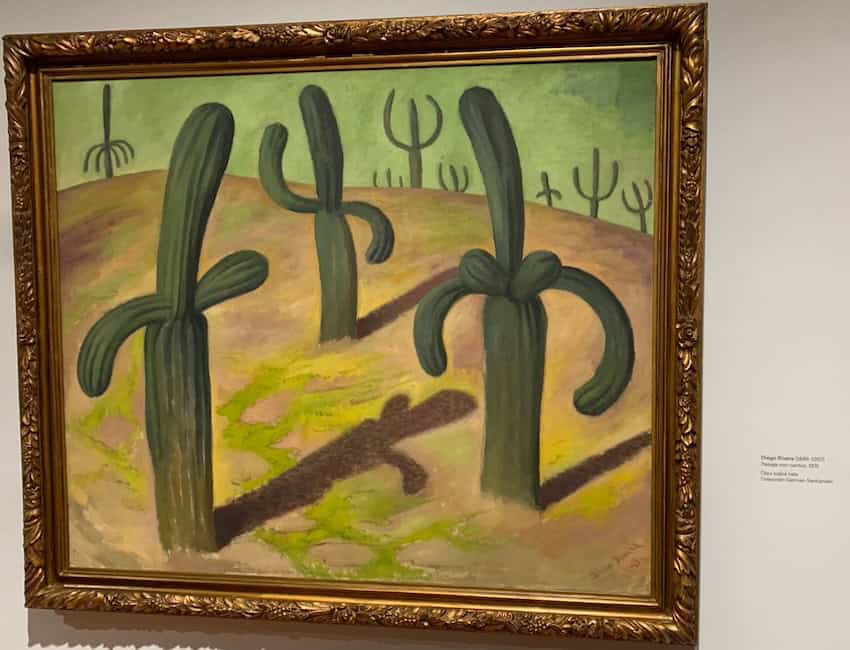
The decree seeks to eliminate contradictions between the existing Monuments Law, which does not contemplate a restriction on exports, and multiple presidential decrees declaring national artistic monuments and prohibiting private owners from exporting works by specified artists.
It would explicitly prohibit the “definitive export of goods owned by private individuals that have been declared artistic or historical monuments under the jurisdiction of the National Institute of Fine Arts and Literature (INBAL).”
The proposal empowers INBAL to investigate, protect, conserve and restore such works in the possession of private individuals to guarantee the right to culture above the right to private property.
To date, 10 separate presidential decrees have declared the works of Diego Rivera, David Alfaro Siqueiros, José Clemente Orozco, Octavio Paz, Remedios Varo, Frida Kahlo and María Izquierdo as national heritage.
However, there are exceptions. The works of Diego Rivera and José Clemente Orozco can be definitively exported if they go to museums.

As for Frida Kahlo’s works, the permanent export of her easel paintings, graphic works and technical documents in the hands of private individuals and within Mexican territory has been prohibited since 1984.
As many of Kahlo’s works were already outside the country when the decree was issued, and as the exact location of some remain unknown, it is “essential to safeguard the pieces still in the country,” the new proposal asserts.
Sheinbaum’s proposal is time-sensitive as the Supreme Court is set to take up a challenge to the 1984 Kahlo decree filed by the owner of the painting “Self-Portrait with Medallion.”
There is precedent to countermand these decrees. In 2010, collector Andrés Blaisten obtained an injunction against the prohibition of the export of the works of María Izquierdo and that specific decree was declared unconstitutional.
If the Court resolves the matter before Sheinbaum’s reform is enacted, it must determine if its ruling applies only to the 1984 decree and if it only applies to the party filing the injunction.
And if it rules in favor of the decree, it must explain why it deviated from the 2010 decision, while also raising the constitutional question of how a presidential decree supersedes a law passed by Congress.
The tension between property owners and heritage laws has become palpable in recent months thanks to the Gelman collection controversy, which involves the transfer of 160 of its 300 works to Banco Santander in Cantabria, Spain.
KioskNews shows a cleaned-up reading view extracted from the publisher’s page — the original always lives on their site, not ours.