The China car flood is out of control
The automobile changed our world and symbolises prosperity and personal freedom for billions of people. Making automobiles, meanwhile, is a miserable, grinding affair.
The world’s automakers eked out an aggregate operating margin of just 3.6 per cent last year; it was collectively less in dollar terms than that of just one large technology company, Apple. Understanding why helps to explain the current angst surrounding iconic car brands in the US and Europe and the threat from Chinese new entrants — and what might be done to address it.
The big problem is that, as much as customers like buying cars, nations are more in love with just making them. The closure of a car plant is as much a societal bombshell as it is an economic decision, which means that decision often gets deferred. No politician wants to see thousands of jobs lost on their watch. Auto plants aren’t just factories for consumer products but also symbols of economic vitality and reserves of industrial capability underpinning national security.
The result is chronic overcapacity. About 85 million new passenger vehicles will be sold around the world this year, according to a new report from BloombergNEF. Yet the global industry is capable of churning out 142 million vehicles.
Building assembly lines is capital-intensive, so profitability rests on running them as much as possible to spread fixed costs across as many vehicles as possible. The breakeven point to cover costs, in terms of capacity utilisation, isn’t set in stone, but industry analyst Glenn Mercer posits a threshold of 80 per cent or more. This makes the current global level of 60 per cent look dismal. Barring South Korea, none of the major automaking nations or regions look particularly good on this front. The US has notably lost the leading position it held before the pandemic.
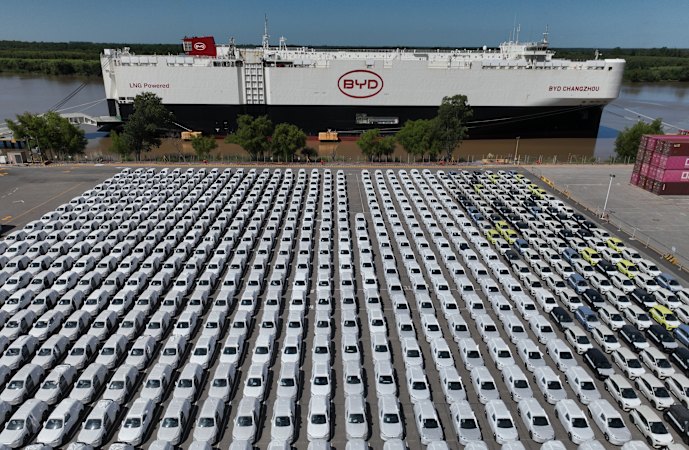
Roughly 28 million vehicles’ worth of new manufacturing capacity has been added over the past decade, and four-fifths of that is in China. Yet sales have risen by only 5 million over that same period. China’s own vehicle market has plateaued, leaving the country with enough capacity to make more than two cars for every one sold there. Domestic automakers are now pushing millions of vehicles overseas in order to keep their plants running; without that, their utilisation would be below 50 per cent, rather than a merely dismal 60 per cent. China is exporting its excess car capacity problem across the world.
The rest of the world has noticed. The US has effectively closed itself off from Chinese models. As Washington seeks to reshore ever more of its automotive supply chain, it has also turned against its North American free trade partners, with Mexico, a major exporter of vehicles, looking particularly exposed. Europe is imposing quotas, having tried and failed to stem the tide of Chinese imports with tariffs, and with mighty Volkswagen AG now taking the once unimaginable step of ending production at several German plants.
An added complication is electrification, a multi-speed process encompassing battery-electric vehicles, range-extended EVs and different flavours of hybrids. Incumbents including General Motors and Ford are reconfiguring plants for flexibility to shift production between different types of drivetrains. This type of mixed-assembly accounts for roughly half the world’s capacity, according to BloombergNEF, and is projected to overtake internal combustion engine-only capacity in the US this year.
The shift to EVs exacerbates the problem of excess capacity, as not only Chinese EV makers but startups such as Rivian Automotive open their own dedicated assembly lines. While dedicated capacity for producing gas-guzzlers is projected to decline by about five million units by 2030, more than 10 million vehicles’ worth of mixed and EV-only capacity is expected to open in the same period.
A healthy industry demands that capacity be taken out of the system. As trade restrictions grow, that process must centre on China, home to only a quarter of global vehicle sales but more than a third of its manufacturing capacity. There is, however, a deal to be struck that could help with this process, with the US leading the way.
As much as US automakers are shielded from Chinese competition for now, they also risk irrelevancy and condemning American drivers to unaffordable vehicles under perpetual protectionism. Accommodating Chinese competition through mandatory joint venture plants in the US offers a way of importing needed know-how and technology without sacrificing the domestic industry altogether.
The key would be to repurpose existing capacity for Sino-US joint venture plants; opening brand new ones would compound the existing problem of excess. We have seen examples of this elsewhere already, such as Ford’s deal with Geely at an underutilised factory in Spain.
While US politicians are angst-ridden about encroachment on the market, the need of Chinese automakers to diversify away from their own oversaturated market provides a lot of leverage in negotiations. Using that could not only help manage the process of infusing Chinese competition into America’s car market. It could also offer an inducement to rationalise China’s own bloated manufacturing capacity and a means to revivify at least some underutilised plants in the US. A humming assembly line is usually preferable to a moribund one, even if under two flags.
Bloomberg
The Business Briefing newsletter delivers major stories, exclusive coverage and expert opinion. Sign up to get it every weekday morning.
KioskNews shows a cleaned-up reading view extracted from the publisher’s page — the original always lives on their site, not ours.