Cambricon’s third quarter profit surges 148% to US$210m amid push to replace Nvidia chips

Chinese artificial intelligence chip giant Cambricon Technologies reported a 147.7 per cent surge in third-quarter profit on Friday, as the country’s aggressive push to replace Nvidia chips continues to fuel high growth among local chipmakers.
The Shanghai-listed chipmaker generated 1.4 billion yuan (US$210 million) in net profit for the three months ended September 30, up from 566.6 million yuan during the same period last year.
Revenue reached 3.5 billion yuan, an increase of 104.5 per cent from a year ago, according to its stock exchange filing. That was faster than the company’s 75.8 per cent revenue increase seen in the second quarter.
Cambricon attributed the revenue surge to its continuous market expansion and efforts to “facilitate the implementation of AI applications”. This top-line increase directly drove the year-on-year surge in total profit and net profit, the company said in the filing.
Shares of Cambricon closed up 5.5 per cent at 932.2 yuan ahead of the earnings release on Friday.
Earlier this week, Hygon Information Technology, another leading domestic AI chipmaker, posted third-quarter revenue of 5.9 billion yuan, an increase of 45.5 per cent year on year. Its net profit for the quarter surged 37.9 per cent year on year to 1 billion yuan.
The momentum at Cambricon and Hygon builds on Beijing’s initiative to develop a self-sufficient AI computing ecosystem, as the country accelerates the deployment of AI infrastructure powered by home-grown chips.
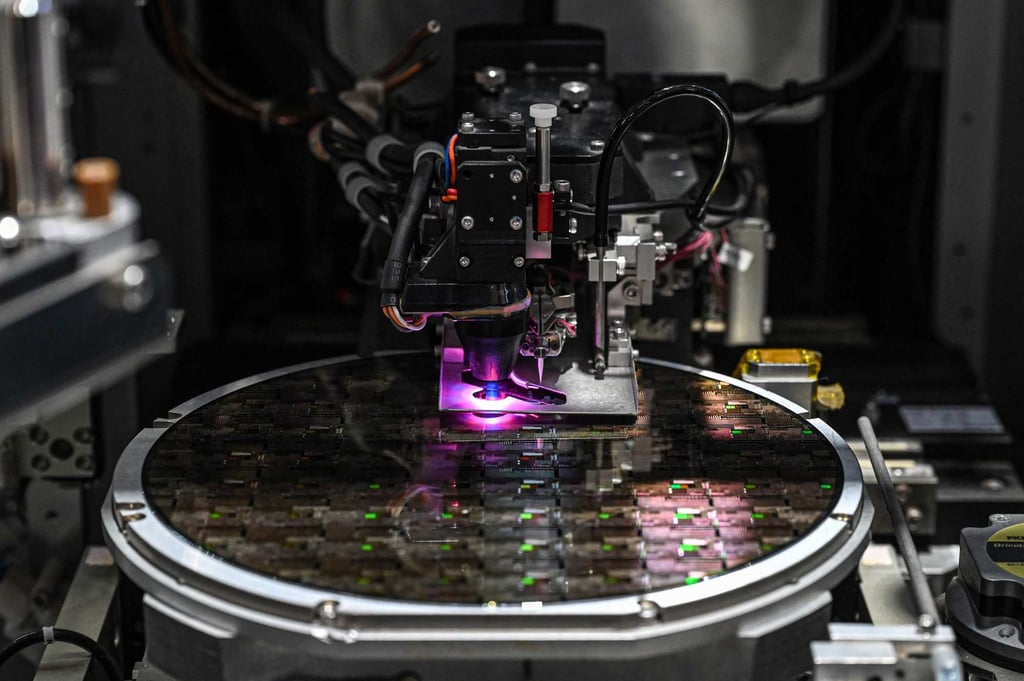
The two companies – regarded as top-tier players in the domestic AI chip sector – are moving rapidly to fill the market vacuum left by Washington’s export controls that have cut off China’s access to advanced AI accelerators from US chip giants like Nvidia.
Analysts said Cambricon’s earnings outlook depended largely on the commercialisation progress of its latest chips, which was in turn affected by supply chain pressures, especially the shortage of high bandwidth memory chips required for AI data centres.
“Cambricon delivered [its] MLU692 to a major cloud service provider in Q3 for testing, but we expect most revenue to be recognised in Q4,” Morgan Stanley analysts wrote in a recent research report. “MLU580 shipments also remain limited as higher high bandwidth memory costs pressure unit economics.”
The MLU692 is part of Cambricon’s MLU690 chip series, also known as Siyuan 690. The series can outperform Nvidia’s H20 by 50 to 150 per cent when measured in “tokens per second”, a metric that essentially counts how many words or other data AI can process and spit out, according to an earlier Morgan Stanley report.
Hygon, meanwhile, faces high expectations for its next-generation central processing unit and its deep computing unit – a type of accelerator card designed specifically for AI.
The company said on Thursday that the progress was “on track” with key metrics such as compute density and interconnect bandwidth set to be upgraded, though mass production timelines remained pending.
KioskNews shows a cleaned-up reading view extracted from the publisher’s page — the original always lives on their site, not ours.