When it comes to election pressure, this year's Georgia or Michigan could be anywhere
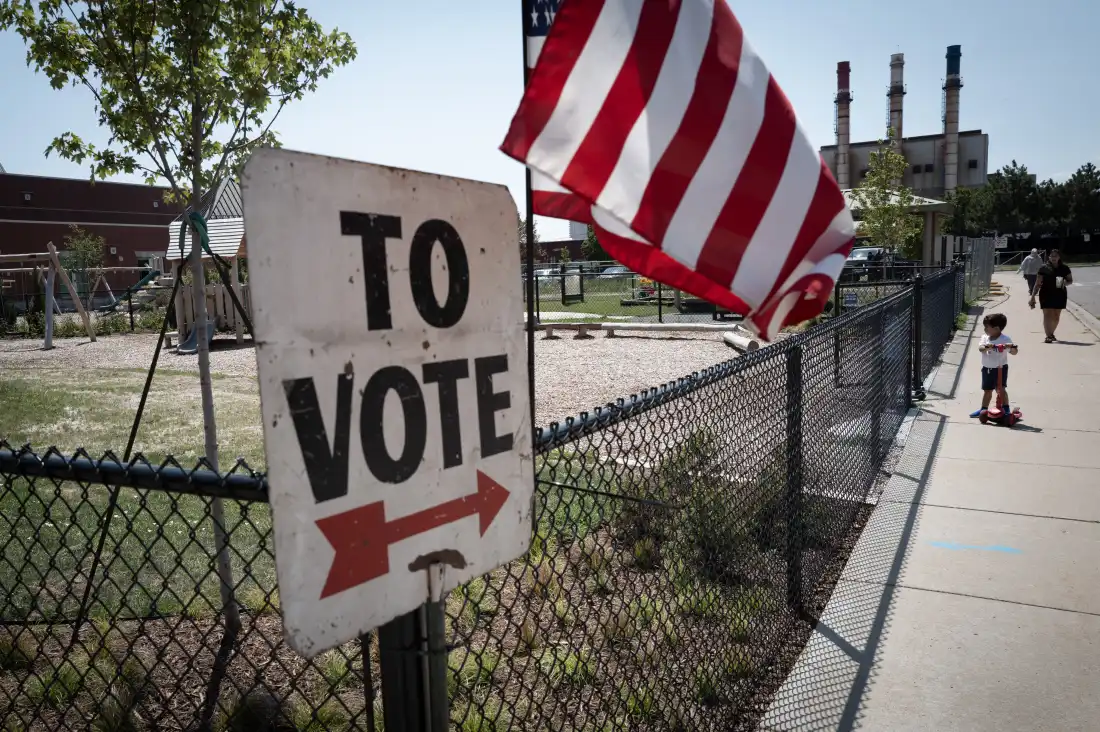
A sign directs residents to a polling place in Dearborn, Mich., on Aug. 4. Scott Olson/Getty Images hide caption
Scott Olson/Getty Images
There's one big difference, Tina Barton says, between running an election in a battleground state and a non-battleground.
It's what happens when there are mistakes.
"If a human error happens, it's easily explained in the press and it's not a story," Barton says. "You have a human error in a battleground state and all of a sudden it can become a massive conspiracy."
Barton would know.
In 2020, she oversaw elections as city clerk of Rochester Hills, Mich. On election night, her office mistakenly sent an unofficial absentee vote file twice because the first one didn't initially appear to send.
Such mistakes happen every election cycle in a national process run by tens of thousands of human beings. A machine isn't plugged in. A poll worker sleeps through their alarm clock and doesn't open a precinct on time. Someone gets handed the wrong ballot.
In Barton's case, the issue didn't impact actual votes, and it was corrected in the tally the following day.
But it changed her life regardless.
The chairwoman of the Republican National Committee accused her office of improperly giving votes to Democrats, and Barton received a rush of death threats, including a voicemail saying she deserved a "throat to the knife" because she had "frauded out America of a real election."
More than half a decade later, for better or worse, election officials in swing states like Michigan, Georgia and Arizona are more used to that level of pressure and scrutiny.
In this year's midterms, however, because the races that will decide control of the U.S. House and Senate are spread around the country, local officials in places like Iowa, Alaska, New York and Kansas may find themselves in the national spotlight for the first time.
Chris McGinn is executive director of the Texas Association of County Election Officials. In an interview with NPR earlier this year, he noted that Texas has been a reliable Republican state for the better part of 50 years, which has meant fewer competitive elections and less pressure on voting officials in federal election cycles.
A huge part of McGinn's job has been preparing clerks for the possibility that could change this year, considering the U.S. Senate race there could decide the balance of power in that chamber. The Republican nominee for that seat sought to help President Trump overturn his 2020 election loss.
"We're still in a state of not thinking it can happen to us — 'That happens in other places,'" McGinn said. "One of the things that I jokingly but realistically preach to our members is we don't want to be Florida in 2000."
On a whole, the threat environment for voting officials seems calmer than it did in the period following 2020.
Wendy Link — the supervisor of elections for Palm Beach County, Fla., a county that includes part of a toss-up congressional district this year — says her office still regularly gets "love letters," as she calls them, but she's not as worried for own safety as she has been at different points in the job.
"We get emails saying, you know, 'We're going to send our army to arrest you, you'll be spending your time in Guantanamo Bay,'" Link told NPR. "So do I love reading some of the emails? No. Do I think some of them are clearly intended to intimidate me? Yes. But am I reaching out and asking for a security detail? No."
But Barton, the former Michigan clerk, worries it could all escalate again if the midterms are close. She's now vice president of the Committee for Safe and Secure Elections, which helps local officials game-plan and prepare for different worst case scenarios.
"It can happen whether you're a red state or a blue state. Controversy can find you," Barton said. "All it takes is some ballot equipment going down, a problem with ballots jamming, a website going down."
Researchers who study election misinformation say most false narratives usually emerge from real events like those Barton mentioned, which are then seized on by influencers or politicians to falsely imply they're happening intentionally or at a wider scale than they actually are.
This year CSSE doubled the number of trainings the organization led when compared to 2024 — a sign of new concerns around the Trump administration's actions in elections but also an expanded understanding of what it means to be in a battleground state.
When Barton talks to officials in competitive districts, her message is simple.
"I've told them all, you better be on your game," Barton said.
KioskNews shows a cleaned-up reading view extracted from the publisher’s page — the original always lives on their site, not ours.