Google supplier Biwin, GPU leader Moore Threads see stocks plunge despite revenue surge
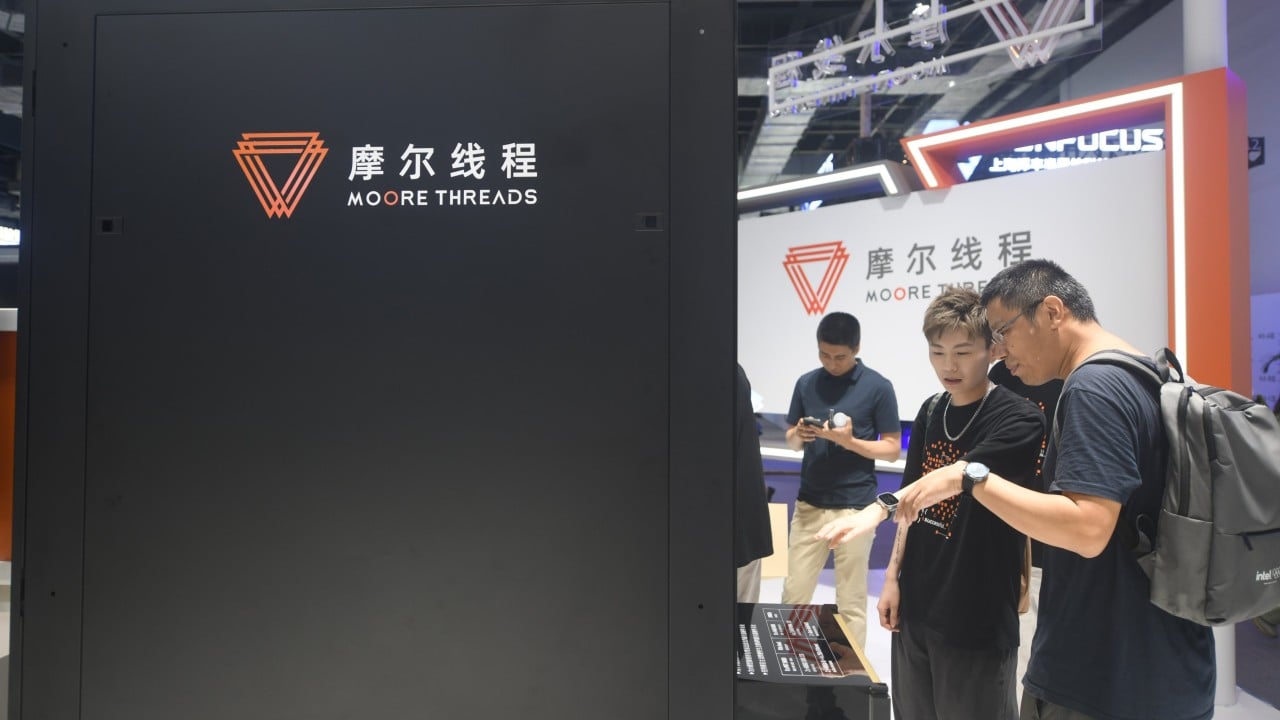
Shares of Chinese semiconductor suppliers Biwin Storage Technology and Moore Threads tumbled on Thursday alongside a broader rout in mainland technology stocks, despite blockbuster third-quarter revenue driven by strong artificial intelligence demand.
Both stocks plunged more than 10 per cent during Thursday morning trading, reversing Wednesday’s rallies of 8.4 per cent for Biwin and 5.8 per cent for Moore Threads.
The tech-heavy Star 50 index in Shanghai also dropped more than 4 per cent, deepening a slide that had already seen the bourse lose more than 40 per cent of its value from a July peak as of Wednesday’s close.
The market retreat overshadowed eye-catching headline earnings from both firms, as investors weighed near-term margin pressures and cash burn against long-term AI promises.
Beijing-based Moore Threads, one of China’s leading graphics processing unit (GPU) makers, reported a nearly 1,774 per cent surge in third-quarter revenue to 1.55 billion yuan (US$232.4 million). Net profit reached 49.3 million yuan, or 20.1 million yuan excluding non-recurring items.
The company attributed its rapid expansion to robust domestic demand for GPUs used for AI model training and inference across cloud providers, telecommunications operators and computing centres.

But profitability remains fragile amid steep product development overheads.
Moore Threads logged an adjusted net loss of 130.7 million yuan for the first nine months, with research and development expenditure rising around 55 per cent to 1.34 billion yuan, eating up nearly 41 per cent of total revenue.
Meanwhile, Shenzhen-based Biwin posted a net profit of 1.6 billion yuan for the quarter ended September 30, up 525 per cent year on year, while revenue more than doubled to 6.14 billion yuan, according to an exchange filing on Wednesday.
However, the flash memory module maker experienced a sharp sequential slowdown. Net profit slumped 62.5 per cent from the second quarter, while revenue dropped nearly 30 per cent, according to calculations based on company disclosures.
Biwin attributed its year-to-date performance to resilient AI computing demand, a strong memory market cycle and an improved product and customer mix.
Storage products for emerging AI devices generated 4.82 billion yuan in sales during the first nine months, up nearly 390 per cent from a year earlier, serving tech giants including Google and Meta Platforms, Biwin said.
Still, investor caution has mounted over downstream digestion.
In a September report, Zheshang Securities flagged concerns that elevated memory chip prices could dampen demand among customers of module suppliers. The brokerage argued, however, that Biwin’s push into AI devices, enterprise storage and advanced packaging could support long-term growth.
Capacity expansion has also strained cash reserves at both companies.
Biwin recorded a nine-month operating cash outflow of 10.04 billion yuan, while Moore Threads posted an outflow of 3.31 billion yuan. Both companies attributed the burn to rising procurement costs, with Moore Threads pointing to production expansion and strategic stockpiling.
Despite the equity market pullback, institutional analysts remained positive on the broader semiconductor cycle. In an October 19 report, Nomura projected that memory supply shortages could persist through at least 2028.
“The market is underestimating both the breadth of AI demand and the earnings that such strong demand can generate across the value chain,” Nomura analysts wrote. But they added that sustained cuts to computing commitments or significant delays to funded projects would challenge that outlook.
KioskNews shows a cleaned-up reading view extracted from the publisher’s page — the original always lives on their site, not ours.