Hongkongers lose HK$220 million to customer service scams in August

Scams involving fraudsters posing as customer service officers caused losses of more than HK$220 million (US$28.2 million) in August in Hong Kong, more than triple the monthly average in the first seven months of the year, police had said.
The police force also warned that scammers had shifted their modus operandi from using phishing links to taking real-time control of victims through direct calls and screen sharing, or tricking them into installing a malicious app that turned mobile phones into a credit card reader.
Hong Kong recorded 29,670 scam cases in the first eight months of 2026, up 4.5 per cent from 28,379 in the same period a year earlier, with losses rising by 3.8 per cent to HK$5.2 billion.
About 17 per cent, or around 5,000 cases, were customer service scams, which incurred total losses of nearly HK$700 million.
The number of such scams soared from a monthly average of about 480 in the first seven months to more than 1,680 in August. Losses exceeded HK$220 million in August, more than triple the monthly average of the previous seven months.
More than 1,600 cases in August involved scammers making phone calls and posing as customer service staff from banks, logistics firms and telecoms companies. The remaining 80 cases involved message-based scams.
Superintendent Rachel Hui Yee-wai of the cybersecurity and technology crime bureau said the fraudsters’ shift away from phishing links reflected the evolution of scams as the public grew wary of such tricks.
“They no longer just send you a link. They call you directly, and instantly they are working on your emotions,” she said.
“If they want to take everything in your account, they have to operate with you, step by step, in real time. When you get stuck, they guide you on the spot, even via screen sharing. That gives them far greater control over the victim than a link ever could.”
She urged the public to verify any customer service claim through official channels found independently – never through contact details provided by the caller.
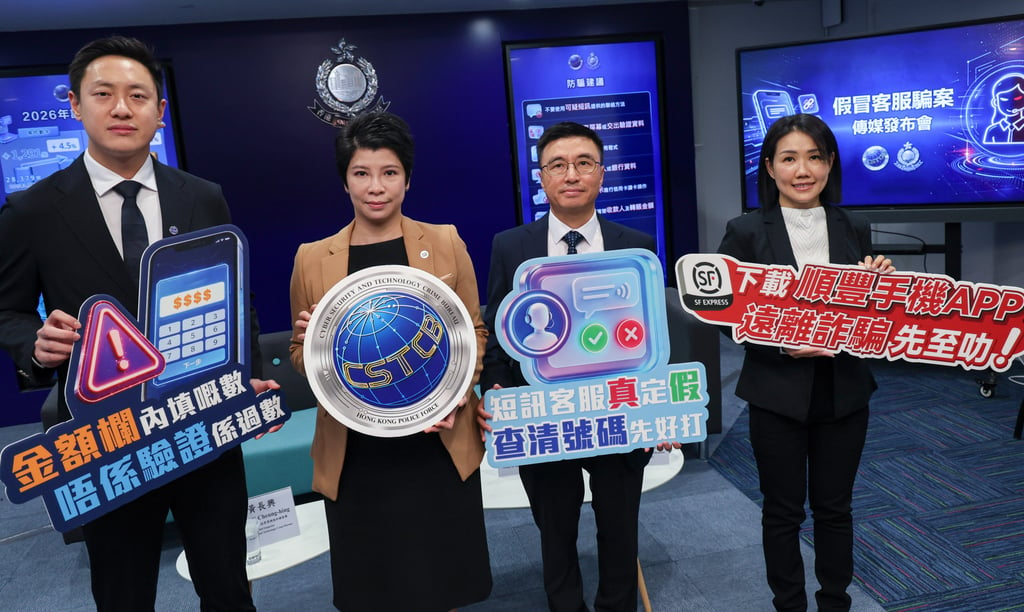
Chief Inspector Wong Cheung-hing of the bureau said police had identified two new methods used by scammers.
In the first, victims are tricked into downloading a malicious application on their phone and then instructed to enable near-field communication (NFC), the technology behind contactless payments, and tap their credit cards on the phones for “verification” or “refund” purposes. They unknowingly hand over their card data, after which fraudulent transactions follow.
“When the victim notices unauthorised transactions and questions them, the scammer claims a refund is due and asks them to tap the card again, completing a second theft,” Wong said.
The second method involves scammers posing as courier staff who claim a parcel cannot be delivered and that compensation is due. They then guide victims to log in to their own online banking and add the scammer’s account as a new payee.
Claiming the account has to be verified, the scammer gives the victims a string of digits as a “verification code” and tells them to enter it into the payment amount field, sending the sum to the fraudster’s account.
02:28
Hong Kong, Macau police arrest 8 in HK$100 million Vietnamese coffee investment scam
Police cited two cases in August with combined losses of nearly HK$8 million. In one case, a 74-year-old businessman who received a phishing text impersonating a courier firm, called the customer service number provided and gave his account details, losing HK$3.4 million.
In the other case, a 53-year-old housewife returned a call from scammers posing as Taobao customer service staff who promised her compensation for “a damaged parcel”.
After logging into a fake website and her online banking account, she added a scammer-controlled account as a payee and entered a “verification code” in the amount field, transferring HK$4.46 million.
In response to the rising losses, police said they had stepped up action on three fronts: taking down scam websites and their operators; intercepting bulk scam texts at the telecoms level; and arresting those who laundered the proceeds.
More than 1,500 fake sender IDs had been blocked in the first eight months of the year, while the force’s Scameter app logged over 500,000 public scam reports during the same period, more than 40,000 of them courier-related.
On the industry side, major courier firm SF Express said it had stopped sending customer notifications by SMS in 2025, pushing all updates through its official app instead.
Chun Yuk-ying, head of public affairs and communications at SF Express, said the switch had cut the firm’s scam victimisation rate from 5.03 per cent to 0.65 per cent.
KioskNews shows a cleaned-up reading view extracted from the publisher’s page — the original always lives on their site, not ours.