Many radicalised individuals are ‘normal’ folk misled into believing ideologies: Expert
SINGAPORE – They work behind closed doors, their identities kept a secret, because their job includes working with Internal Security Act (ISA) terror detainees to turn them around from being a threat to society.
Dave (not his real name) has been an intelligence psychologist with the Internal Security Department (ISD) for five years.
When a radicalised person is detained, Dave and others in the team are among those called in to rehabilitate the individual.
He said intelligence psychologists conduct psychological assessments and interventions for individuals detained or issued with restriction orders under the ISA for terrorism-related activities.
Dave, who is in his 30s, added: “Our aim is to better understand each person’s rehabilitation needs, psychological vulnerabilities to radicalisation, motivations and strengths, and tailor our rehabilitation approach accordingly.
“We also run psychological rehabilitation programmes that strengthen areas such as critical thinking, emotional regulation, identity development and adaptive coping.”
In its annual terrorism report released Sept 10, ISD, which is part of the Home Team, said the terrorist threat in Singapore remains high, fuelled by conflicts in the Middle East.
Youth radicalisation is a pressing concern, with the number of cases involving young people in Singapore in the past five years, almost quadrupling from four cases between 2017 and 2021 to 15 cases since 2022.
The report also noted that the rehabilitation programmes have been successful. Since 2002, more than 80 per cent of Singaporeans detained under the ISA have been released after making good progress in their rehabilitation.
Dave and his colleague Cass (not her real name), who is also an intelligence psychologist with ISD, spoke with media via e-mail in a rarely granted interview.
Their counter-terrorism involvement is part of SGSecure, a national movement launched in 2016 to prepare Singaporeans to deal with terrorist attacks and equip them with skills to handle a crisis. The movement will mark its 10th anniversary on Sept 23.
During the interview, Dave and Cass recounted their experience counselling radicalised individuals.
Dave said it was early in his career when he counselled a youth detainee.
“At the time, I had certain expectations about what a radicalised person would look and behave like.
“However, as I sat down with the individual, I was surprised by how ‘normal’ they seemed - their speech, behaviour, and mannerisms were familiar, because it felt like it almost mirrored my younger self.
He said the encounter made him realise that the threats he was dealing with were not always visible just because they were ‘extreme’, but could be more subtle and invisible.
“This understanding changed the way I approached my work, making me more aware of the complexities and nuances of radicalisation, and more fundamentally, no one is immune to radicalisation,” he added.
Dave said the experience also helped him to see that many of the radicalised individuals were ‘normal’ people “who had been misled, some even duped, into believing certain ideologies”.
He added: “This led me to recognising that rehabilitation required a deeper understanding of the individual’s motivations, vulnerabilities, and circumstances.
“Most importantly, it made me believe that these individuals deserve a second chance. Despite the harm they may have wanted to cause or the ideologies they may have espoused in the past, I came to understand that they are still human beings capable of growth and change.”
Cass said she worked with a youth detainee she named ‘Daniel’, who transformed into “a confident and capable individual, excelling in his academics and socially, and finding direction in life”.
Daniel came under ISD’s radar after he posted defaced images of Halimah Yacob and called for militant group Islamic State in Iraq and Syria (ISIS) to behead her.
He was detained by ISD in January 2020 at the age of 17, and was the youngest detainee then.
“A crucial element in Daniel’s success was the multi-disciplinary and collaborative approach ISD adopted for his rehabilitation.
“By bringing together a diverse range of stakeholders, including his family, psychologists, case officers, religious counsellors, mentors, and education institutions, we were able to create a cohesive and comprehensive support system that catered to his unique rehabilitation needs,” she said.
Cass added that Daniel’s journey reinforced her perspective that by creating and providing an environment that is supportive, nurturing, and empowering, “individuals can flourish and move toward the best versions of themselves”.
Daniel was eventually released in January 2022.
To determine if a person has been rehabilitated, Dave said that ISD conducts psychological and risk assessments on the person.
Other rehabilitation experts from various fields are also involved in the decision-making process, he added.
Cass said an individual’s rehabilitation is broadly organised around ISD’s three-pronged approach of ideological, psychological and social rehabilitation.
She added: “Within each of these areas, there are different programmes and interventions that an individual may undergo. Rehabilitation is not one-size-fits-all.
“We assess each individual’s needs, vulnerabilities and strengths, and identify the programmes and support that would be most helpful to them at that point in their rehabilitation journey.”
Dave said intelligence psychologists in the ISD use psychological science to better understand radicalisation, support rehabilitation, contribute to prevention, and ISD’s capability-building efforts in countering such security threats.
Beyond rehabilitation, they also train mental health practitioners in the community to recognise potential early signs and vulnerabilities to radicalisation, and connect individuals with appropriate support before their radicalisation deepens.
Support officers
Psychologists in the Home Team also counsel their own officers.
Cass said as the manager, her role is to ensure that resilience and psychological wellbeing are built into the way the team is trained, supervised, and led, to help them be better prepared to deal with difficult or high-pressure situations.
The support is also given to first responders.
Diong Siew Maan, director of the Home Team’s psychology division, has worked with officers in several high profile cases, such as the 2004 Tsunami in Phuket, and the Tuas View drowning incident, which saw a young Singapore Civil Defence Force full-time national serviceman drown in a ragging incident.
She said: “Psychologists are very much part of the (Home Team) operation systems.
“In preparing for operations, we may have pre-psychological briefing session to prepare our officers to know what to expect. During the operations, we will also be tracking some of these issues, and address it there and then.”
Beyond the Home Team, the psychologists are also involved in supporting the Ministry of Home Affair’s SGSecure movement to help Singapore to better respond in the event of terror attacks.
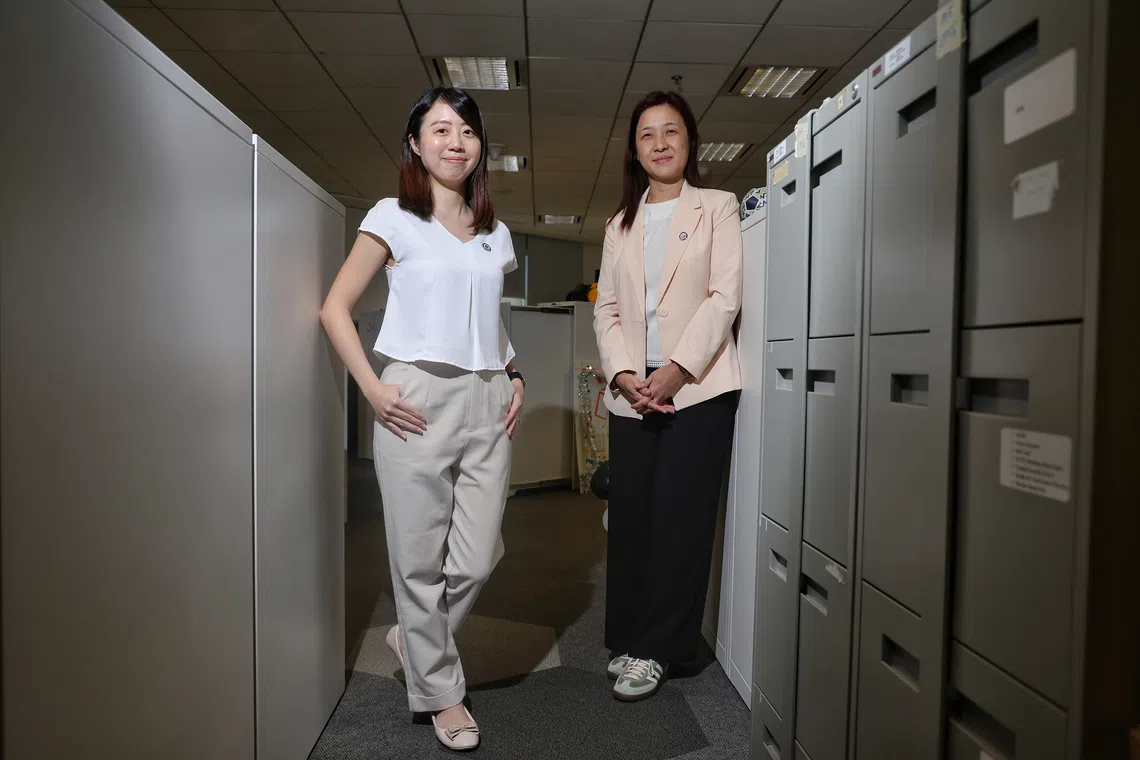
Lead psychologist Jasmine Tan (left), assistant director, Home Team Psychology Division, and senior principal psychologist Diong Siew Maan, director, Home Team Psychology Division, at MHA HQ on Sept 10.
ST PHOTO: KEVIN LIM
Jasmine Tan, who is assistant director of the Home Team’s psychology division, said it covers several aspects to psychological preparedness - cognition, emotion and action.
“What we eventually want to do is (to ensure) that in times of a terror (attack) or crisis, people will not freeze up. Collectively, this helps in our collective response and resilience,” she added.
Diong said that Singaporeans’ attitudes towards terror attacks and terrorism have evolved over the past decade.
She added: “We have done studies, we know that people are generally aware. They know they need to report any suspicious behaviour, or items.
“This shows that people are actually thinking about it, and they are aware that these threats are real.”
But Tan said there are psychological barriers to overcome including the bystander effect, where people are less likely to help because they assume someone else will do it.
There is also the fear being perceived as ‘kaypoh’ or punishment for reporting suspicious items that are not really a threat.
In June 2025, the Ministry of Home Affairs conducted two social experiments to test the public’s response to terror incidents.
The results showed that out of 2,500 who walked past the suspicious items in Tampines and Bishan, fewer than 500 noticed them.
Said Diong: “I think fewer reports does not mean that we don’t care or that we are complacent. It provides a snapshot, but I think Singaporeans still care.”
“There have been a lot of occasions where there was a call for help, and Singaporeans responded.”
Given that Singapore has not experienced a mass terror attack, Tan emphasised mentally preparing members of the public in the event of such incidences.
“Everybody can play a part, so it’s about equipping them with the agency to do something in those situations. This could be helping people to evacuate, providing first aid, or even psychological first aid.”
KioskNews shows a cleaned-up reading view extracted from the publisher’s page — the original always lives on their site, not ours.