Michael Higgins: ICJ risks destroying credibility if it redefines genocide
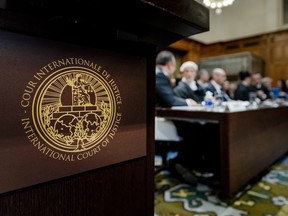
A ruling expected shortly by the International Court of Justice in the Hague could pave the way for a host of countries, including Canada, to stand trial for genocide.
Sign In or Create an Account
In the case of Gambia versus Myanmar the ICJ has been asked to lower the threshold for genocide and if the judges agree it would almost certainly lead to an avalanche of lawfare cases.
The World Court would find itself less concerned with justice than politics.
Indeed, politics is at the heart of the effort to reduce the standard for genocide. A lower standard would make it easier for South Africa to make its case at the ICJ that Israel is committing a genocide in Gaza.

Columnist Jesse Kline keeps you up to date with what’s happening in Israel and the effects of antisemitism on life here in Canada. Friday mornings.
By signing up you consent to receive the above newsletter from Postmedia Network Inc.
A welcome email is on its way. If you don't see it, please check your junk folder.
The next issue of Channel Israel will soon be in your inbox.
We encountered an issue signing you up. Please try again
But if the ICJ lowers the threshold merely to appease those who wish to punish Israel then it makes a mockery of itself.
Genocide is the “crime of crimes.” Raphael Lemkin, a Polish-Jewish lawyer, coined the word in 1944, writing, “By ‘genocide’ we mean the destruction of a nation or of an ethnic group.”
Four years later, the Geneva Convention defined genocide as “acts committed with intent to destroy, in whole or in part, a national, ethnical, racial or religious group.”
To prove genocide involves making the case that there was a “specific intent” to destroy a group, in whole or in part.
Alan Kessel, a Canadian lawyer and diplomat who represented Canada in the early stages of the Myanmar case, said, “Genocide is probably the most difficult issue to prove and it was designed that way. It was particularly made difficult because we do have war crimes, crimes against humanity, but genocide would be the most heinous.”
Canada, along with Denmark, France, Germany, the Netherlands, and the United Kingdom intervened in the Myanmar case “in order to set out their interpretation of the relevant provisions of the Genocide Convention before the Court,” said a statement from the Canadian government in 2023.
Ireland was also granted intervenor status but in its submission it asked the ICJ to broaden its interpretation of what constituted a genocide. It has made a similar submission in South Africa’s case against Israel.
Kessel, who has retired from the federal government but was the assistant deputy minister for legal affairs at Global Affairs Canada, said Ireland has been pushing for countries to be found guilty of genocide on the basis that they “should have known of the natural and probable consequence of the conduct.”
“That is not a test that any of us uses and it’s not a test that we would want to see the ICJ use because that would be open to incredible mischief,” said Kessel, now a senior fellow at the Macdonald Laurier Institute.
“The ‘should have known’ basis is not what we consider a clear intent. It’s a much lower basis. I mean, anybody should have known or could have known or might have known.”
Kessel believes that in the Myanmar case there is enough evidence for it to be found guilty of genocide using the current high standards of proof and intent. Myanmar is accused of using genocidal policies against its Muslim Rohingya population. Thousands were killed and more than 700,000 fled to neighbouring Bangladesh during an army crackdown in 2017.
But he believes some countries want to use the Myanmar case to reconfigure the definition of genocide so it can be used against Israel. South Africa is claiming Israel has committed genocide in Gaza with its military operations in the wake of the horrific October 7 massacre by Hamas.
However, lowering the standard wouldn’t just punish Israel, it would leave Western democracies open to prosecution for genocide as well.
“If you water down a definition such as this, that would not be in the interests of NATO or the Western Alliance or many other Western nations. If you narrow everything down and everything becomes genocide, then you are in a really difficult place as Western democracies who have particular political or policy reasons for engaging in military activity and particularly defensive military activity,” said Kessel.
Orde Kittrie, a U.S. law professor and author of Lawfare: Law as a Weapon of War, said the ICJ had long had a stringent definition of genocide.
“If you lower the threshold, it will not only pave the way for a genocide finding in South Africa’s pending case against Israel, but it would unleash genocide claims against the U.S. and other NATO organization members and their officials in international courts and foreign courts,” he said.
Canada could find itself in the crosshairs because of any future peacekeeping role or for past conduct in Afghanistan, for instance.
“The Canadian military, the militaries of the Western Alliance are watching this like hawks and are concerned as to what will come out of that court,” said Kessel.
He sees immense potential for hostile countries to engage in mischievous lawfare.
“People who would be watching this clearly would be the likes of Russia and China, the North Koreans, the Iranians, and the like who would like to see a major discussion as to the lowering of the standard of genocide.”
Kessel added that while trying to lower the standard of intent looked benign “many of these decisions can tie our hands. And that’s probably the last thing that the Western Alliance wants at this time, especially with the Alliance in a bit of disarray.”
It is unfortunate that the word genocide has been tarnished and debased with its use as a mere political slogan. But courts are places where words and definitions matter and where the notion of a genocide isn’t just a military action, or even a war, but the most horrific crime imaginable.
In an article last year, Kessel wrote, “If we are to honour Lemkin’s legacy, we must use his word with the care, clarity, and weight it demands.”
The World Court is concerned with justice, not politics, and unless it wants to see its reputation sullied and its judges derided it should reject lowering the standard for genocide.
National Post
Join the Conversation
This website uses cookies to personalize your content (including ads), and allows us to analyze our traffic. Read more about cookies here. By continuing to use our site, you agree to our Terms of Use and Privacy Policy.
KioskNews shows a cleaned-up reading view extracted from the publisher’s page — the original always lives on their site, not ours.