[OPINION] A reset the Senate impeachment court needed
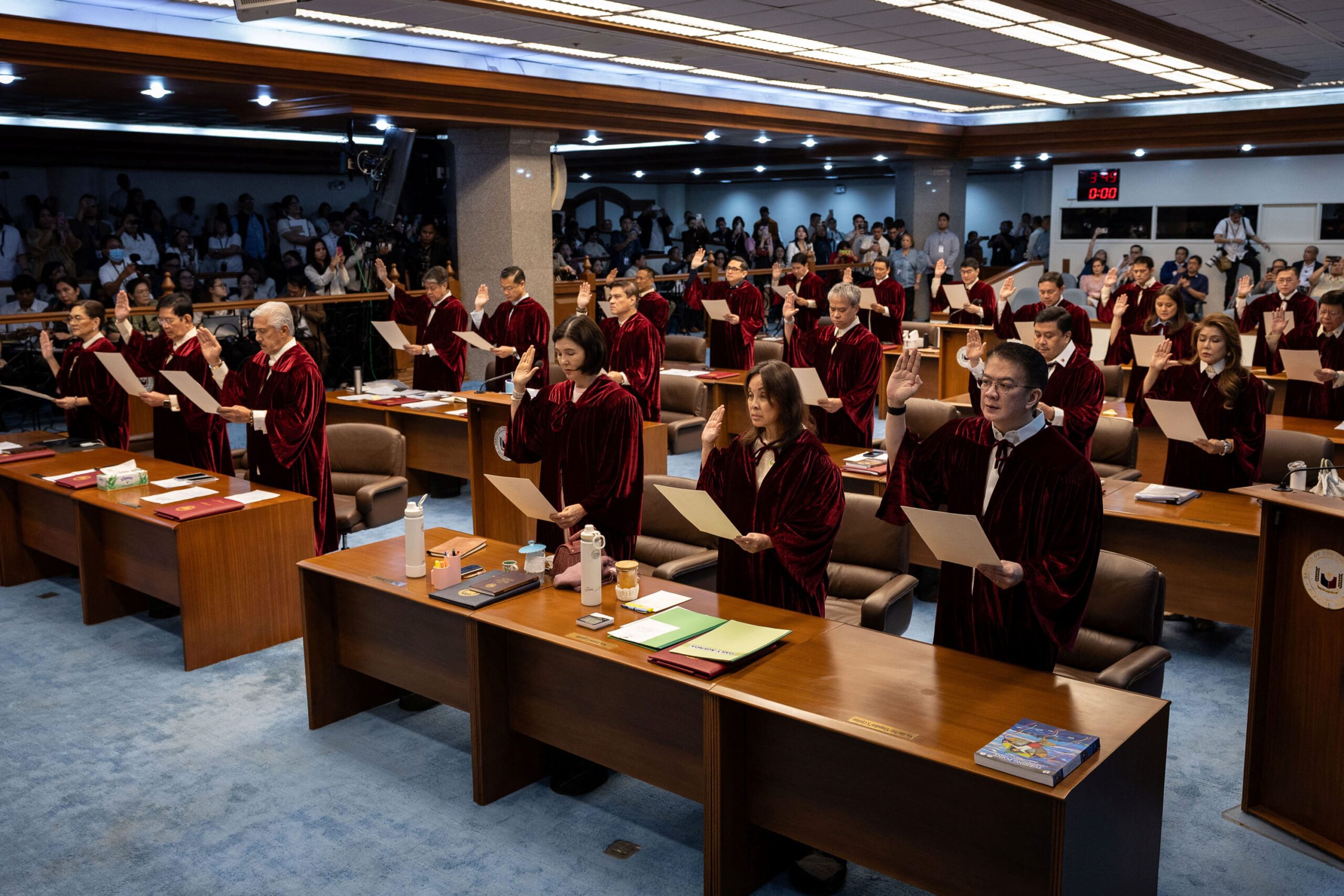
- Three former chief justices provided insights on constitutional interpretation during a Senate discussion, emphasizing the importance of understanding the phrase 'two-thirds of all members of the Senate' in the context of impeachment.
- The justices criticized the Senate's legalistic approach to impeachment, urging a focus on justice for the people rather than procedural technicalities
This is AI-generated. Read the article for full context. Report any errors.
It’s a rare thing to have three former chief justices speak on a common subject as the nation watches. This week, joined by former associate justice Adolf Azcuna, they accepted the Senate’s invitation to share their insights on Article XI, Section 3(6) particularly, the phrase “two-thirds of all members of the Senate.”
What unfolded was a day of meaningful conversation about the Constitution. We are all better for it.
The Senate’s decision to take guidance from the jurists was inspired. First, it enables the chamber to dispel potential claims that it rushed or cavalierly treated a constitutional question. Second, the exercise allowed the Senate to pause its increasingly judicialized posture to seek broader constitutional guidance.
It’s guidance that former chief justice Hilario Davide is in a unique position to provide. He wasn’t just a member of the 1987 Constitutional Commission, he presided over the country’s first-ever impeachment trial of a Philippine President, Joseph Estrada. For him, “members” refers to those who are not suffering from any condition, which render them “incapable of exercising their powers or performing their duties as senators, or who are prohibited to do so by reason of some legal restraints or impediments.” He cautioned against interpretations that “would defy reason, logic and, common sense”.
For his part, former chief justice Artemio Panganiban wondered if the logic of a literal reading holds when math defies reality. For him, voting without participation is neither truthful nor fair; and impeachment is about truth‑seeking, not procedural gamesmanship.
Former chief justice Reynato Puno shared that provisions can be read literally (textualism) or broadly considering constitutional functions (functionalism). Favoring one school does not mean that the other is wrong. He then warned the senators against taking the literal too far — so much so that it ends in absurdity.
It was only Azcuna who insisted on a purely literal reading — the threshold is inflexible because “[A]ll means all.” For him, a fluctuating denominator would allow temporary legislative majorities to abuse the impeachment process. He ventured however, that a fugitive senator like Bato dela Rosa could be considered to have resigned and therefore no longer a member.
The insight offered by the jurists comes at a much-needed time. For weeks the public had grown tired with the legalistic direction taken by the trial. For what is essentially the equivalent of a human resource or labor proceeding (in impeachment, the officer only loses his job, not life or liberty), the Senate has embarked as if it were a division of the Sandiganbayan: parsing technicalities, debating obscure procedure, and litigating minutiae — sometimes to the frustration of the senators themselves.
Devolving into cynicism
This fixation came to a head a few days before the retired chief justices and framers were due to speak. The public watched a session devolve into cynicism, if not outright disrespect, of a jurist who deserved none.
Deans, former cabinet officials, and others used words like rude, boorish, and crude to describe the incident. Even some of the most partisan voices online felt discomfort. Perhaps worried that the same egregious behavior would be on display when the other jurists visit, Senator Erwin Tulfo raised his concern to the presiding officer. After all, the Senate cannot be seen as allowing its eminent guests to be publicly disrespected. Yet, it was the logical end point when ceremony is prioritized over substance and accountability.
Against this, last week’s amicus session came as a welcome and much-needed reset.
While it achieved the nominal purpose of giving the body a framework to decide the threshold issue, it provided the Senate something greater. It re-centered the conversation on constitutional purpose and design, rather than procedural games. It reasserted the political-constitutional nature of the process. It reoriented focus towards wisdom over impudence. Most of all, the former chief justices encouraged the senators to take a broader view: Less about the trappings of courts, more about the greater needs of a nation and its people.
Justice for our people
“What do our people expect from you? It’s not legalism, it’s not judicial conduct, it is justice for our people,” pleaded Panganiban. Meanwhile, Puno gave equally consequential reassurance: that the Senate’s role, and its sole power to decide these questions are free from interference – even from the Supreme Court. There was something profoundly significant in that counsel. It’s not often to see former chief justices advise senators to stop asking, “what would the Supreme Court do?”.
Yet, that was precisely the significance of their intervention. Text over function? This threshold question mirrored a Senate focused on mimicking conventional courts — ceremony over substance. The chief justices reminded the Senate that it need not look over its shoulder as it presides over impeachment. There is something far larger at stake than legal minutiae. And perhaps this is why the words of the justices went viral and dominated the news. They spoke of justice for the people. They emphasized fairness, not technicalities. They reminded the Senate that its constitutional authority was also supreme.
As the hearing neared conclusion, a friend texted, “As a textualist, how do you feel today?” I first thought of sending Justice Scalia’s classic quip (“I’m a textualist, not a nut”). However, the jab made me reflect on how textualism can be misused. Textualists prefer the stability offered by a law’s printed text. They shy away from the adventurism offered by the more flexible schools like functionalism or its cousin, pragmatism.
And yet, one must concede how Senator Ping Lacson’s and Senator Risa Hontiveros’s deft questioning revealed the limits of textualism. The circumstances that beset the Senate are not of its own doing. Yet, it threatens to render its constitutional duty pointless.
Rare moment
How sacred is the literal approach? So sacred that, for Justice Azcuna, losing the ability to hold the most powerful people is a price we need to pay. This might be the point where some textualists might balk. The text’s job is to give life to the words of the Constitution, not defeat it. And by “words” we don’t mean isolated letters divorced from their surrounding sentences or phrases.
Impeachment was designed to be hard.
However, the textual direction of the 1987 Constitution is in fact to make it easier than in the 1935 or 1973 versions. It’s possible that a functional reading might lead to a “dominating Congress.” But is that such a bad thing? Our immediate history shows that the dangers of an abusive president far outweigh an assertive Congress.
Text matters. I always remind my students. Yet, there are those rare constitutional moments when rigid textualism must yield to reality. The three former chief justices may have made a good case that perhaps this is one such time. After all, we should be mindful that, “it’s a Constitution that we are expounding.” – Rappler.com
John Molo teaches Constitutional Law and Litigation in UP Law and UA&P Law. He is a 1st VP of the Phil. Bar Association and past President of the Harvard Law Alumni Association (RP). He has argued several landmark cases before the Supreme Court.
KioskNews shows a cleaned-up reading view extracted from the publisher’s page — the original always lives on their site, not ours.