POETRY CORNER: It's time to retire ancestors and spirits and face the finality of death
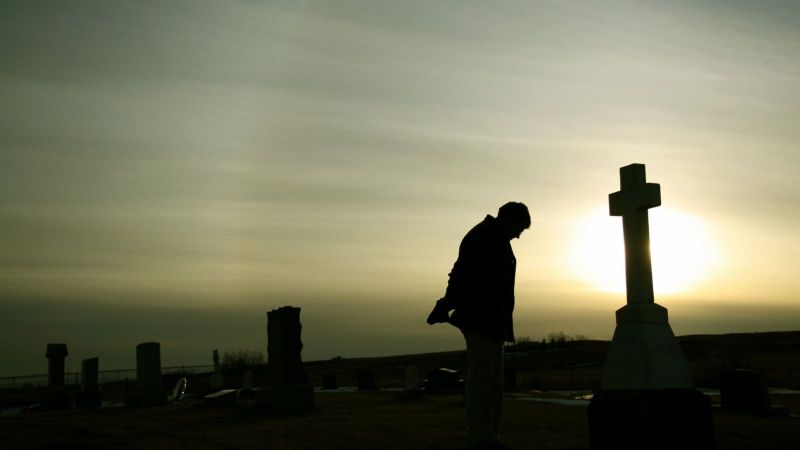
It is as hard to lose a parent as it is to lose progeny, whether it is one’s own child who is lost, or the child of a close relative. It is hard, as well, to lose a sibling or a bosom friend. This is because deep in our Homo sapiens character we know intuitively we’re not going to ever see them again.
The idea of “passing away” is just something that we cooked up because it is relatively soothing. Demise is something that’s built into the structure of our existence. And when we’re dead, we don’t know that we are, the same way we never knew we were “dead” before our parents had us.
In an interview on Piers Morgan Uncensored, he asked Professor Richard Dawkins: “Have you thought about what happens when your life ends?” Dawkins replied: “Well, I’m 83. Have I thought about what happens? … Of course, I die.” When Morgan pressed him, Dawkins said: “I think I get buried or cremated. And that’s it.”
He continued: “I mean, you have a brain which decays. How could there be anything other than that? There’s just nothing, just like there was before you were born.”
This very fact is perhaps why we humans came up with the concept of religion, of an afterlife in which we see all the loved ones we’re going to hang out with, forever, and good friends who are yet to die after we have left the planet, and so on until the end of time. We don’t have a shred of evidence to back any of it up. And this is where charlatans and mediums step in.
The website Big Think agrees that “it’s not the soul, the immaterial spirit. But the truth of the matter is we don’t have any better idea today how the brain accomplishes what the spirit was supposed to accomplish. Sorry.”
I’m not sorry. It is high time we grew up and moved beyond voodooism and fetish witchcraft and all ideas of the supernatural. We live in a natural world of explainable volcanoes and tsunamis and hurricanes. There is no tokoloshe under anyone’s bed.
And yet… by moving beyond what we inherited, where should we be heading? The answer is simple and sensible: we need to embrace science, reason and anything else that can be tested and verified.
The stories we tell
Rumi said: “Your body is away from me / but there is a window open / from my heart to yours. // From this window, like the moon / I keep sending news secretly.” My sentiment exactly: I recognise the longing, the feeling that love must somehow reach the absent person. But feeling a connection does not make it a channel of communication with the dead.
Poets, we are told, are liars who tell the truth. Their metaphors can express our grief with extraordinary precision without telling us anything about what happens after death. I can believe in Rumi’s window as poetry without believing that anyone waits on the other side.
Neither the poet nor the reader needs to mistake the image for a fact. The longing is real; it does not make the reunion real.
Why can’t religion assume a similar position? No one has ever died and come back. We would know. We don’t have any facts or evidence for the claim. So, did Jesus Christ rise from the dead? It is doubtful at best. Many gods or deities achieved the same feat, according to their followers.
Osiris was killed and dismembered by his brother, Seth, and restored to life by his wife, Isis, becoming ruler of the underworld. Tammuz, also known as Dumuzi, was associated with fertility and vegetation. In some traditions, he and his sister alternated periods in the underworld.
Adonis, a youth loved by Aphrodite, was killed by a boar. In Ovid’s account, his blood gave rise to anemones. Other traditions describe him spending part of the year with Persephone and part with Aphrodite. Attis, associated with Cybele, castrated himself and died, after which his body was preserved from decay.
In some Orphic traditions, Dionysus, often identified as Zagreus, was torn apart by the Titans and subsequently restored or reborn. Some accounts connect his rebirth with his preserved heart and Semele.
These are examples of ancient traditions involving holy death, restoration, rebirth, and/or return from the underworld. However, the stories differ considerably, and not all describe a god dying and subsequently returning to life.
What makes us think that our edition of the tale is the right one, even in the absence of reliable eye witnesses and historian records?
Mourning blues
Truth is, when someone dies, there’s real grief, real angst: “Stop all the clocks, cut off the telephone, / Prevent the dog from barking with a juicy bone, / Silence the pianos and with muffled drum / Bring out the coffin, let the mourners come.”
WH Auden’s Funeral Blues hit all of us with those opening words. Who would harbour such profound and quasi-religious thoughts if they knew they would be reunited with their loved one?
To me, such a promised reunion has no basis in reality. The person we love is gone, so let the sorrow begin. Do not stand in the way of my mourning by telling me I will see my love again, spend time with them, talk with them.
Until some proof or evidence becomes available to mortals like me, I see no reason to believe in any kind of resurrection – whatever rising from the dead may mean. But anyone is welcome to do so.
“Ah, Grief, I should not treat you / like a homeless dog / who comes to the back door / for a crust, / for a meatless bone. / I should trust you. // I should coax you / into the house and give you / your own corner.” Thus writes Denise Levertov in Talking to Grief.
One of the key words in Philip Larkin’s The Mower is “unmendably”. Grief needs to be given room, needs to be surfaced and suffered, without any accompanying sacraments promising eternal life.
Even those who profess to believe that kind of promise do weep, wear black and shave their heads. They mourn, even as they cling to the hope of a rich and joyful afterlife – or pretend to. Once gone, life is irretrievable, except in poetic imagery and reveries. DM
Rethabile Masilo is a Mosotho poet from Lesotho who lives in Paris, France.
The Hovering Boy
I have asked my siblings to help me
shift the furniture against the walls
into an arena, to make more room,
her Madonna heart is within that room,
but there is not only her in there, sitting
with that long smile. An angel flies in
on one wing; now there’s a mockery
of life, for there is no uncertainty
in the way we acknowledge a loss.
She knows the truth behind the world,
the surprises it peddles in darkness.
In my own room I put my belongings together,
for I must be on my way in order to be back.
She’s in there, now, while night touches itself,
its fingers slow and lingering. She waits
until her boy comes in and floats to her
in that pernicious room, on the morning
of which she’ll pick her things and pack,
in order to come back another day,
and wait for night that starts to arrive
when she leaves, and the boy flies away.
Rethabile Masilo, Waslap (Onslaught Press, 2015)
The Mower (excerpt)
The mower stalled, twice; kneeling, I found
A hedgehog jammed up against the blades,
Killed. It had been in the long grass.
I had seen it before, and even fed it, once.
Now I had mauled its unobtrusive world
Unmendably. Burial was no help.
Philip Larkin, Collected Poems (The Marvell Press and
Faber and Faber, 1988)
Rethabile Mosilo is a Mosotho poet from Lesotho who lives in Paris, France.
This story first appeared in our weekly DM168 newspaper, available countrywide for R39. The e-edition of Daily Maverick’s weekly newspaper, DM168, is now free for readers who are signed into their Daily Maverick account. Click on the cover of the newspaper below to access the e-edition.
KioskNews shows a cleaned-up reading view extracted from the publisher’s page — the original always lives on their site, not ours.