The long way home: Free after decade in Iraqi prison, Benjamin Hassin begins new life in Jerusalem
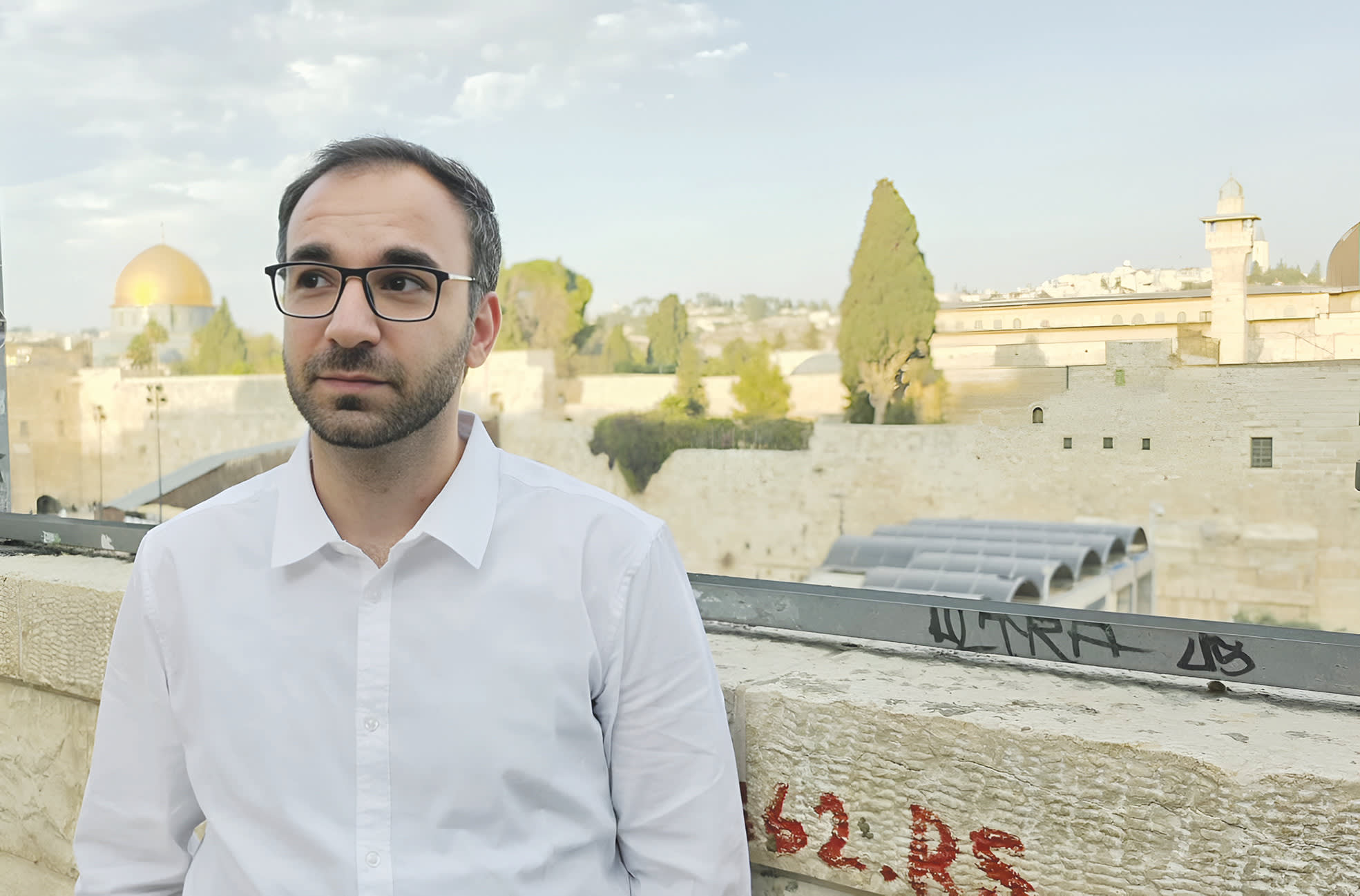
Arrested in Iraq in 2015 and subsequently sentenced to death, Canadian-Israeli Benjamin Hassin endured more than a decade of imprisonment. Now, he speaks to The Jerusalem Post about his ordeal, the people who did not abandon him, and his arrival in Israel
Just over a month ago, on the eve of Rosh Hashanah, Benjamin Hassin landed on Israeli soil for the first time in 12 years.
He was greeted by security officers at the airport, who hugged him and welcomed him home.
The average passenger arriving at the terminal likely had no idea who Hassin was, or why he was being greeted so warmly.
They likely did not know that the 31-year-old Canadian-Israeli had been incarcerated in a prison in Iraq just a couple of days prior. And that he has been imprisoned there since 2015, awaiting execution.

Today, he is studying in Aish Hatorah Yeshiva in Jerusalem, which is where the Post met him to hear his story.
Iraq to Israel and back again
Hassin was born in Iraqi Kurdistan in 1994 to a Jewish family. A year after he was born, in 1995, his family (parents and maternal grandparents) immigrated to Israel, and then in 2002 moved to Canada, where he lived until finishing high school.
At 18, Hassin returned to Israel with the intention of spending time with friends and family before traveling to Sydney, Australia.
But just two days before he was set to fly to Sydney, Hassin decided to cancel his flight and instead travel to Iraq to visit his paternal grandparents.
He chose to stay there for a few months and rented an apartment. During this time, he reported watching videos about the ISIS insurgency and decided to volunteer as a soldier in the Kurdish force.
“It was an American-led brigade, about 200 soldiers,” he explained. “It was led by the Americans, and it was supervised by the United Nations.
“I participated in a few battles, six, I think.”
Volunteering in the army, at just 20 years old and with no military experience, fighting ISIS, was “frightening,” he said. The volunteers received only 10 days of weapons training before they began fighting.
“A lot of terrorists, a lot of bombings, a lot of killings.”
His retelling was delivered in a quiet, matter-of-fact way, a striking juxtaposition to the sheer gravity of the situation being recalled.
After about a year of fighting, Hassin decided he had reached the limit of what he could handle, and informed his unit that he wished to leave – which he was allowed to do given he was only there on a voluntary basis.
But, due to a life-changing turn of events, his decision to leave the fighting would ultimately not mean he would be leaving Iraq.
On June 5, 2015, Hassin was in a taxi on the way to a friend’s house when the driver heard him speaking Hebrew, realized Hassin was Israeli, and threatened to hand him over to ISIS.
The situation became heated, and Hassin, who was armed, drew his weapon and shot the driver in self-defense. The driver died a few days later from his wounds, and Hassin was arrested and charged with murder.
What followed was the beginning of more than a decade in Iraqi custody.
“I spent two months and 27 days in pretrial detention,” he said. “It [his cell] was around 3 feet by 5 feet. I couldn’t stretch my legs fully.”
The treatment during this time was severe. Hassin described emotional and physical abuse, beatings “for no reason,” cigarette burns, a toenail being ripped out, and broken fingers. He showed different scars on his hands and arms and explained what caused them.
He was also handcuffed the whole time, and still bears the physical effects of that 11 years later, with swelling in his hand to this day from the pressure.
“They’d also use sleep deprivation,” he continued. “They’d wake you up in the middle of the night and just say, ‘Go for a walk,’ or ‘go to the washroom.’ So you couldn’t sleep continuously.”
One of the worst forms of abuse that he remembers was being made to wear a blindfold when leaving his room.
“They’d just say ‘Go straight,’ and suddenly I’d fall down the stairs. It was more than the physical pain. Physical pain I knew would go away. But the emotional stuff, that was the worst.”
After the pretrial detention was over, Hassin was moved to a general population prison in Sulaymaniyah. He recalls this being four meters wide and five meters long, with about 20 people in the room at any given time.
This was a holding facility, so he said most prisoners were there for short periods of time, maybe a few days or weeks. Maximum a month.
Hassin was there for five years and two months.
“I still don’t know why I stayed that long there,” he said.
“I had a few lawyers. Two lawyers were actually threatened and resigned from the case. One of them quoted me $100,000 for his lawyer’s fee and said he could get me a 15-year sentence. He was taking advantage of my status, and it was, simply put, manipulation: other prisoners were paying $4,000 or $5,000.”
Hassin refused this. “I told them I’m not going to pay that. I haven’t done anything.”
The years passed slowly, with little to distinguish one day from the next. For the first two years, Hassin said, he was so afraid for his safety that he avoided sleeping at night.
“I’d sleep in the day, like, 10 a.m. to, like, 4 or 5 p.m. At night, I’d just read books or watch TV.”
A friend outside prison would bring him five or six books every few weeks. He read extensively, including Russian literature and philosophy, while much of the rest of his time was spent waiting and thinking.
He was not allowed a Jewish prayer book or any Jewish items, despite requesting them. While praying was forbidden for him, he recalls feeling connected to God spiritually during that time.
Sentenced to death
“Everything happens really slowly there,” he recalled. “It was just listening to people argue about nothing. Fighting about nothing.”
Hassin was finally sentenced on 16 October 2020. He received the death penalty.
This remained in place until November 2025, when his death sentence was annulled after a sulha agreement, with $200,000 in funds raised at the request of the Iraqi authorities (the money was used to persuade the family of the alleged victim to accept the reduced sentence).
However, Hassin was not granted release from prison.
He explained that several executions had taken place in 2014 or 2015, but protests by the families of those executed, along with intervention by the UN and foreign governments, had led to a temporary suspension of executions.
He added that, under the judicial process, a death sentence would be reviewed after 30 days by a panel of 13 judges, including the chief judge. All 13 judges upheld his specific death sentence, he said.
The case was then – according to him – sent to the office of the prime minister or deputy prime minister for final approval, after which an execution could normally take place within 52 days.
However, his execution was never approved, and the case remained pending for years, leaving him waiting without knowing when or whether the sentence would be carried out.
While he can’t say for sure that he received different treatment because he was Jewish and Israeli, he knew that it was a focus for those handling his case.
“On all my case files, the first thing you’d see is a photocopy of my Israeli passport and my ID. And then after that you’d see the statements and what happened throughout the case. So I’m not sure if that affected it, but it probably did.”
Hassin, although somewhat disconnected from the outside world, was aware of October 7 when it happened. Two weeks later, suspecting possible consequences for the Jewish inmate, Hassin’s lawyers asked to have him transferred to a maximum security prison, where he then stayed for a year and nine months.
“It was better there for me. I felt safer.”
He qualified his last statement: “Well, not safe exactly. They all knew I was Israeli. They all knew I was Jewish.”
Throughout his whole time in prison, Hassin was supported by his lawyer Allen Lowy, who would fly to Iraq and visit him in prison. He was also aware of the support of the global Jewish community, particularly the American Jewish community, which was advocating for him and attempting to raise funds.
Despite that support, there were long periods when Hassin understandably struggled to imagine a future outside prison.
During the first five-and-a-half years in prison, he said, he used to call family in Canada once a week or once every two weeks, using the pay phone in the prison cell. After he received the death sentence, Hassin said he stopped calling home.
This reflected the change in his mentality. Prior to the death sentence, he said he held on to hope that he would survive, that he “wouldn’t be that guy who dies in prison.”
But after the sentencing, he said, “Psychologically, I knew it was going to end there, and it was going to be a sad story.”
Nevertheless, he continued to make plans for a life he was increasingly convinced he would not see come to fruition.
“When I was on death row, I said to myself, man, one day, if I do get out, I’m gonna go to the beach.”
Matters changed again when he found out his death sentence had been annulled in November 2025, and that it had changed to a 15-year sentence.
“There’s a law that says you have to finish 75% of the 15 years, which is 11 years and 3 months, and then one can ask to be let off on good behavior.” By this time, he had almost served the 75%, and he became slightly hopeful he would be granted parole.
Gave up hope, then, a breakthrough
However, he said the judge wrote in her two-page report that “according to my crime and according to what happened, I should have been executed years ago, and that I don’t deserve to go back into society.” She rejected his request for parole.
“So I gave up again. I was like, they’re not gonna let me go.”
But after years of expecting the worst, the news he had almost stopped hoping for arrived without warning, on an otherwise nondescript Wednesday, September 16, 2026. Hassin could not sleep, and said he called his lawyer on a whim.
“She said, ‘You’ll be out in 15 minutes.’”
He said the whole process of leaving prison took around an hour and a half, but that he was out the same day.
After that, life has rapidly looked different.
“I met up with the lawyers. They got a five-star hotel [in Iraq]. I didn’t sleep that night.”
The idea of being in prison one day and in a resort hotel the next is inconceivable to most, but Hassin describes it fondly.
“I kept going for a walk, going downstairs, just walking around. I had some tea. I had some ice cream. Small things.”
The group then flew to Dubai, where they had a six-hour layover before flying to Israel.
And when he finally arrived at Ben-Gurion Airport, the welcome described at the beginning of this story brought home a reality that had seemed impossible for more than a decade: he was free, and he was back in Israel.
For the first time in a long time, he “broke down and cried.”
Meeting his family again after so long was jarring but special, he added, tearing up as he spoke.
“When I left my sister in 2012, she was nine. My brother was 12. Now they’re much older. I feel guilty missing out on a lot.”
His siblings, now adults, have since created a family group chat, sending him hundreds of messages and videos throughout the day. It is one of the many ordinary aspects of life that changed during his imprisonment, alongside technology, smartphones, and the rise of AI.
Perhaps one of the most bizarre parts of the story is him ending up at Aish in Jerusalem, studying in yeshiva.
While on the surface it seems to be a peculiar transition, Hassin said it was actually a long time in the making.
“I thought about it even before I got arrested,” he said. “When I was in prison, it became one of those plans like visiting the beach. I thought, if I do get out, I’ll probably go study at Aish.”
He was accepted by the rabbis at the center and arrived almost straight after landing on erev Rosh Hashanah.
He has nothing but good things to say about the yeshiva, and the quiet and thoughtful base it has provided him in the aftermath of his ordeal.
“The classes are amazing. I like the religious debates. Everyone has been so nice and helpful.”
Obviously, it is an adjustment. But Hassin remains positive, and revels in his freedom. He travels to see family in Tel Aviv often, and makes frequent trips to the beach, the thing that he hoped for during those long years in prison.
“It’s a hard transition, but it’s not like I am going from good to bad; I’m going from bad circumstances, life-threatening circumstances, to the safest, most friendly environment. It’s going to take time, but I’ve got all the time in the world.”
While the departure from prison is still fresh, Hassin said it is vital that he shares his story because it is his way of thanking those who helped him and supported him.
“The story’s really not based on me; the story’s based on the people who helped me. There’s nothing special about what I’ve been through. The beauty of the story is the people who helped me get out,” he said, in characteristically humble fashion.
Hassin thanked the thousands of people who contributed to his release, not least the over 6,000 people who raised more than $300,000 in 48 hours to pay for the sulha and legal fees. He also expressed gratitude to Stella Rapp, then head of the consular department at the Foreign Ministry, and her successor Eyal Siso, both tireless advocates for his case.
Since his release, he has also received messages from some of those who helped, including a rabbi who was eager to meet him.
He hopes that just as strangers were willing to help him when he needed it most, he might one day be in a position to offer that same support to somebody else, whether through financial assistance, visiting someone who is ill, or simply showing up for someone in need.
While he wants to stay at Aish for the near future, he is considering going to university and studying computer science.
For now, though, he is in no rush. After more than 11 years in prison, the prospect of an ordinary life, of studying, working, eating ice cream at the beach, is more than enough.
“A normal lifestyle would be good for me, I think,” he mused.
Although he warned the Post that he lost his sense of humor while in prison, there was a clear twinkle in his eye as he said that.
KioskNews shows a cleaned-up reading view extracted from the publisher’s page — the original always lives on their site, not ours.