CONSTITUTION @ 30: Art, justice and Ruth Bader Ginsburg — Celebrating 30 years of the Constitutional Court
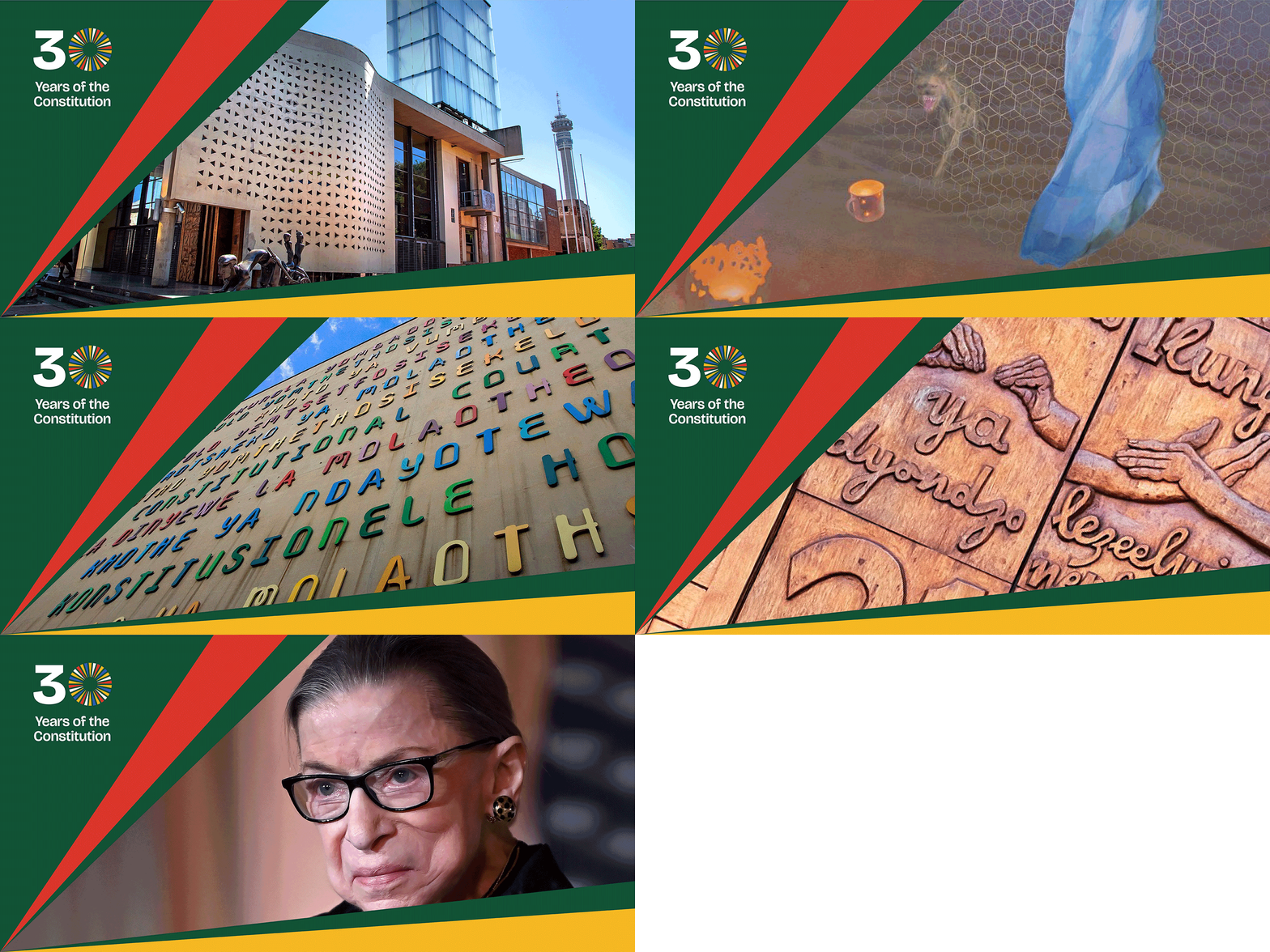
The adoption of South Africa’s non-racial Constitution 30 years ago included the creation of a new apex court – the Constitutional Court. Over the decades, this court has issued landmark judgments that fundamentally transformed South African jurisprudence, particularly through expanding free speech protections and securing the right to shelter.
Back in the late 1990s and early 2000s, despite disagreement over the nature and treatment of the HIV/Aids epidemic and South Africa’s support for Robert Mugabe’s regime in Zimbabwe, the bilateral relationship between the United States and South Africa remained generally cordial.
Could we help the court?
During my time with the American Embassy in South Africa, our team paid close attention to the new Constitutional Court’s mandate to consider foreign legal precedents when reaching its decisions. However, conversations with members of the court revealed a major practical hurdle: researching international law was time-consuming and often incomplete.
We realised we could bridge this gap by providing access to Westlaw, an electronic database containing US court decisions and legal material from virtually every jurisdiction across the United States. In those early days of searchable internet databases, lawyers and judges typically researched precedents by directing interns and clerks to laboriously search through stacks of published law reports. Westlaw, by contrast, offered a continuously updated digital alternative.
Because Westlaw belonged to the Thomson Reuters media empire, major local and international law firms in South Africa were already using it. We approached Westlaw’s local representatives and urged them to extend courtesy log-ins to the Constitutional Court.
Recognising the immense public benefit of assisting the new court, the company agreed to grant the court multi-year, free access. Sometimes a simple initiative yields profound public benefits at minimal cost – an outcome that gives us great pride.
The Constitutional Court’s art collection
Shortly after I retired from diplomatic service, Justice Albie Sachs invited me to visit the court’s temporary quarters in Braamfontein. He wanted to discuss a new task that he and fellow Justice Yvonne Mokgoro were undertaking: assembling an art collection for the court’s permanent home using a modest starting budget of R10,000.
Apex courts around the world take varied approaches when choosing art and architectural design for their buildings. For instance, the architects of the US Supreme Court building, completed in 1935, adopted a neoclassical style typical of official Washington, decorating the building’s exterior pediments with bas-relief friezes depicting historical lawgivers such as Solon, Confucius and Moses.
Other nations adorn their courts with portraits of eminent jurists and political leaders, or depictions of heroic moments in national history. Still others commission works illustrating allegorical concepts like “blind justice” – often drawing on centuries-old traditions of depicting a toga-clad woman holding a balance scale and a sword.
Justices Sachs and Mokgoro took a distinctly different path. Working under severe financial constraints, the two began gathering art even before workers finished constructing the new court building.
Instead of purchasing an established collection, they built a repository that arrived organically from artists and generous donors. When I met Justice Sachs in his temporary office, donated artworks were already filling the walls.
Among the growing collection, Judith Mason’s The Blue Dress stands out as perhaps the best-known piece. Mason created the work after hearing radio broadcasts of Truth and Reconciliation Commission testimony regarding the execution of two anti-apartheid activists, Harold Sefola and Phila Ndwandwe, by security forces.
Ndwandwe had reportedly been kept naked in her cell to force her to inform on her comrades; in defiance, she fashioned plastic bags into crude clothing to preserve her dignity. Moved by this story, Mason collected discarded blue plastic bags, sewed them into a dress, and painted a poem on the fabric honouring Ndwandwe’s extraordinary courage.

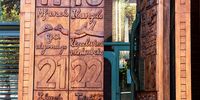
As construction neared completion, workers installed the building’s main entrance doors – massive wooden sculptures carved by hand. These doors depict the 27 fundamental human rights listed in Chapter Two of the Constitution (the Bill of Rights) using South Africa’s 11 official languages, alongside sign language. The bronze door handle incorporates Braille commemorating the court’s opening in 2004.
The late artist and set designer Andrew Verster, alongside artist Andries Botha and a team of skilled carvers from KwaZulu-Natal, created these magnificent doors. Verster likened the collaborative process to building a Gothic cathedral, where thousands of hands contributed to create a unified whole.
Outside the court stands a large bronze statue cast from a smaller clay work by the famed artist Dumile Feni, titled History. The Tallix Art Foundry in Beacon, New York, scaled up Feni’s original work and cast it in bronze before shipping it to South Africa in 2003 as a gift to the court.
The sculpture depicts a broad-shouldered man straining to pull a cart carrying several figures. While the figure initially seems burdened, closer reflection reveals a tribute to those who tirelessly carry the responsibility of caring for others.
As Justices Albie Sachs and Edwin Cameron noted, Feni created no racial distinctions among the four figures, showing how human relationships rely on mutual dependence: “Sometimes you carry, and sometimes you are carried.”

Since those early days, leading figures and emerging artists alike have donated works to the court. The collection now features pieces by William Kentridge, Judith Mason, Dumile Feni, John Baloyi, Willie Bester, Marlene Dumas, Karel Nel, Cecil Skotnes, Hamilton Budaza, Sue Williamson, Anton van Wouw and Andrew Verster.
Artists felt drawn to the vision of a court that embodies constitutional values through diverse artistic expressions. Justice Sachs’ well-known passion for connecting art, justice, and freedom helped catalyse this massive outpouring of creative support.
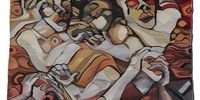
In the end, the Constitutional Court spent its entire original art budget of R10,000 on a single piece: Joseph Ndlovu’s tapestry Humanity. Justice Sachs frequently observes that the collection essentially assembled itself through the passion and enthusiasm that the artistic community felt for South Africa’s new democracy.
Today, the curatorial staff offers theme-focused “Art & Justice” public tours that highlight the court’s position at the intersection of constitutional law, public memory, and artistic expression, allowing visitors to engage directly with the core values of South African democracy.
A visit by Associate Supreme Court Justice Ruth Bader Ginsburg
On 7 February 2006, less than two years after the court moved into its permanent home, US Supreme Court Associate Justice Ruth Bader Ginsburg delivered a major address at the court. Justice Sachs initiated the invitation, which our embassy and the State Department facilitated, making Ginsburg the first American Supreme Court justice to visit South Africa.
Before President Bill Clinton appointed her to the US Supreme Court, Ginsburg had built a distinguished legal career advocating for women’s equality and environmental protection, alongside her work with the American Civil Liberties Union and service as a federal appellate judge. Despite her stance as a leading progressive jurist, she maintained a close personal friendship with her conservative colleague Antonin Scalia, bonded by their shared love of opera.
From the opening moments of her speech, Justice Ginsburg praised Section 39 of South Africa’s 1996 Constitution, which explicitly directs courts to consider international law and permits them to consult foreign law when interpreting the Bill of Rights. She noted that while countries like India and Spain embraced similar principles, the practice of looking to foreign decisions remained contentious in the United States.
Ginsburg openly defended comparative legal analysis, arguing that American jurisprudence grew richer when judges learn from other constitutional democracies like Canada, South Africa and the United Kingdom.

She anchored her belief in comparative dialogue within the foundational history of the United States, pointing out that the authors of the Declaration of Independence cared deeply about international public opinion. Quoting former DC Circuit Chief Judge Patricia Wald, Ginsburg emphasised that foreign judicial decisions offered a rich pool of persuasive reasoning that judges could draw upon with appropriate caution and restraint.
She respectfully rejected Justice Scalia’s view that US judges should ignore foreign commentary, asking why judges who freely consult legal treatises and law review articles should refrain from reading well-reasoned decisions from the Supreme Court of Canada or the Constitutional Court of South Africa.
Justice Ginsburg concluded her address with a call for humility and international comity, observing that American courts benefitted when they respected the opinions of humanity and learnt from legal innovations worldwide. While today’s more inward-looking US Supreme Court contrasts with her vision, Ruth Bader Ginsburg’s enduring optimism reminds us of the power of constitutional courts to look outward and learn from one another. DM

This story is part of a series marking 30 years since the signing of the Constitution. The series has been made possible, in part, by the support of the Friedrich Naumann Foundation.
KioskNews shows a cleaned-up reading view extracted from the publisher’s page — the original always lives on their site, not ours.