GROUNDUP: Tshwane’s drinking water crisis a wake-up call for SA as sewage pollution sickens hundreds
On Monday, 19 October, local, provincial and national authorities reported that at least 408 people, predominantly children under the age of four, had contracted gastrointestinal illnesses from tap water between 7 and 18 October. Most were rehydrated and discharged within a day. No deaths were reported, according to Health Minister Aaron Motsoaledi.
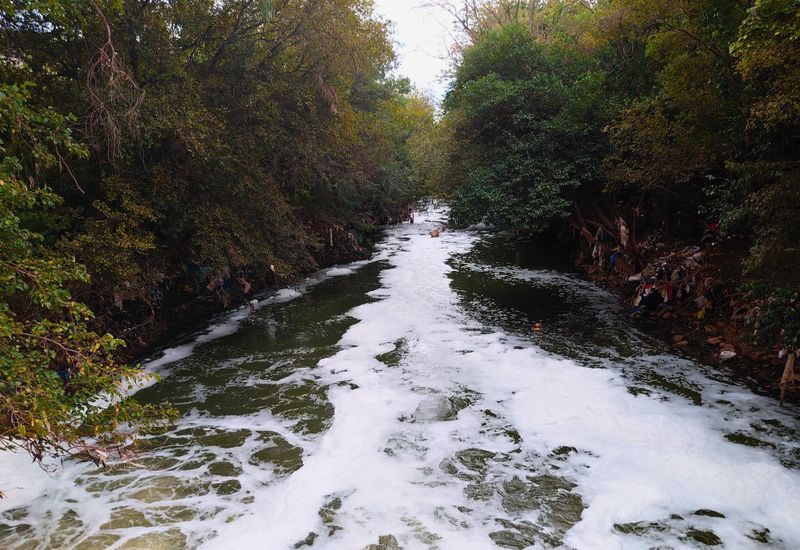
The water came from the Bronkhorstspruit Water Treatment Works (WTW), supplying areas that include Bronkhorstspruit, Zithobeni, Dark City, Rethabiseng and Sokhulumi in the northern Gauteng metro. The river water that the treatment plant abstracts is heavily polluted with sewage.
GroundUp reported on 9 October residents’ concerns about discoloured water coming from their taps, but we received no communication from officials.
Tests by the Department of Water and Sanitation on 14 October found extremely high levels of E. coli and total coliforms in water from the treatment works and two reservoirs.
E. coli signals recent faecal contamination, and some strains cause severe diarrhoea, with a small share of cases potentially leading to kidney failure, which can be fatal, particularly in children under five.
High total coliform counts signal that other disease-causing germs may be present. Norovirus, Shigella and Campylobacter were detected in patients in this recent outbreak.
Between 24 September and 14 October, municipal officials at the Bronkhorstspruit Water Treatment Works did not chlorinate the water to kill harmful pathogens. They failed to warn residents.
‘Monopoly’
Tshwane Mayor Nasiphi Moya said at a press conference on Monday that the supplier of chlorine had a “monopoly” and alleged that prices had increased fourfold. Negotiations between municipal water and sanitation officials and the supplier had reached a deadlock.
Moya said the officials had not informed the City leadership about the shortage of chlorine. Disciplinary and consequence management action was under way, she said.
Chlorination had since resumed, but water was still unsafe to drink.
But this comes after years of inadequate maintenance to the more-than-60-year-old Bronkhorstspruit Water Treatment Works. In September, Tshwane spokesperson Lindela Mashigo said that the plant had not operated at capacity for years and had frequent breakdowns.
Moya said the City spent R20.8-million on the plant in 2025/26 and had approved R57-million for 2026/27, and R30-million for 2027/28.
The water from the Bronkhorstspruit Water Treatment Works is still considered dangerous and should only be used for flushing toilets. Residents have to rely on 36 water tankers.
According to the Department of Water and Sanitation, the Bronkhorstspruit River, which the plant draws from, is badly contaminated with sewage pollution from upstream dysfunctional wastewater treatment works under Victor Khanye Municipality and dysfunctional City of Tshwane sewage pump stations.
Water management expert Dr Anthony Turton told GroundUp that “the whole national system is designed on the indirect reuse model”, meaning treated sewage flowed into rivers that supplied drinking-water plants.
The Department of Water and Sanitation’s 2025 Green Drop Report flagged widespread sewer blockages and pump station outages across South Africa that caused raw sewage to bypass plants entirely, leading to direct river contamination.
“All potable plants are designed on the assumption that influent quality meets certain parameters. None were designed to convert raw sewage into potable water, which is what they are now being asked to do,” said Turton.
On the quality of treated effluent, one of the areas the department audits, 597 of 848 systems scored below 31% (critical).
The national average of microbiological compliance is 35%, which means that effluent routinely fails limits for faecal bacteria such as E. coli before being discharged.
Chemical compliance sits at 48% nationally, indicating a failure to treat organic loads, ammonia and nutrients. This can trigger eutrophication, harmful algal blooms and ecological destruction as species cannot survive with the severe oxygen depletion.
GroundUp has reported extensively on how South Africa’s rivers, streams and ecosystems are being degraded by raw sewage in numerous municipalities, including Matlosana, Ditsobotla and Tswaing in the North West, Mangaung in the Free State, Dawid Kruiper and Kai !Garib in the Northern Cape, Kouga in the Eastern Cape, Emakhazeni in Mpumalanga, and Gauteng’s Johannesburg, Tshwane and Mogale City.
The 2025 Green Drop Report found 396 (47%) of the 848 municipal wastewater systems assessed were in a critical state, including 159 that were formally disqualified. Only 14 systems earned Green Drop certification, the report’s top rating, which requires scoring at least 90% overall to meet standards.
Not one wastewater works is fully compliant
Turton argues that treated wastewater released into our rivers needs to be almost perfectly compliant with the standards, and that the Green Drop results show how far we are from that. Not a single wastewater works is fully compliant. Wastewater treatment, he says, is not like a school exam where 51% is a pass. With public health and drinking water sources at stake, anything short of near-total compliance is a failure.
Department of Water and Sanitation spokesperson Wisane Mavasa told GroundUp on 16 October that ongoing water pollution continued to affect the water supply in Gauteng, increasing treatment costs and requiring upgrades to “highly sophisticated water treatment technology”.
Hammanskraal’s Temba Water Treatment Works (the site of a deadly 2023 cholera outbreak), Pretoria East’s Rietvlei Water Treatment Works and Bronkhorstspruit’s Water Treatment Works “are not producing water suitable for human consumption, and as a result alternative supply has had to be sourced”, said Mavasa.
GroundUp reported in October how pollution from Ekurhuleni has forced the Rietvlei Water Treatment Works offline. With criminal charges laid against the East Rand metro and its water utility, Department of Water and Sanitation Deputy Minister Jack Bloom said at the time that “one city’s pollution becomes another city’s water crisis”.
Turton said “the sewage crisis is what will destroy water security in South Africa. It is an existential threat to the national economy.”
According to the Department of Water and Sanitation’s own National Pollution Register, there are seven open cases against the City of Tshwane relating to water pollution.
Lack of accountability
WaterCAN director Ferrial Adam said that despite the substantial state resources spent investigating failures and alleged wrongdoing, the public had yet to see meaningful consequences.
“There is a clear collapse of oversight, and lives could have been lost,” she said. “People are getting sick, communities are suffering.”
Turton believes underperforming officials should be held personally accountable. He said political appointees should be removed and replaced with experts.
He also says “water mafias” have gained control of the procurement systems to exploit the crisis. Turton said they needed to be weeded out and criminally charged.
Speaking to GroundUp at the idle Rietvlei Water Treatment Works in Tshwane on 8 October, Mavasa and Bloom referred to the Water Services Amendment Bill as a mechanism that could improve accountability and performance. The bill has been tabled.
The Department of Water and Sanitation says it currently lacks the powers to act when municipalities fail. The bill would give it enforcement powers and require water service providers to hold operating licences, which could be revoked after persistent failure.
It would also make municipal managers and company directors personally liable for failure to take reasonable preventive steps. DM
KioskNews shows a cleaned-up reading view extracted from the publisher’s page — the original always lives on their site, not ours.