Head Start got her out of homelessness. Trump proposal threatens that help for others
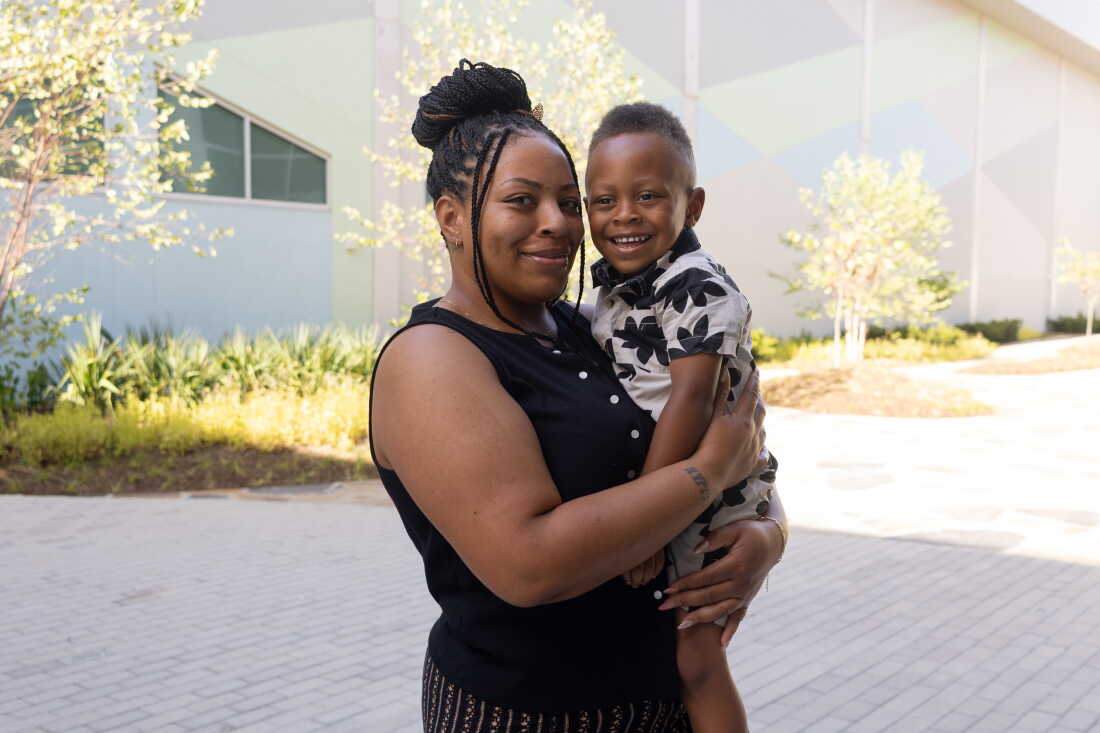
TaNisha Thomas found herself and her young son homeless after she lost her job a few years ago. Head Start provided childcare that allowed her the space and time to find a new job and go to college. Center for Transforming Lives hide caption
toggle caption
Center for Transforming Lives
Catch up on what you missed with our Education newsletter, sent weekly.
No one thing led to TaNisha Thomas becoming homeless.
Things started to unravel when she lost her job at the shipping company DHL in 2021. She was pregnant, and she got so far behind on rent she had to move back home to Fort Worth, Texas.
She remembers all the nights spent on the couches of family members and friends. Every morning started with a list of high-stakes questions rolling through her mind: "I don't know where we're gonna eat and I don't know where we're gonna sleep," she recalls. "Every day I'm working towards just surviving."
After she had her son, she managed to get a job at Walmart — then her car broke down. Between Ubers to get to work and childcare costs, she was spending money faster than she could make it.
Once she ran out of couches, Thomas started making calls. She had to use public Wi-Fi since her phone service had been cut off.
She found the Center for Transforming Lives, a Fort Worth nonprofit that works to get single mothers back on their feet after hardship. The center's staff quickly helped enroll Thomas' son in Head Start. The 60-year-old anti-poverty program provides preschool and childcare along with meals and support services for qualifying families. It now serves more than 700,000 kids each year from birth to age 5.
More than 60,000 of them are homeless.
Given Thomas' lack of permanent housing, her son avoided having to wait for a Head Start slot. It gave her time to take a breath and take care of herself.
It's a moment she now credits as saving her life: "I can tell you without a shadow of a doubt that I would not be here. I would not be alive," she says. "I wouldn't have made it through that time without them."
If the new Trump administration proposal, to shrink a 133-page list of Head Start requirements down to only a handful, is adopted, mothers like Thomas likely wouldn't be able to take the same path.
Shutting the door on homeless students
That's because the new proposal would eliminate a rule that allows centers to set aside spots for homeless students and those in the foster care system. Right now, Head Start centers can reserve up to 3% of their slots for families who are homeless or for children in foster care.
And families would no longer be able to simply declare they are homeless; they would need to prove it, says Barbara Duffield, the executive director of SchoolHouse Connection, a national organization working to overcome homelessness through education
"Most of the families who are living in rural and suburban parts of the country have no documentation to show that they're experiencing homelessness," Duffield says. "Mostly they're going from place to place because there aren't shelters."
Others are fleeing domestic violence or dangerous living conditions and do not have time to gather paperwork before leaving. Under present guidelines, homeless students can enroll without birth certificates or other necessary documents, and families are given time to get them together while the children access care. The new proposal could bar students from services until they have the correct paperwork.
Duffield says if that part of the proposal is adopted, it will almost definitely result in fewer homeless students participating in Head Start at all.
"Head Start is so much more for families who are experiencing homelessness," she says, "because of its ability to stop the harm that's already happened and then set families up for never experiencing homelessness again."
A push for more students, less regulation
The Trump administration's new proposal confused some advocates. Many were bracing for the administration to cut the program outright based on other actions it has taken related to Head Start. Instead, the proposal lays out a goal of drawing more students into Head Start: at least 200,000 more by its own estimates.
The proposal would limit how much Head Start centers can spend on administrative overhead, from a maximum of 15% to a 5% cap. This is money that centers spend on things including front office workers and education specialists. A specialist in Fort Worth is the one who noticed Thomas' son was not speaking at a year old, got him a speech pathologist and eventually, dental surgery.
The Trump administration estimates the changes would save $2.2 billion, which it said it would put back into Head Start.
"We have 1,600 Head Start providers across the country," Alex Adams, the U.S. Department of Health & Human Services' (HHS) assistant secretary for family support, said in an August call with reporters announcing the proposed changes. "And one-size-fits-all mandates from Washington cannot fully account for the realities facing these 1,600 grantees."
Since its launch in 1964, the $12 billion HHS program has, for the most part, enjoyed bipartisan support. Lawmakers often cite it as a success — including Health Secretary Robert F. Kennedy Jr. during that call with reporters. But in recent years, some conservatives have criticized Head Start, saying it wastes money and fails to have a lasting impact on students.
"Flexibility is permission. It's not a mandate," Adams said. "The opportunity for these programs to make a different decision does not necessarily mean they must make a different decision."
The proposal is open to public comment in the Federal Register until Oct. 6 and so far it has drawn more than 12,000 comments.
A path erased
With her son cared for during the day, TaNisha Thomas finally had the time to get counseling to address her depression and start a job hunt. She even enrolled in college courses, beginning work on an associate degree in mental health and human services.
She says having teachers provide consistency and routine for her son was a huge weight off her shoulders: "I'm not saying that I don't care about his education and his development, but that was not my concern. My concern was us just making it to tomorrow."
Two years later, their lives are unrecognizable. Thomas' son is in preschool. And she is a student at the University of Oklahoma pursuing her bachelor's degree in social work.
KioskNews shows a cleaned-up reading view extracted from the publisher’s page — the original always lives on their site, not ours.