Why ECI software ERONET is at the centre of the row over SIR
Roughly 17.6 million voters across Telangana, Karnataka, Maharashtra and Delhi have received notices under a single, controversial category — logical discrepancy — as the Special Intensive Revision (SIR) of electoral rolls grinds through its third phase.

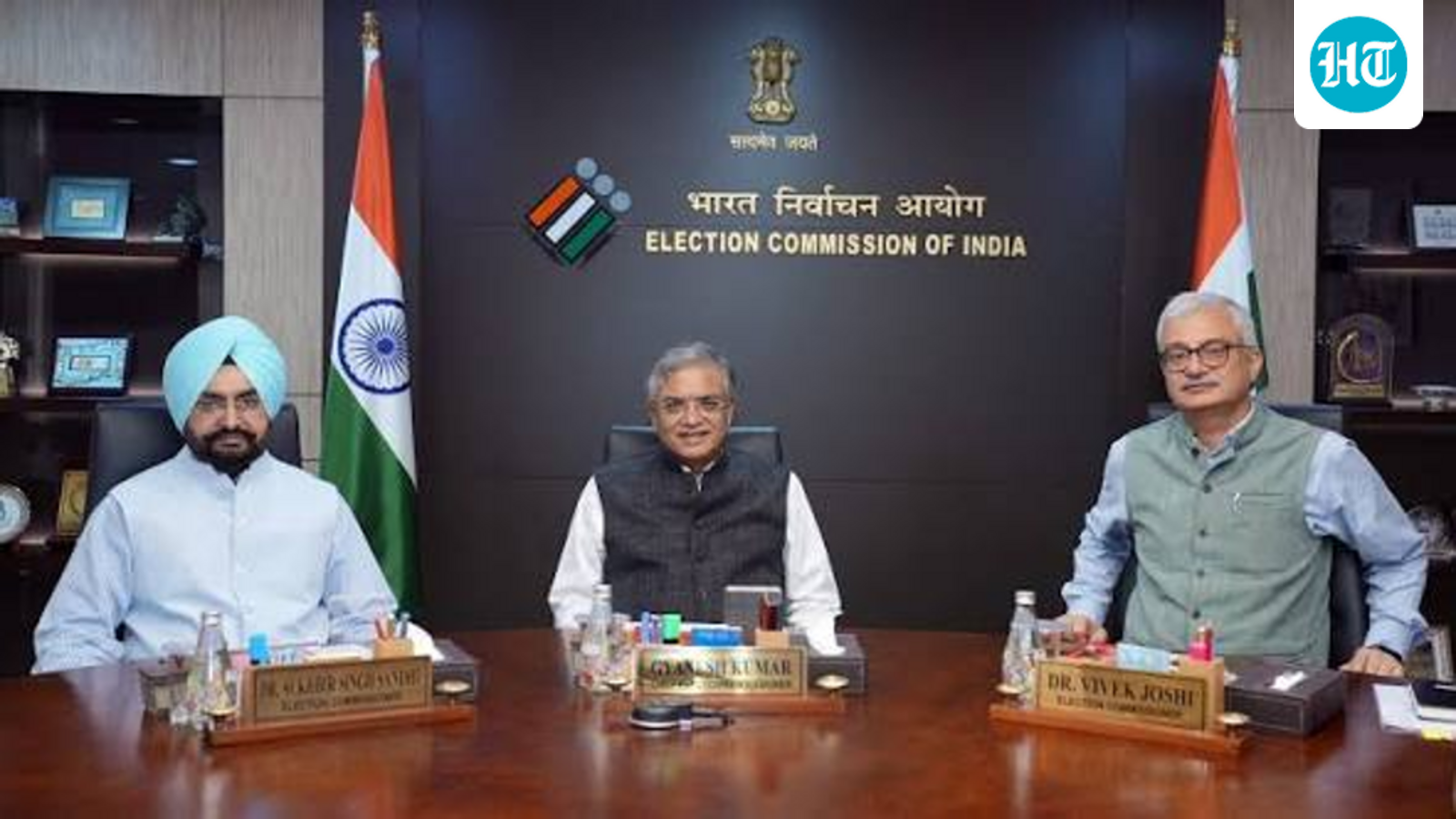
Behind these numbers is a piece of software —ERONET, which now sits within the poll body’s umbrella software ECINET—and an institutional fight over who controls it. This fight has pulled in two sitting Election Commissioners, the Commission’s Director General of IT, and the Cabinet Secretary.
ERONET, or the Electoral Roll Officers’ Network, processes enumeration forms and attempts to match a current elector with a corresponding entry in the base rolls. And in Telangana, Karnataka, Maharashtra and Delhi , it has flagged a large number of people because of a mismatch. The 2002 base rolls were in Telugu in Telangana and Andhra Pradesh, Kannada in Karnataka, and Marathi in Maharashtra.
Other states and Union territories such as Odisha, Jharkhand, Haryana, Andhra Pradesh, and Punjab where SIR is underway in Phase 3 either haven’t published a separated logical-discrepancy number, or have bundled this into a broader category, including ASDD (Absent, Shifted, Dead, and Duplicate) .
Similar problems were seen earlier in West Bengal – where six million people were flagged for logical discrepancy and 2.71 million eventually disenfranchised – but little changed, say booth level workers and election officials.
ECI officials told HT that only routine changes were made to the software after the SIR in West Bengal. “We do not think that the software was faulty in the first place. It is routinely updated and that is what happened after West Bengal too. We are always working to make it more efficient,” an official said.
WHO CONTROLS ERONET?
An investigation by the Indian Express stated that since May, two of the Commission’s three members, Vivek Joshi and Sukhbir Sandhu, have formally objected at least 14 times in ten months to decisions, including those they say have concentrated control over the electoral roll in ways the law doesn’t permit.
The last are the most worrying, and Joshi, who raised the alarm first according to Indian Express, describing a “gradual centralisation of the electoral roll database” Sandhu reiterated the concern in August according to the report: state election officials were telling him they lacked “proper and complete access” to the ERONet portal — the system they’re legally required to use to maintain their own rolls. This would appear to be the first big problem with ERONet.
He went further, questioning whether the Commission’s Director General of IT, Seema Khanna, had any legal authority to restrict access that belongs, by statute, to EROs and other statutory officers.
Khanna, the ECI’s senior-most technology official, who has publicly presented ECINet’s design and described cybersecurity as central to its architecture, was copied on repeated requests from state CEO offices for fixes that never arrived in time, Indian Express reported citing the example of Goa where EROs cleared 97 voters for inclusion in the rolls, but could not make changed in the database before the deadline, leaving all 97 off the final list despite a statutory officer’s ruling in their favour.
Goa’s CEO office wrote eight times in a single week to Gyanesh Bharti, the senior deputy election commissioner in charge of the state, copying director general (IT) Seema Khanna every time, seeking a rollback facility that never came, the report added.
HOW GOOD IS ERONET?
The other big problem is ERONET’s ability, or lack of it, to deal with mismatches.
In Hyderabad, where the 2002 rolls were in Telugu, Qamer Fatima is one of its victims. On September 8, the 55-year-old received a notice from the Telangana CEO that said her name did not match “Qemar Fatima” in the rolls.
“All my current documents have the same spelling of my name as my voter ID. I don’t know how to prove that the person on the 2002 rolls is me,” Fatima told HT. “The BLO has asked for some documents. But he also doesn’t know anything either. He said that after receiving the required documents, he will send my application to the commission’s office and then we will wait to see if the name appears on the rolls,” she added.
If Fatima cannot establish the link before November 5, she will have to file a fresh Form 6 application and declare herself a first-time voter.
A booth level officer admitted that the mismatch was a “transcription error” when ECI software rendered the Telugu names into English. At least 205 voters across six booths in Hyderabad’s Langer House area, where Fatima lived, received notices for identical reasons.
An official at the Telangana CEO office confirmed to HT that previous rolls were in Telugu and that translation errors resulted in anomalies. “The 2002 base roll was a mess. Names and surnames were inconsistent. When they were translated to English and matched with the current list several errors came up. People, however, should not panic. A notice doesn’t mean their names will be removed from the list. There is enough time for corrections. This is why SIR was needed. The new list will be the perfect list,” the official said.
One month before completion of SIR in West Bengal, ECI in January 2026 launched the ECINET platform which had ERONET integrated within it. ECINET had 22 built-in Indian languages. Officials told HT that integrating these two platforms allowed cross-verification of voter names and addresses recorded in regional languages against a centralised, standardised dataset, which helped catch spelling variants, and script-conversion errors.
When the logical discrepancies category was first introduced in West Bengal, HT reported that ERONET first read old paper voter lists written in Bengali and converted them into English, before comparing names and family details with present-day voter records. If the old and new spellings did not match, the system automatically flagged that particular voter, even for common spelling differences.
But the software made other mistakes too.
In Bengaluru, Joan Fathima received a notice because of a gap of less than 15 years between her and her father’s age in 2002. “This information is wrong. The age difference between my father and me is 27 years. The BLO wants me to bring the age proof of my 80+ year old father,” she told HT.
At least 87 of the 332 notices served at Fathima’s booth cited the same age-gap discrepancy as the reason.
HT reached out to officials at the Karnataka CEO office who refused to comment on specific cases.
The same error surfaced more than 300 kilometres away in Udupi, where 62-year-old Nirmala B, a retired government school teacher, received an identical notice over a parent’s age gap of under 15 years. “This is absolutely incorrect. My father is 87 years old. The age gap is 24. The BLO has asked for his age proof and I will submit that,” she told HT. “But what about people who don’t have age proof?”
A BLO in Bengaluru said the fault didn’t lie with the field verification but the backend software calculation. A senior ECI official defended the reliance on software despite its flaws, arguing there was no realistic alternative at this scale.
“We have now integrated ERONET with ECINET. This has helped reduce errors because the detection of duplicate voters, verification, and updation are now happening on one single platform. It is impossible to carry out an exercise of this scale manually without technology. Checking duplication and mapping progeny manually will take years. We fix all problems with the software in real time,” the official said.
Officials at the Delhi, Karnataka and Telangana CEO offices told HT that complaints about the app from BLOs were addressed as they came in. “We do receive complaints from BLOs about the app,” an official said, adding that fixes were pushed through continuously rather than in scheduled batches.
CAN IT BE THE ARBITER?
Article 324 of the Constitution gives the Election Commission full control over how electoral rolls are prepared. The Supreme Court confirmed this in a 1977 case, ruling that this power belongs to the Commission collectively, not to any individual office under it.
Nowhere does it mention the Director General of IT as a decision-maker over individual entries in the electoral roll.
Under Section 13B of the Representation of the People Act, 1950, the Commission appoints an Electoral Registration Officer (ERO) for each constituency. Once appointed, that ERO becomes the legal custodian of the roll. The Registration of Electors Rules, 1960 states that EROs are the ones who process applications and decide disputes, following the law and any directions the Commission gives them. The Commission itself only supervises from above.
ERONET and ECINET, often used interchangeably, are part of ECI’s larger software and technology network. ERONET or Electoral Roll Officers’ Network was rolled out from 2017-18. ECINET, launched in January 2026, is the newer, unified interface that integrates ERONET and more than 40 of the ECI’s other applications into a single app and website for voters, BLOs, and officials.
KioskNews shows a cleaned-up reading view extracted from the publisher’s page — the original always lives on their site, not ours.