Singapore unveils robot to tow fire-hit electric vehicles to safety
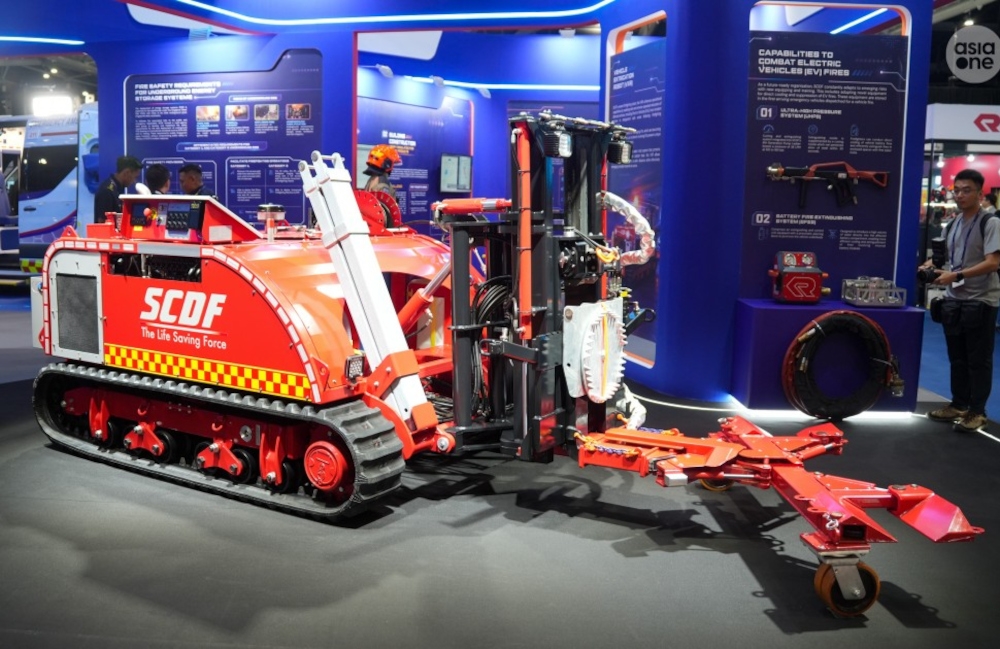

As electric vehicle adoption gains momentum in Singapore, the Singapore Civil Defence Force is preparing itself to mitigate the risk of thermal runaway from battery fires with its new Vehicle Extrication Robot. — AsiaOne pic
First Published: Wednesday, 28 Oct 2026 1:19 PM MYT
Singapore Civil Defence Force unveils robot that can extract, relocate electric vehicles involved in fires
SINGAPORE, Oct 28 — With electric vehicles (EV) gaining popularity, making up 57.6 per cent of all new car registrations in the first quarter of 2026, the Singapore Civil Defence Force (SCDF) is stepping up efforts to prepare for fire-related incidents.
The lifesaving force on Wednesday (October 28) unveiled its new Vehicle Extrication Robot (VXR) at the Singapore-International Disaster and Emergency Management Expo (SIDEX), held at the Singapore Expo.
Speaking at the event, Second Minister for Home Affairs Sim Ann pointed to SCDF’s Transformation 2030 vision, “Prepared, even for the unexpected”.
“The aim is not simply to respond better when emergencies occur, but to anticipate risks and strengthen capabilities before they are needed,” she highlighted, noting that the built environment has become more complex, alongside the emergence of new risks.
Sim noted that growing EV adoption can introduce new challenges for firefighters.
“Lithium-ion batteries can undergo thermal runaway, and affected vehicles may remain at risk of re-ignition even after a fire has been extinguished,” she pointed out.
Thermal runaway refers to a condition when an electrochemical cell increases its temperature through self-heating in an uncontrollable fashion and progresses when it is generating heat at a higher rate than can be dissipated.
And because the cells are densely packed, thermal runaway of one cell is likely to propagate and eventually set the whole battery on fire.
About the Vehicle Extrication Robot
In a factsheet to the media on Wednesday, SCDF said that the risk of thermal runaway during EV battery fires require a holistic mitigation response.
“As affected EV batteries may remain at risk of re-ignition even after the fire has been extinguished, they need to be relocated to a safe area as quickly as possible,” said SCDF.
To this, the SCDF’s latest addition to its fleet of unmanned capabilities can be operated from up to 300 metres away, allowing firefighters to relocate an affected EV to a safe area once the fire has been extinguished.
The VXR is also equipped with an integrated water mist system that protects it from radiant heat.
Demonstrating its utility in a video, SCDF showed that an EV can still have high temperatures even after a fire has been put out.
In such cases, firefighters will deploy the VXR to tow the affected EV to another location. For example, if an affected vehicle is in an enclosed carpark, it will be relocated to an open space.
During the towing process, the VXR’s water mist system is activated to shield it from the risk of reignition.
Once in an open area, firefighters are then seen deploying other firefighting equipment, including unmanned firefighting machines, to cool down the vehicle.
The VXR will begin operational trials at Punggol Fire Station and Kallang Fire Station from October 2026 and April 2027 respectively. — AsiaOne
KioskNews shows a cleaned-up reading view extracted from the publisher’s page — the original always lives on their site, not ours.