When the Press Was Silenced, Who Kept the Stories Alive?
There was a time when the question was not whether you could find information, but whether you were allowed to publish it.
When Martial Law was declared in 1972, newspapers, radio stations, and television networks were shut down or placed under government control. Journalists critical of the government faced arrest and other forms of repression. Yet the press did not disappear entirely. An alternative press emerged — made up of journalists, student editors, religious groups, workers, and others who continued to put stories into the public sphere despite the risks.
They came to be known as the “Mosquito Press.” The name itself was meant to diminish them, as something so small and annoying can easily be clapped to death. But what made the metaphor powerful was precisely what it implied: even something small could be persistent enough to make itself heard.
Decades later, the way we tell and consume stories has changed dramatically.
We no longer have to wait for tomorrow’s newspaper or the evening news to know what is happening. A phone can bring us breaking news, livestreams, commentaries, vlogs, podcasts, and countless opinions within seconds. A student journalist can publish a story online and reach people far beyond their campus. A creator can explain an issue to millions from a bedroom. A single post can spark a national conversation.
But the same technology that has made information more accessible has also made it harder to determine what deserves our trust.
In the Philippines, social media remains a major source of news, while creators and influencers increasingly play a role in how people encounter current events. The 2026 Reuters Institute Digital News Report found that social media remains the dominant source of news in the country, while 36% of respondents said they consume content from creators or influencers who mainly focus on news. At the same time, overall trust in news fell to 28% in the report’s survey.
This does not mean that every vlogger is a journalist, or that every creator is spreading misinformation. In fact, creators can make complex issues more accessible and bring important conversations to audiences that traditional media may not always reach.
But it does mean that the responsibility of telling stories no longer belongs only to the newsroom.
We are all participants in the information ecosystem.
We share. We repost. We comment. We create. We screenshot. We forward messages to group chats. We decide, often within seconds, what deserves our attention and what deserves to be believed.
And that raises an uncomfortable question: In a world where everyone can tell a story, who is responsible for telling it truthfully?
This is where the lessons of the past continue to matter.
The struggle for press freedom during Martial Law was not simply about newspapers or journalists. At its heart, it was about the public’s ability to access information, question those in power, and hear stories that might otherwise disappear.
Today, the challenge may look different.
We may have more platforms, more voices, and more information than ever before. But abundance does not automatically mean truth. A story can be buried by an algorithm. A false claim can travel faster than a correction. A carefully researched report can compete for attention against a 30-second video designed to go viral.
For young people especially, this changes what journalism asks of us.
For student journalists, the responsibility is not only to produce the next issue of a campus paper. It is to ask better questions, verify before publishing, give context, listen to the people behind the story, and understand that every piece of information we put into the world can shape how someone understands an issue.
For audiences, it means becoming more critical of what we consume and share.
And for all of us, it means recognizing that press freedom is not only a concern for journalists. It is a public concern.
Because when the press is free, people have more space to question, scrutinize, participate, and make informed decisions. When information is restricted or distorted, everyone is affected.
This is why remembering Martial Law cannot simply be an exercise in looking backward. It is also an invitation to ask what we are doing with the freedom, platforms, and tools we have today.
Remembering through film
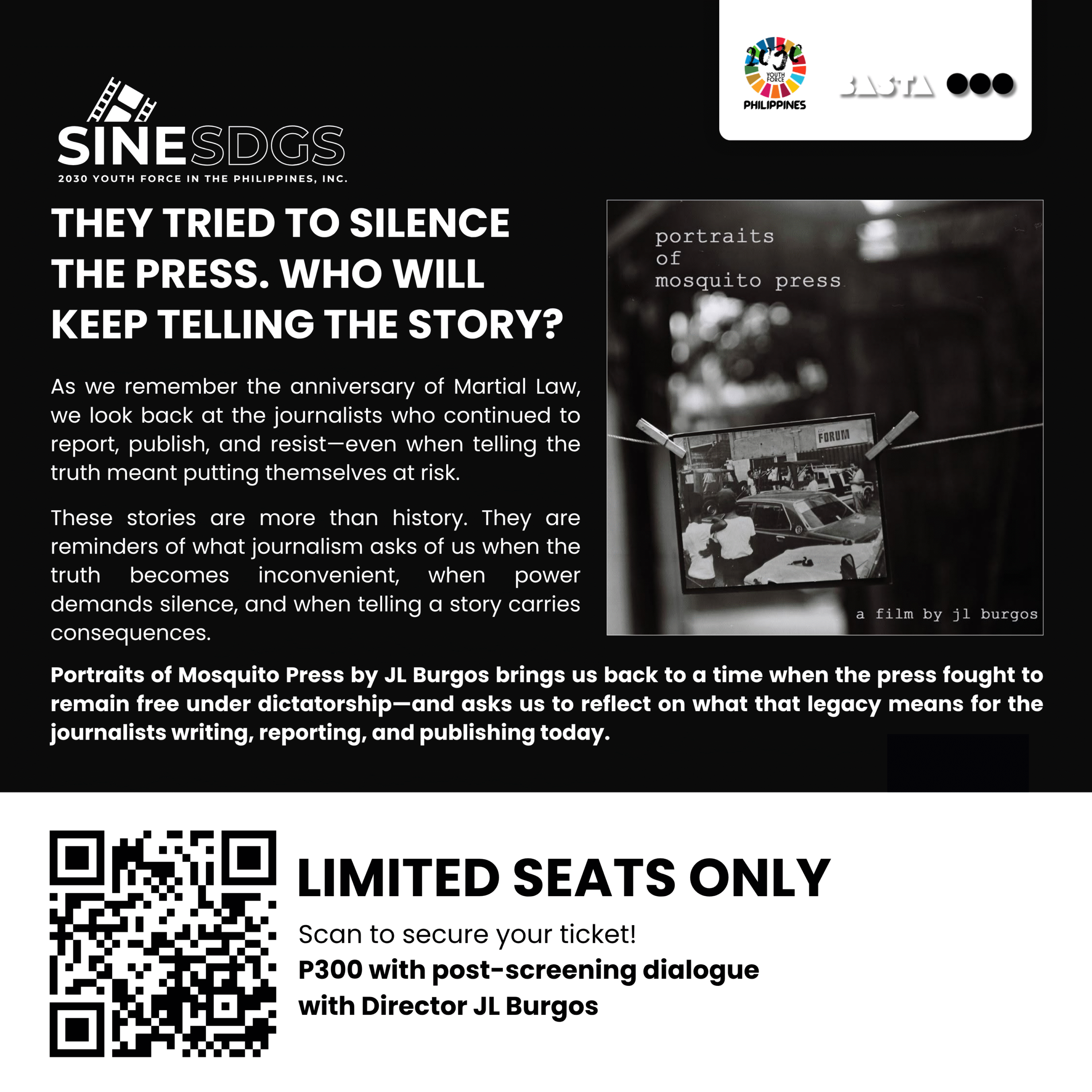
As we commemorate the 54th anniversary of the declaration of Martial Law this year, 2030 Youth Force in the Philippines Inc. is bringing this conversation to the screen through #SineSDGs, our youth-led film screening initiative that uses cinema to connect stories with issues that matter to young people and communities.
With the screening of Portraits of Mosquito Press, a documentary by JL Burgos that revisits the history and struggles of the alternative press during the Marcos dictatorship. The film draws from the experiences of Jose “Joe” Burgos Jr., his family, and the college editors who helped build an alternative newspaper while facing harassment, arrest, and raids.
For us, the film is not only an opportunity to remember a difficult chapter in Philippine history. It is an opportunity to pause and ask what that history means in the present.
What does press freedom look like when news can come from a TikTok video as easily as a newspaper?
What happens when misinformation can reach thousands before a journalist has the chance to verify the facts?
What responsibility comes with having the power to publish?
And perhaps most importantly: What stories will we choose to keep alive?
These are conversations we hope to open with young people, especially student journalists and aspiring storytellers who are growing up in an information landscape vastly different from the one the Mosquito Press navigated.
The tools may have changed. The platforms may have changed. But the responsibility to seek truth, tell stories with care, and protect the public’s right to information remains.
This is what #SineSDGs hopes to create: not simply a movie screening, but a space to watch, reflect, question, and talk about what stories mean for the world we are building today.
Join us for #SineSDGs: Portraits of Mosquito Press on September 25 at 7 PM at Basta Cafe, Quezon City, followed by a post-screening dialogue with Director JL Burgos.
Tickets are ₱300, with limited slots available. A portion of the proceeds will support youth-led activities of 2030 Youth Force in the Philippines.
Because sometimes, remembering the past is not about staying there.
KioskNews shows a cleaned-up reading view extracted from the publisher’s page — the original always lives on their site, not ours.