[Column] The market rejected Trump's pressure tactics
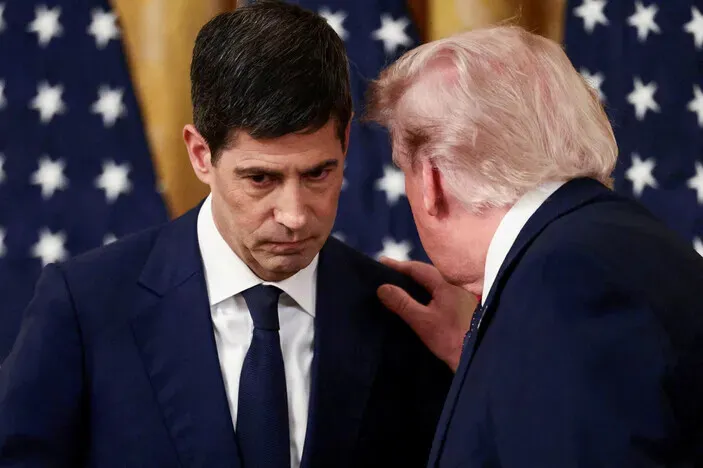
US President Donald Trump speaks to Fed Chair Kevin Warsh at an event at the White House in May 2026. (Reuters/Yonhap)

Lee
By Lee Bong-hyun, director of the Hankyoreh Economy and Society Research Institute
The US Federal Reserve has raised its benchmark interest rate. President Donald Trump tried — and failed — to block the hike, which is clearly a negative factor for the midterm elections just six weeks away. While the Fed appears to have withstood political pressure, the move was more about playing catch-up with market rates raised earlier.
The hike came after the 10-year Treasury yield surged past 5% to hit a 19-year high. Had the Fed frozen the rates, the market would have questioned its autonomy and commitment to combat inflation, and the price for that would have been an even steeper rise in the rates.
Over the past three decades or so, interest rate decisions by central banks have been an area where economic theory and market mechanisms function most rationally. Such authorities set such rates while communicating with financial markets on things like inflation, growth and employment, consistently maintaining the appearance that rate decisions are independent of politics.
But in an era where the norms of hegemony are crumbling, narrow-minded leadership is violently rattling economics, a field clinging to the guardrail of rationality. Ahead of monetary policy meetings, Trump has pressured the Fed not just to freeze interest rates but cut them, yet his logic amounts to nothing more than a barrage of free-for-all trumpery.
“Because the US economy is so strong, regardless of whatever formula they use, we should have the lowest interest rates in the world,” he said. In essence, he reduced monetary policy, which impacts the national economy with a time lag, to a matter of an individual or company trying to get a loan from a bank.
Nobel laureate economist and columnist Paul Krugman in July last year wrote in a Substack essay that “a hot economy is a reason to raise interest rates, not cut them.”
Not just Trump but Vice President JD Vance and House Speaker Mike Johnson have also made similar claims. The Trump camp’s persistence in making these false assertions since his first term offers a clue as to their intentions. A defining characteristic of the post-truth era is the blurring of the “truth value” of words.
In his 2005 book “On Bullshit,” the philosopher Harry G. Frankfurt said that while a liar possesses at least some awareness of truth and falsehood, “bullshit” is words haphazardly uttered to serve the speaker’s own ends regardless of accuracy. Trump’s calls for rate cuts can aptly be described as “economic bullshit.”
His reckless rhetoric extends beyond monetary policy. He now claims that this is the “greatest economy we’ve ever had by far best-ever” to justify loosening his administration’s purse strings and giving handouts.
He promises that if the Republican Party retains its majorities in both the House and Senate in the midterm elections, he will distribute a “Trump dividend” of US$5,000 per adult, funded by tariff revenue. Not only is securing the US$1.2 trillion needed for this pledge out of the question, but monetary easing and massive fiscal stimulus combined could cause inflation to spiral out of control.
On tariffs, Trump repeatedly claims that American consumers bear no costs and that China pays “billions of dollars” in such levies to the US. But the burden is largely passed on to Americans. In February, the Federal Reserve Bank of New York released a report saying 94% of such costs were borne by US companies and consumers in the first eight months of Trump’s second term.
Earlier this month, Trump on his social media platform Truth Social wrote, “Lower the rate, or I’ll stop trading with countries with which we have a deficit.” Of course, he offered no explanation on how he linked monetary policy with trade deficits. This view stems from his consideration of trade as a zero-sum game while ignoring how a country’s trade deficit and capital account surplus are two sides of the same coin.
Trump is not the only leader who has used his power to try to suppress economic principles. Turkish President Recep Tayyip Erdoğan, based on a fringe theory that raising interest rates drives up prices, pressured his central bank to lower rates, only to see inflation skyrocket past 85% annually. Unable to sustain this, he raised the benchmark interest rate in September 2023 to 30%, a 20-year high. Though he later changed course, it was only after the Turkish public paid a heavy price.
When neoliberalism dominated the globe, economics reigned as the king of all disciplines. The Washington Consensus, a set of 10 pro-market policy prescriptions to help emerging economies see economic growth and macroeconomic stability, devised a formula of fiscal discipline, free trade and deregulation for governments worldwide. Countries learned through experience that defying this prescription invited retribution from markets, sovereign bond yields, and credit rating agencies. This way, economics acted like the laws of physics.
The most powerful person in the US is now single-handedly destroying that intricately woven theoretical and practical framework. The system is holding up for now as the Fed and the bond market have responded to Trump’s economic bullshit with market pricing, not arguments.
Not even Fed Chairman Kevin Warsh, who was appointed by Trump, could defy the bond market. Yet the unconventional tactic of the wooden horse was what brought down the walls of Troy. When economics ultimately falls to an onslaught of preposterous claims, people might find themselves reminiscing about how things were better back when at least uncomfortable explanations (or theories) were around.
KioskNews shows a cleaned-up reading view extracted from the publisher’s page — the original always lives on their site, not ours.