Chris Selley: A European alliance deserves more seriousness than Carney’s treated it with
As a strategic communications exercise, the Liberal government’s pursuit of some kind of enhanced relationship with the European Union has officially reached the status of farce.
Sign In or Create an Account
First the Wall Street Journal reported over the weekend that Canada was seeking “associate membership in the EU.
Prime Minister Mark Carney quickly and unambiguously tamped that down on Sunday: “We’re not looking to become a member of the European Union,” he said.
Then, on Wednesday, EU President Ursula von der Leyden announced she was pleased to be talking about “associate membership.”

Columnist Jesse Kline keeps you up to date with what’s happening in Israel and the effects of antisemitism on life here in Canada. Friday mornings.
By signing up you consent to receive the above newsletter from Postmedia Network Inc.
A welcome email is on its way. If you don't see it, please check your junk folder.
The next issue of Channel Israel will soon be in your inbox.
We encountered an issue signing you up. Please try again
Then, the Journal, citing a “senior Canadian government official,” reported Wednesday that it was Canada who hatched the “associate membership” idea, and had to convince von der Leyden and others to adopt it.
“We were the ones who proposed associate membership,” a senior Canadian official said. “Let’s bundle it together, let’s give it a name.”
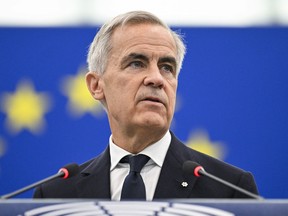
And in Carney’s Thursday speech to the European Parliament in Strasbourg, France, the prime minister fulsomely embraced the moniker he had disavowed just a couple of days before. “Yesterday, President von der Leyen spoke of … opening the door to Canada becoming the European Union’s first associate member. Canada welcomes this ambition,” he said.
The general idea in play here is remarkably popular. This month, 49 per cent of Canadians told pollster Abacus Data they support Canada becoming a full-on “member state of the European Union,” with only 30 per cent opposed. Asked about “deepening strategic cooperation” or “closer integration” with the EU, fully 80 per cent of poll respondents said they were on board.
So, I have no idea why the Liberals seem determined to play silly buggers instead of speaking plain English. It seems like it could only make people more dubious. Maybe the Red Team just knows no other way. (Carney did at least confirm any deal would be brought before Parliament for a vote, which is at least something — even if it’s the bare minimum.)
Shambolic communications aside, Carney did put some meat on the bones of this idea in Strasbourg. Notably, he said he desired free movement of “youth” between Canada and the EU for the purposes of studying and work.
Canada has a similar agreement with Australia and the United Kingdom, among other countries — including EU members France and Germany. But it will be interesting to see what Canadians make of that idea. Many are leery about anything that sounds like easier entry for foreign students and workers. That went wrong very recently, to the point that Carney himself has spoken of having “taken back control of immigration.”
Beyond that, however, Carney mostly spoke of Canada and the EU as hugely high-functioning countries pursuing synergies. “Europe brings … market power, research depth, advanced manufacturing, the ability and the will to set standards that the world frequently adopts, (and) a defence-industrial base that’s being rebuilt at speed,” said Carney.
It got me more to thinking about the things Canada could and should learn from Europe, new alliance or not. The EU’s standards and regulations are famously numerous, but their commonality is certainly something to which Canadian jurisdictions should aspire. Estimates vary on how much such interprovincial barriers cost the Canadian economy, but however much it is, it’s 100 per cent too much.
Europe’s rapidly growing “defence-industrial base” is something Canada should be paying attention to for sure. Europe is facing a serious threat from Russia, of a sort that Canadians simply aren’t used to. Our unearned sense of security is part of the reason governments have been able to treat military procurement first and foremost as a political football.
Carney didn’t mention them, but health care and infrastructure spending are other areas where Canada should be paying close attention to the EU. No European country’s health-care system is perfect, and metrics vary significantly between countries, but many have far more resources and produce better health outcomes for less or the same expenditure. (Germany spends roughly what Canada does on health care, as a percentage of GDP. Germany has 39 ICU beds per 100,000 population, while Canada boasts 14.)
Needless to say, Europeans aren’t much bothered about “two-tier” systems so long as they get the care they need. Hint, hint.
Meanwhile, it’s universally acknowledged that Canada (and the United States) spend vastly more on infrastructure — railways, roads, bridges, everything else — than most of our European peers do. The reasons are complex, but not unknowable. We just don’t want to know them. Europe does.
National Post
cselley@postmedia.com
Join the Conversation
This website uses cookies to personalize your content (including ads), and allows us to analyze our traffic. Read more about cookies here. By continuing to use our site, you agree to our Terms of Use and Privacy Policy.
KioskNews shows a cleaned-up reading view extracted from the publisher’s page — the original always lives on their site, not ours.