10 years after Leonard Cohen’s death, his songs grappling with faith live on
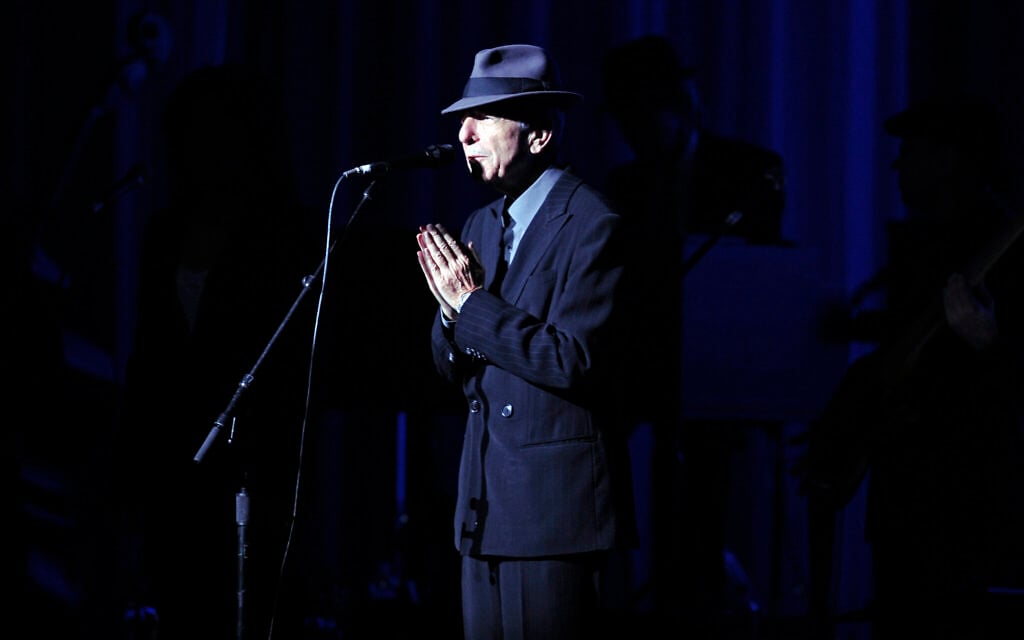
THE CONVERSATION via Reuters — Right now, Leonard Cohen is on many of his fans’ minds.
The Canadian poet, novelist and singer-songwriter died Nov. 7, 2016, just one day before US President Donald Trump was first elected.
Ten years later, as the Democrat “blue wave” hopes to close the bracket on a president who once memed himself as Jesus personified, Cohen’s legacy has become effortlessly epic — even biblical — in quite a different way.
0:00 / 0:00
Promoted: American Technion Society

Tribute gatherings
Tribute gatherings for the singer abound. Cohen was the subject of a sold-out event at the Toronto International Festival of Authors at the end of October.
Adam Cohen’s family tour, which began in Canada this month and reaches Europe in winter 2027, pairs his father’s music with archival photos and film.
Get The Times of Israel's Daily Edition by email and never miss our top stories
By signing up, you agree to the terms
Ottawa’s Gladstone Theatre advertised their “Ten Years Gone” commemoration with a question quite suggestive to people like me who study the evolution of sacred texts: “What would Cohen say today?”

Cohen’s ‘contemporary psalms’
As an answer, I highlight an under-celebrated part of Cohen’s poetry and song. As I detail in my 2023 book “Prophets of Love: The Unlikely Kinship of Leonard Cohen and the Apostle Paul,” all of Cohen’s work is infused with biblical allusions. But some of Cohen’s work does more than echo biblical themes.
It takes on biblical format, in the tradition of poetic prayer known in Hebrew as tehillim. Tehillim, or Psalms, inform the Jewish liturgical tradition of addressing God directly, not only in praise, but also in lament, desperation and challenge.
This is most explicit in what publisher McClelland and Stewart called Cohen’s “contemporary psalms” in his “Book of Mercy.” In 1984, as Cohen turned 50, his life provided the material for the 50 psalms of lament, complaint, joy, doubt, adoration and desperation that made up this poetry collection.
Like the biblical Psalms, these short poems are numbered rather than titled. Cohen described the collection as “meant for people like myself who could use it, at a particular time,” as “a book of prayer.” Many interpreters continue to analyze this collection as Tehillim.
Writing liturgy
Although modest about himself in public, Cohen never lacked ambition for his poetry. Rabbi Mordecai Finley, who has read Cohen’s poems aloud for High Holy Days, recalls Cohen confiding that he felt he was always writing not just poetry, but liturgy.
Cohen’s song “If It Be Your Will” echoes the Friday evening prayer service welcoming Shabbat, and “Who By Fire” is a nearly word-for-word arrangement of the High Holiday prayer, the “Unetaneh Tokef.”
Cohen’s “Anthem,” with its famous line “that’s how the light gets in,” inspires ponderings from both Christians and Jews.
And “Hallelujah,” — a biblical term heard in church services — is a star example of a Cohen song as religious anthem, despite its references to surprisingly carnal biblical texts.
I believe Cohen’s grappling with the divine, whether overt, or nestled within his sensual poetry, might prove to be his most enduring memorial.
Multiple traditions and levels
Cohen biographer and author Harry Freedman reports that Cohen studied in India, referenced the Kabbalah frequently and knew the lore of the Christian Desert Mothers and Fathers.
Both Kabbalah and early Christian ascetics blur the boundaries between the erotic and the divine.
Cohen’s way of addressing the sensual and the spiritual simultaneously allows the same song to reach different people — or reach the same person at different times.

He could also speak from multiple traditions. Cohen was an ordained Rinzai Zen monk, the grandson of a famous rabbi and Talmud scholar. As an impressionable child he went to mass with his Irish nanny in Montreal, a city of churches.
In “I’m Your Man,” music journalist Sylvie Simmons chronicles how Cohen was a deeply knowledgeable Jew who moved comfortably between the Torah, Talmud, Tao Te Ching, Sufi mysticism and the New Testament.
No religious tourist
Fewer Canadians remember the literary critic Northrop Frye than know Cohen. But the poet turned out to be the perfect example of the professor’s point: the educated imagination lives and breathes the vocabulary of the sacred. Cohen was no religious tourist.
Rather, the singer “spoke multiple religions” fluently, always from his Jewish roots.
At this 10th yahrzeit of his passing, it’s worth considering to whom (besides his audiences) he addressed his final performances. In “Traveling Light,” from “You Want it Darker,” he sang:
“But if the road leads back to you, Must I forget the things I knew… Traveling light, like we used to do.”
Grappling with God
Like the ultimate Psalmist, King David, dethroned and on the run, Cohen was at a low point in his career when he wrote Book of Mercy.
In those dark days of seeming failure, before Jennifer Warnes’s Famous Blue Raincoat revived his career, “Book of Mercy” was the middle-aged Jewish poet’s attempt to leave at least something of permanence: “We talk in this manner, we sing the time-honored songs, and we compose new ones, as we were commanded,” he wrote in “25.”
Yet, for me, it is Cohen’s final albums 20 and 30 years later, as his life neared its end, that most resemble the Psalms in how they grapple with God.
Psalms for every human experience
Through the years, Cohen addressed God right before our eyes in the person of a lover. At the end of his life, he boldly exposed the relationship that had been there all along — perhaps most notably in the song “You Want it Darker.” Here, he addressed God as “My lord,” incorporated elements of the Jewish mourners’ prayer and adapted Rosh Hashanah liturgy.
Was Cohen writing and adapting Kaddish for his own impending death? I believe so, although in true Cohen fashion his words also mourn humanity overall, and challenge the divine.
As I wrote in “Prophets of Love,” for Leonard as “Cohen” (Hebrew for priest), existential longing and divine connection are inseparably linked at the base of the human condition.
So, 10 years later, even if you are already a devotee, have a listen again. Pay special attention to how Cohen challenges, pleads with, chastises and even woos the divine.
If you are not yet a fan, buy one of the iconic Canadian’s final albums, when he could feel death waiting at the door. You may find that, just as for many faithful opening the ancient psalms, there’s material in Cohen’s contemporary psalms for every human experience, including yours.
Matthew Robert Anderson is an adjunct professor in the Department of Theological Studies at Concordia University. The Conversation is a collaboration between academics and journalists that publishes stories on science, health, politics, environment and more.
KioskNews shows a cleaned-up reading view extracted from the publisher’s page — the original always lives on their site, not ours.