Who is to blame for Hong Kong's deadly 2025 fire?

Make this your preferred source to get more updates from this publisher on Google.
HONG KONG — An independent Hong Kong committee blamed a renovation contractor and consultant as well as four government departments for a deadly blaze that killed 168 people in the city last November, according to its report released to the public on Thursday.
The more than 1,000-page report by the judge-led panel detailed a series of regulatory and supervisory failings in Hong Kong's building renovation and regulatory system that it said had contributed to the rapid spread of the fire.
Key findings
Prestige Construction & Engineering Co. Ltd, the main contractor for the works, and Will Power Architects Co, the consultant for the works, were fully aware of the fire risks and ignored all complaints raised by residents.
Prestige failed to maintain proper oversight at every level and cut corners. It also did not effectively enforce anti-smoking policies on site, despite persistent complaints.
Prestige refused to conduct works in phases as requested by the management committee, resulting in all eight blocks being simultaneously enclosed in combustible scaffolding and materials, which contributed to the rapid spread of the fire.
Will Power, as project consultant, failed to provide proper independent supervision of Prestige and did not intervene in key safety issues.
Will Power approved the use of flammable foam boards and non-fire-retardant scaffolding nets, despite knowing the fire risks and initially expressing concern.
Will Power failed to act as an independent supervisor, instead enabling or acquiescing to Prestige's cost-cutting and unsafe practices, betraying the trust placed in it by homeowners.
'Likely a cigarette'
The fire was most likely started by a "glowing source...likely a cigarette."
No government department took effective ownership of various fire safety issues, and complaints about fire hazards "fell into a vacuum."
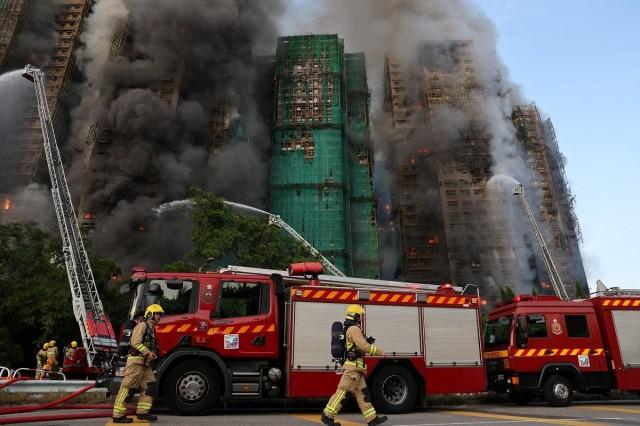
Firefighters work as efforts are underway to extinguish flames engulfing bamboo scaffolding across multiple buildings at the Wang Fuk Court housing estate in Tai Po, Hong Kong, China, November 26, 2025. REUTERS/ Tyrone Siu
Multiple government departments failed to properly investigate persistent and well-documented resident complaints about fire hazards, smoking, unsafe materials and procedural irregularities.
The way in which the Labour Department handled complaints outlining serious safety concerns—such as smoking on site, and about fire retardancy of scaffolding nets and foam boards—was unsatisfactory.
Government failures
Hong Kong's Independent Checking Unit (ICU) failed in its supervisory responsibilities to ensure safety. The ICU's systemic regulatory failures and operational lapses were major contributors to the unsafe conditions that led to the fire.
There was inadequate regulation and verification of temporary building materials (e.g., scaffolding nets, foam boards, plastic sheeting), with authorities relying on paper certificates without laboratory testing or on-site sampling, enabling the use of non-fire-retardant materials.
There was a lack of effective communication and coordination among government departments, leading to complaints and fire safety issues being passed between departments without resolution, creating regulatory vacuums.
The disaster involved not just violations of safety rules but also long-standing flaws in the regulatory regimes and slack enforcement attitude.
Various unlawful and dubious practices in the large-scale building and renovation industry are acknowledged, including bid-rigging. "Some of them have triad affiliations ... The committee is of the view that such a corrupt eco-system is intolerable."
The Competition Commission (CC) and Independent Commission Against Corruption (ICAC) both found that bid rigging is a widespread, systemic, and long-standing practice among building maintenance contractors in Hong Kong.
Investigations revealed that some bid-rigging operations are orchestrated by syndicates, often with triad involvement, who coordinate which contractors will win certain tenders through cover bidding, bid suppression or bid rotation. — Reuters
KioskNews shows a cleaned-up reading view extracted from the publisher’s page — the original always lives on their site, not ours.