New Zealand election result unclear
WHAT NEXT? With no clear majority, New Zealand faces a long wait until Nov. 27, when the final votes are to be announced to find out who would lead the next government
New Zealand faced the prospect yesterday of weeks or even months of political wrangling after a knife-edge election that produced no clear winner.
New Zealand Prime Minister Christopher Luxon declared his right-wing coalition had a mandate to form the country’s next government — while conceding results remained too close to call definitively.
Preliminary results have his National Party winning the most seats, giving them a very slim majority of just two if combined with their coalition partners, the populist NZ First and the libertarian ACT.
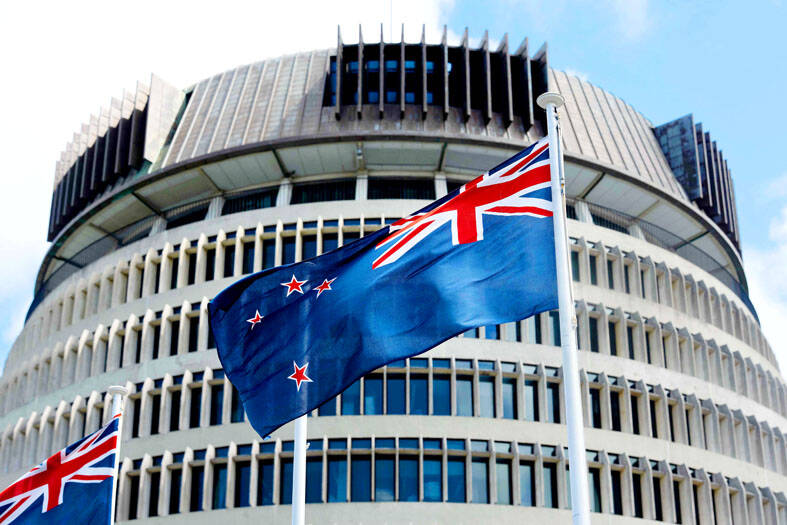
The New Zealand flag flutters in front of the parliament building in Wellington yesterday.
Photo: AFP
“New Zealanders have given us the biggest seats in parliament, 42 seats as it stands today, and a pathway to form a government,” Luxon said yesterday, adding that “there’s no doubt about it. We’ve got a mandate.”
He said his National Party had done well given the war in the Middle East and subsequent global fuel shock that has been widely blamed for New Zealand’s economic difficulties.
Opposition Labour Party leader Chris Hipkins has joked that while the country had spoken, “it may take us a little bit longer to figure out exactly what it is that you’ve said.”
However, the results show he has only a very narrow path to power for his left-wing grouping, which also includes the Green Party and Te Pati Maori, representing the interests of New Zealand’s indigenous community.
Luxon would run a caretaker government until the final votes are announced on Nov. 27.
“I think everyone’s over politics, so let’s all just have a bit of a break for the next three weeks,” he said.
That final tally would include nearly 400,000 so-called “special votes” — among them about 100,000 votes cast overseas and by people within New Zealand, but outside the local electorate in which they live.
Historically, special votes leaned left, potentially giving the Labour or Green parties an additional one or two seats at the expense of the right-bloc.
Last week’s knife-edge poll drew intense attention to the country’s minor parties, in particular the upstart centrist Opportunity Party.
Under the country’s mixed-member proportional representation system, voters must tick two options — a general party list as well as an individual member to represent their electorate.
Results put Opportunity winning seven seats, potentially giving the party a kingmaker role in the next government.
With 100 percent of the preliminary count done, Luxon’s National are on 42 projected seats and Labour on 36, the electoral commission said.
The Green Party is in third place with 16 seats, while ACT are on 13 and NZ First have 12. Te Pati Maori have five.
Luxon said yesterday that while it was “unlikely” he would need Opportunity Party to form a government, he was willing to work with leader Qiulae Wong on issues on which they agree.
“We can work with our current coalition partners to form the government,” he said. “What I’ve also said, though, is that there is a need for us to go forward in cross-party collaboration in a lot deeper way.”
Many Kiwis are struggling to make ends meet — the price of basic goods remains stubbornly elevated, and unemployment at its highest in more than a decade.
KioskNews shows a cleaned-up reading view extracted from the publisher’s page — the original always lives on their site, not ours.