Taiwan looks to autonomous swarms to counter Beijing’s grey-zone pressure
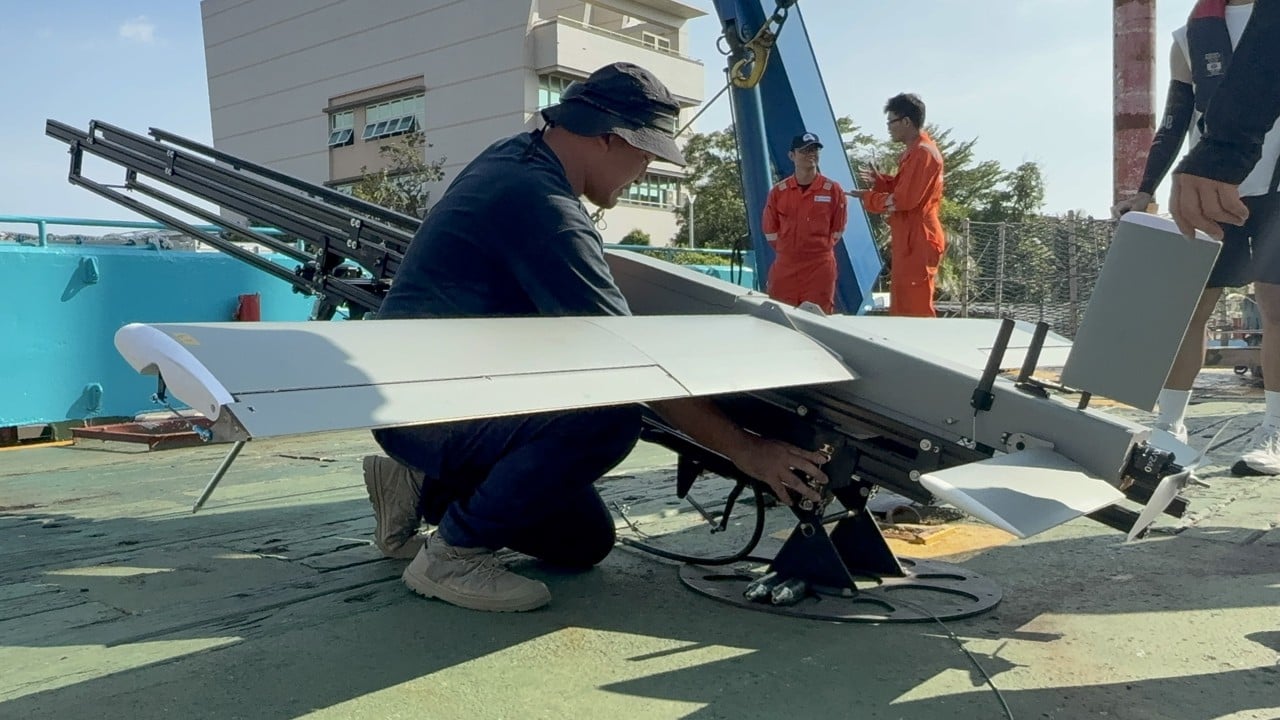
Taiwan is developing an AI-powered system to coordinate drone fleets for maritime surveillance and countering “grey-zone” activities, with researchers completing a simulation involving 20 aircraft, according to the island’s Ocean Affairs Council.
The system, which is funded by the council, would allow different types of drones to autonomously divide tasks, plan routes and coordinate their movements while providing wide-area, persistent surveillance for coastguard operations.
The council said on Monday that a research team led by Taiwan’s National Cheng Kung University had completed simultaneous flight simulations involving two fleets comprising 20 drones, marking a shift from controlling individual aircraft to coordinating multiple groups.
PLA kicks off military exercises around Taiwan
The early-stage project focuses on three US-made vertical take-off and landing (VTOL) fixed-wing drones – the JUMP 20, V-BAT and Flexrotor – and integrates artificial intelligence (AI), flight dynamics and swarm-control technologies.
Researchers are using AI-based multi-agent reinforcement learning to enable the aircraft to autonomously allocate missions, plan routes and coordinate with each other.
The project also incorporates leader-follower formation control and dynamic obstacle avoidance, allowing the drones to adjust routes in response to changing missions, conditions and obstacles.
To prevent collisions in the simulation, the researchers programmed three-dimensional separation and a minimum vertical distance of 30 metres (100 feet) between aircraft into the control algorithms.
“The next stage will involve hardware-in-the-loop testing, prototype integration and flight trials over actual maritime areas to assess reliability under different sea and weather conditions,” the council said.
It said strengthening “maritime domain awareness” and developing integrated aerial and maritime coastguard operations were central to growing law-enforcement needs.
Uncrewed aircraft could provide “multi-drone coordination, wide-area coverage and persistent surveillance” and be additional “eyes in the sky” for coastguard personnel amid “various forms of grey-zone harassment” from Beijing, it said.
Beijing regards Taiwan as part of China to be reunited by force if necessary. Most countries, including the United States, do not recognise Taiwan as an independent state, but Washington is opposed to any attempt to take the self-ruled island by force and is committed to supplying it with weapons.
The research was announced as Taiwan’s coastguard expands both its uncrewed aircraft fleet and the number of personnel trained to operate such systems.
The V-BAT, a tail-sitter VTOL drone developed by US defence technology company Shield AI that can operate in confined spaces, is among the more advanced platforms being introduced.
Its ducted-fan design allows it to take off from a relatively small area on a ship before transitioning to horizontal flight, while its endurance of more than 12 hours allows prolonged maritime surveillance.
The first V-BAT delivered to Taiwan, which has been designated primarily for training, was publicly unveiled two weeks ago by Ocean Affairs Council Minister Kuan Bi-ling.
Taiwan’s Coast Guard Administration (CGA) has budgeted NT$1.2 billion (US$39 million) to acquire 12 V-BATs and six command-and-control systems, with the remainder of deliveries expected in the coming months.
Kuan said the introduction of sophisticated equipment must be accompanied by improvements in personnel skills and training, stressing that effective use of the technology was ultimately what mattered.
In July, the CGA took delivery of 45 multirotor training drones to distribute among coastguard units as part of a programme to familiarise frontline personnel with drone operation and eventually give officers basic operating skills, according to the administration.
02:55
Taiwan concludes annual war games, including preparing for PLA sea blockade
The broader programme is part of an Ocean Affairs Council initiative to develop what it calls an integrated “sea-air” coastguard, combining uncrewed platforms with upgraded intelligence, surveillance and reconnaissance systems.
The council said recent conflicts in Ukraine and the Middle East had shown how uncrewed aircraft were evolving from individually operated platforms towards coordinated fleets of different drone types.
For Taiwan’s coastguard, the shift could extend surveillance beyond the reach of ships and coastal sensors while allowing drones with varying capabilities to work together across a much wider area.
KioskNews shows a cleaned-up reading view extracted from the publisher’s page — the original always lives on their site, not ours.