60 Minutes Transcript: Artificial intelligence and the future of work
This past week in Washington, America's tech titans met with President Trump to talk about, well, the future of humanity … specifically, will AI, artificial intelligence, mark the end of civilization as we know it? Only slightly less grave and only slightly less depressing, there's a related, more immediate question: Will AI take our jobs?
Real Jon walks out:
That right there? Not me … That was AI. So it is, we don't exempt ourselves in wondering: is any line of work safe? So far this year, U.S. companies have cited AI as the No. 1 reason for layoffs. AI, after all, doesn't sleep, or take sick days. Is this technology simply going to transform how and where we work, much the same way other workplace revolutions did? Or is this one different? Is the great job apocalypse upon us?
Tape:
Here in this nondescript office in downtown San Francisco, these 20-somethings are designing the future of your workplace.
You may not have heard of Mercor, but it's quickly become a leader in a booming new industry built around supercharging the already supercharged rise of artificial intelligence.
BRENDAN FOODY: We were, in January last year, about 20 people.
JON WERTHEIM: How many now?
BRENDAN FOODY: Now it's 400 people in San Francisco, yeah.
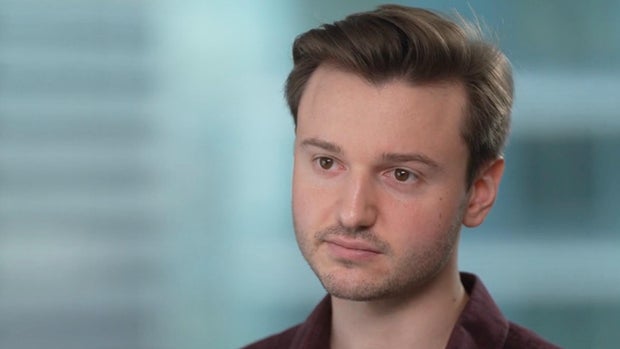
Brendan Foody is Mercor's CEO. It's now a multibillion-dollar company, and he's now a 23-year-old billionaire. Backstory: four years ago, ChatGPT came out and Foody and his two co-founders — high school buddies — saw where the technology was heading. To get better, AI needed more information than what was widely available on the internet.
JON WERTHEIM: AI went from this high-powered search engine to all of a sudden we're in astrophysics. We've gone from cutesy to holy moly in a very short amount of time.
BRENDAN FOODY: I think that's spot on. And the core thing powering that huge transformation and the capabilities is human intelligence.
JON WERTHEIM: It seems like overarching goal, anything we humans can do, we want AI to be able to do.
BRENDAN FOODY: I think a significant portion of things. Everything that humans want AI to be able to do — we wanna teach it how to do that.
So what does Mercor do? Well, when the big AI companies want, say, ChatGPT or Claude to improve in a particular field, they hire Mercor to make their models smarter. Pick a subject, any subject: finance, architecture, poetry. Mercor has assembled an army of more than 100,000 freelancers — humans! — ready to use their hard-earned expertise to train the AI.
Shawna Miller: I work late in the evening …
We met three such experts: Shawna Miller, a winemaker; Robbie Hiser, a music producer; and Melania Poonacha, a physician.
JON WERTHEIM: When you're assigned a task, what are you actually doing? How are you training AI?
DR. MELANIA POONACHA: On one project we were training the AI to be able to accurately interpret laboratory results.
ROBBIE HISER: For a songwriting project, you might get two different versions of the same lyric. And then you go through and give feedback on it.
All three have full-time jobs. AI training is just a side gig. Long-term, by spending hours teaching a computer the tricks of their trade, are they not training themselves out of a career? No, they insist. Hiser believes that great songwriting, for instance, will always require the human touch.
ROBBIE HISER: AI doesn't have any life experience to pull from you know, an AI never had a girlfriend break up with it.
JON WERTHEIM: Real-life inputs that impact songwriting in a way that–
ROBBIE HISER: Absolutely.
JON WERTHEIM: –the robots– yeah–
JON WERTHEIM: There's no way to write that in?
ROBBIE HISER: I don't think so.
Ultimately, Brendan Foody foresees a utopia: advanced AI helping us cure cancer and tackle climate change. And the untold millions of workers? Liberated from the dullest parts of their jobs, they'll be more productive than ever.
JON WERTHEIM: People still have this fundamental question, is my job safe from AI? How do you answer that?
BRENDAN FOODY: I think the key thing to look at is if you become more productive, is there more demand for your expertise in the economy?
JON WERTHEIM: If you're training AI to do what people have spent years and years perfecting in their careers, aren't you necessarily endangering human work?
BRENDAN FOODY: Well, I think that you're changing human work. It might not necessarily be that repetitive task that people have done in the past, but there's still so many other things that people could be able to do. And so I think that evolution is natural.
Whether workers asked for it or not, that evolution is already happening, and not just in the tech hotbeds.
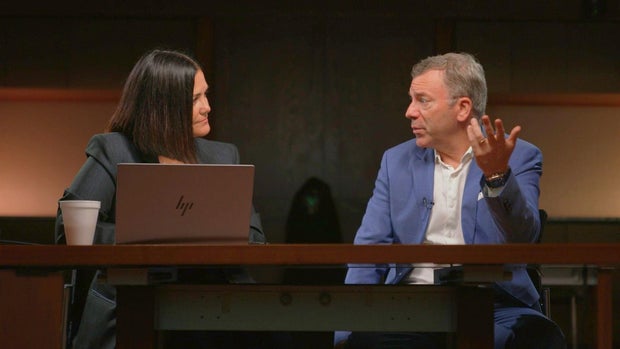
In places like, Columbus, Ohio, where the law firm Vorys, Sater, Seymour and Pease has been serving clients' needs since 1909, Kim Herlihy, a trial lawyer, is a partner at the firm.
JON WERTHEIM: You're going into courtrooms and facing a judge and jury. How is AI gonna help with that?
KIM HERLIHY: AI is never gonna walk into the courtroom and give an opening statement to the jury. But it helps us have additional tools to use as we prepare that opening statement.
A year ago, Vorys worked with Stanford University to build an internal tool for the firm: individual AI personas trained on its senior lawyers. How do they think? What kind of advice do they give? Presto: an AI version of a Vorys partner. Herlihy has her own, which she consulted for us.
KIM HERLIHY: So, what you have on your screen here is a draft opening statement.
JON WERTHEIM: This is. "Ladies and gentlemen of the jury."
Now Herlihy asks her AI double to give notes.
KIM HERLIHY: can see it's an AI comment from my persona, is saying, "The legal phrasing is too stiff for an opening statement."
JON WERTHEIM: I'm just struck that people who aren't familiar with AI, they might think, you know, it's robots, and avatars, it's just a Word doc.
KIM HERLIHY: Yeah, it is. You're not seeing a picture of me, I'm not talking out loud.
Not yet anyway. Still, we wondered: Is today's worker optimizer not tomorrow's worker replacement?
JON WERTHEIM: So we built this model with partner Kim Herlihy's expertise baked into it. It's not hard to see a future in which the client just goes right to the model, is it?
KIM HERLIHY: That's hard for me to see. AI cannot take the place of what's a fundamentally human business. You call your lawyer because you want to look in their eye and say, "What should I do about this issue?"
This sunny picture, it's at odds with the bleak labor predictions many AI executives have been issuing.
It's early and overall unemployment remains generally steady, but mounting research shows that, for the most AI-exposed jobs — take software developers — hiring has slowed and wages have declined. The impact focused on one group in particular: 20-somethings.
CLARA SHIH: Traditionally, the tasks that you might assign to a young person, maybe doing some market research or creating the first draft of a memo. AI is just really good at doing those now.
Until January, Clara Shih was overseeing major AI divisions at Salesforce and then Meta.
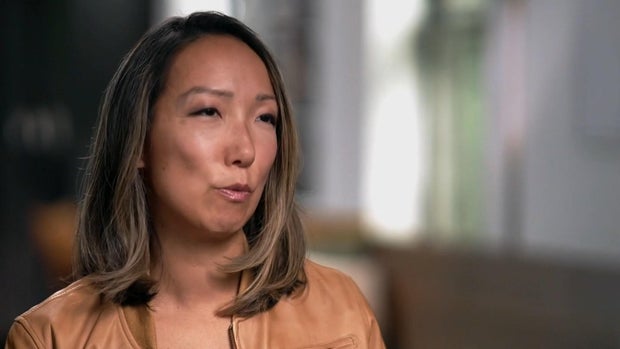
JON WERTHEIM: You've seen how powerful this can be.
CLARA SHIH: Oh yeah. I've seen us go from previously requiring dozens of people to conceive of a product, prototype it, build it, to now being able to do that with one or two or three people using AI agents.
Shih was so alarmed by what this meant for the workforce, she quit her plum tech job and founded a nonprofit helping young people navigate this new economy — and she has emerged as an AI Cassandra.
CLARA SHIH: I think AI's gonna have a profound impact on every profession. There are a lot of people whose jobs it is today within companies to prepare information, research, analyze data for other individuals in that company. And increasingly, although it's starting with the entry level, it could result in a lot of people losing their jobs.
JON WERTHEIM: And job loss means what as you see it?
CLARA SHIH: It's never just about the jobs. It's people's sense of self-worth. It's the fracturing of communities.
Shih knows this cycle firsthand. Her family came to the U.S. from Hong Kong in the 1980s and landed in Ohio, where globalization was hollowing out — factories, then neighborhoods. She sees clear parallels.
CLARA SHIH: I think what we can learn is that first we have to be honest with people about what the risks are. I think, you know, sugarcoating that this AI utopia, maybe we'll get there, but there's a lot of hurt that could happen between now and there.
The public is beginning to revolt. Nearly three-fourths of Americans now fear AI is coming for our jobs and amid this growing backlash, the big tech firms have been massaging their message. Here's OpenAI's Sam Altman in June:
Sam Altman: But I think our industry underestimated how much we're going to be able to keep people at the center of everything in an economy that is and a world that is based on people.
JON WERTHEIM: For a time, the AI companies were trumpeting that this product is gonna make work obsolete. And now there seems to be a pivot and a change of tune. What do you make of this shift?
CLARA SHIH: I think that they ha– the AI labs have every incentive to sell what they're doing to the public now, and I don't think that they actually believe that AI won't hurt jobs.
Back at Mercor, typical trainers can be paid anywhere from $20 to $200 an hour. Not bad. We spoke with more than a dozen Mercor trainers — past and current. Some were happy. Many more said that the gig work comes unpredictably, or not at all. No substitute for a full-time job with benefits.
JON WERTHEIM: I mean sometimes you have experts that are twice and three times your age, and they've spent a lot of time in their field, and one thing they've gotten is a level of predictability and stability in their job. And then it seems like the hours are much more erratic here.
BRENDAN FOODY: Yeah, the hours are more erratic. But it's also something that we're very transparent with them about.
JON WERTHEIM: I mean, it does not sound like stable work.
BRENDAN FOODY: Right now, it generally is more part-time work is what experts sign up for. But for the high-performing experts, we always make sure that they have work available.
Today, AI training is America's fourth-fastest-growing job category on LinkedIn. And just as machinists once replaced artisans, Brendan Foody insists he's creating a career of the future. Out of work? Fear not. Come train AI.
BRENDAN FOODY: Literally, all of the top 20 economists in America, they would say the exact same thing, which is that there's gonna be more jobs in 10 years than there are today.
JON WERTHEIM: You're a top economist in America. What say you?
DARON ACEMOGLU: No. No, not on our current trajectory. I don't see how that could happen. What we are living through with AI is unprecedented. The first phase of the Industrial Revolution lasted for 80 years. Today, it's taking place in one or two years, and it's taking place across many sectors at the same time.
Daron Acemoglu, is a Nobel Prize-winning professor at MIT, who studies technology's impact on labor.
JON WERTHEIM: We were told by a lawyer and also a music producer there are some things that humans– that are so fundamental, humans do them, robots can't. Do you buy that?
DARON ACEMOGLU: Today, absolutely. 100%.
JON WERTHEIM: You said today?
DARON ACEMOGLU: Today. In 15 years' time, what it's going to be capable of doing, I don't know.
JON WERTHEIM: But there's gonna be this huge sector of work training these AI models. So if you're a law student, you have a hard time finding a job, you can still use your expertise.
DARON ACEMOGLU: Here is one thing I'm not uncertain about. What you just described is B.S.
JON WERTHEIM: Why do you say that?
DARON ACEMOGLU: Because the number of people they're employing in these positions is small relative to the number of people who will be replaced. I mean, that's the whole point of automation.
Acemoglu says we could see unemployment triple in the next decade if we do nothing and continue on our current course.
DARRON ACEMOGLU: I am very, very, very cautious in saying we should say no to technology. Absolutely not. But in every technological revolution there is pushback, and that pushback takes many different forms.
He comes with suggestions: designing AI that makes humans better, not expendable, a tax code that incentivizes hiring real people. But the window is closing. And Acemoglu fears for the stability of society itself.
JON WERTHEIM: That shouldn't scare the hell out of us?
DARON ACEMOGLU: It should. And it should move us into thinking about what we can do because there is a lot we can do. Because the future is so uncertain, because the future is so much subject to our choice and agency, it is all the more important that we have this discussion.
Produced by David M. Levine and Meghan Lisson. Associate producer, Mimi Lamarre. News associate, Eric Frank. Edited by Mike Levine.
KioskNews shows a cleaned-up reading view extracted from the publisher’s page — the original always lives on their site, not ours.