The AniNation animation festival marks its first decade of business at the Jerusalem Cinematheque

If, like me, you are of a certain vintage and you instinctively associate the word “animation” with such industry leaders as Disney or former cartoon trailblazer Hanna-Barbera of Tom and Jerry fame, a visit to this year’s AniNation animation festival, taking place at the Jerusalem Cinematheque between November 3-8, should help to flex your thinking on the filmic field in question.
Artistic director Shlomi Steiner Yosef, now in his fifth stint with the festival, has covered numerous stylistic, genre, cultural, thematic, and philosophical bases in a programmatic roll-out that caters to all kinds of tastes, leanings, and age groups. This year’s edition also closes the festival’s first decade of envelope-pushing entertaining endeavors. Not bad going for any cultural venture here, it must be said.
Steiner Yosef does not just have an educated overview of the wider global animation scene. He is in the thick of the creative action himself, as an independent artist, director, and animator who tends to dip into an eclectic range of disciplines in his work. His curatorial choices were duly fueled by his own overarching professional experience.
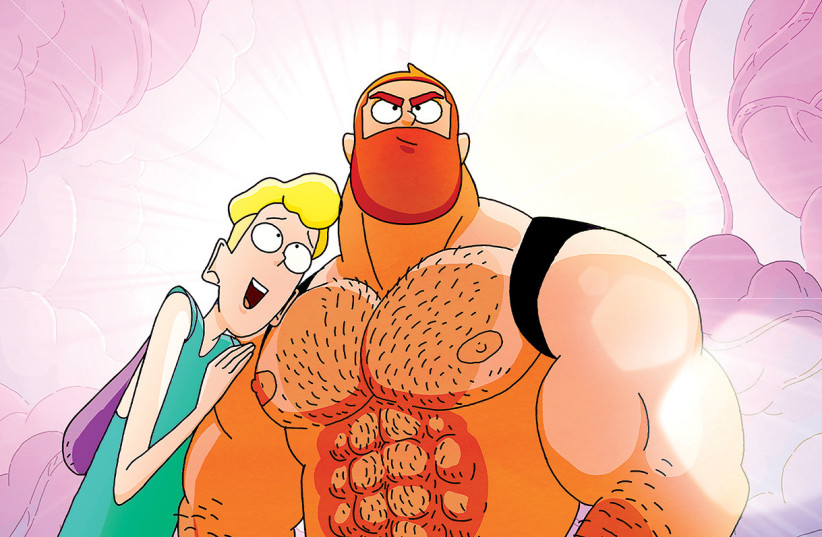
The six-day program is a very varied affair. There are choice items from all over the geographic and cultural landscape, including an intriguing satirical French work called Jim Queen, with the somewhat absurd yet thought-provoking storyline focusing on the outbreak of a virus in Paris that turns gay men into heterosexuals. And there is Peleliu: Guernica of Paradise, which is based on a Japanese manga series.
It is set in the dying days of World War II and raises deep questions about the value of life, morality, and how to physically and emotionally survive extreme violence. That, of course, references our own existential circumstances here and should leave viewers with plenty of food for thought. There is also a nod to the power of art and visual presentation.
“Comics are the art of imagining fictional stories,” observes a Japanese officer in the movie and, one may add, of reflecting real life.
Animation evolution
Animated cinematic material has come a long way since the days of Tom and Jerry and Donald Duck. The festival itinerary features several full-length efforts with intriguing, alluring, entertaining content. In addition to the aforementioned, there is something of a psychedelic film by Spanish director Alberto Vázquez called Decorado.
Imagine, if you will, a central character in the shape of an unemployed middle-aged mouse who surveys the world around him as an artificial theater set. Things go comically from bad to worse as he tries to make sense of the catastrophes he encounters en route to finding his own truth. Not exactly Snow White and her seven little pals.
Interestingly, 41-year-old Steiner Yosef’s own pathway into the inner workings of the animation field was sparked by a perennially popular, perfectly delectable classic created long before he was even a twinkle in his parents’ eyes.
“The first animated film I saw was The Jungle Book, when I was nine,” he says, surprising me, and very pleasantly, I may add. That was a high-class introduction. The Walt Disney Productions creation came out in 1967, the last feature produced by Disney himself, and has proven its staying power over the years, despite being crafted using old-school technological means.
Notwithstanding the huge advances made in animation technology in the almost six decades since that iconic Disney movie, there are contemporary animators who opt, at least, to start with a manually fashioned substratum before bringing in the big technological guns. One such project is Letter to A Pig by Tal Kantor, which was a nominee for an Oscar in the Short Animated Film category in 2024.
If you are more than a little dismayed at the way technology is taking over good old human abilities, proffering neat shortcuts to results and nimbly leapfrogging the “bother” of having to actually put some manual and/or mental effort into the venture, you might find Kantor’s creative process encouraging and heartwarming.
The 30-something Jerusalem-born animator and filmmaker used basic paintbrushes and paper to create the baseline for the characters and scenes in the film that referenced the Holocaust, and shone an unforgiving light on our ability to express sympathy and empathy, and how we treat the world around us.
Steiner Yosef is more than happy to trumpet Kantor’s stellar showing, along with the efforts of his compatriot professional counterparts. And that despite the ludicrously petty support they get from the state.
“Each year, I am so proud of what we [in the Israeli animation community] manage to do, and what I am able to show in the AniNation program,” he beams. “It beggars belief that people continue to create such original and meticulous works here.”
Local industry strides
Things are moving along nicely, despite all the hurdles to be navigated.
“Not so many years ago there was no animation industry here; there weren’t all those [academic] departments that teach animation. Many members of the [animation] community are dead-set on promoting the field. The industry has to grapple with lots of difficulties,” he says.
Naturally, that includes the financial aspect, although Steiner Yosef isn’t taking that personally. “It’s the same for most areas of culture here,” he observes.
Regarding his own professional field, he says that is partly down to simple ignorance rather than any ill will, per se. “They [state powers that apportion aid] just don’t know how to relate to animation, including providing support for the festival. It’s not the same as cinema. Yes, animation is also shown on screens, but it is different, and requires a different approach.”
Things ain’t getting easier, either: “I recently attended a meeting with all the [cultural sector] unions at the Knesset when we learned about the budget cuts.” Cuts? There surely isn’t too much left to cut. “Whatever there was will now be reduced,” he notes with commensurate gravitas. “That’s part of it. The cultural pie is small in any case.”
Steiner Yosef and his fellow Israeli artists can only look on with envy at the helping hand their counterparts in other OECD countries get for their creative endeavors. “France, for example, has the CNC (National Centre for Cinema and the Moving Image). The state and, naturally, the public are totally behind it, and the citizens pay a culture tax and are happy to do so. That money is invested in culture, and helps to disseminate French culture around the world.”
Now there’s a thought. Perhaps making greater efforts to spread the Israeli artistic word abroad might pay dividends and make some difference to the way people elsewhere relate to us. In any case, the politicians don’t seem to be making much headway on that score, so why not give our artists a shot?
There is also a misconception about the financial outlay required to bring animated works to full fruition. One might have thought that, in the absence of actual human actors and with the largely technologically-assisted production and directorial process involved, putting a cartoon movie together is logistically a lot simpler and financially more user-friendly.
“Not at all,” Steiner Yosef enlightens me. “There are so many people involved. You only have to look at the length of the credits at the end of an animated film to see that.” I stand corrected.
Recognition from abroad
Happily, the word of Israeli animation is getting out and about beyond our shores and, amazingly in these politically charged times, there are a bunch of professionals flying in to lend some of their knowledge and expertise to the festival.
“There is a group of 14 coming over – 13 from LA and one from Spain,” Steiner Yosef advises. “They are coming to learn more about Israeli animation. They will also serve as jurors for the competition.” That references the shorts competition, with the entries screened on the first day of the program.
Members of the incoming contingent will also present master classes, including one by celebrated Canadian-American voice actress Tara Strong. “She is renowned for her voice work in animation, websites, and video games,” says Steiner Yosef. Strong will enlighten her audience about what went into devising some of her iconic characters from Hello Kitty, The Powerpuff Girls, and My Little Pony.
That warms the cockles. Indeed, any artists or, let’s face it, anyone at all willing to make the trek over here these days, no doubt defying all manner of anonymous or otherwise online fire and brimstone sent their way via social media, are a welcome occurrence.
One thing that appears to set animated offerings apart from movies with actual actors is the capacity of the former to accommodate and thereafter present to viewers all manner of topics and storylines which may be considered a little too close to the bone for the regular format. Steiner Yosef has a left-field take on that.
“Throughout time, animation has provided a means for conveying messages that could be considered subversive,” he laughs. “That is probably because of its ostensibly innocent image.” If one thinks back to the Disney-like persona conjured by beloved characters such as Mickey Mouse, Cinderella, or Pocahontas, that public profile makes perfect sense.
But there are also decidedly non-lily white figures in the art form’s timeline, such as Fritz the Cat, the eponymous feline from the 1972 film who is into drugs, radical politics, and hedonism. That’s about as far away as you can get from the socially acceptable creatures that are more readily identified with cartoon output. That’s not just an American thing. Animation has also made use of its seemingly non-threatening front elsewhere to bypass political or etiquette strictures.
“Under Soviet Union regimes, there were wonderful works that managed to introduce a degree of criticism of repression,” says Steiner Yosef. “They got away with that because the authorities related to the films as being tailored to children. They didn’t take that on board.”
At the end of the day, the festival honcho posits, all filmic output has some kind of subtext to it. “In Hollywood, for example, there is always some kind of message in there, some kind of [societal-moralistic] Christian American value they want to get across. It’s the same with animation, of course, together with the entertainment element.”
Natalie Rissin’s Ve’az Me At (And So, Who Are You?) contribution to AniNation is a case in point. It is an apolitical venture, though it could be construed as political with a small p, which tells the moving documentary-like story of Rissin’s own mother who of Rissin’s own mother who, at the relatively advanced age of 56, dispensed with her traditional homemaker role and became a flight attendant. It is basically a coming-of-age picture, albeit way past the normal game-changing stage of adolescence.
“It’s interesting that as a service provider she finds freedom. She has to wear a uniform, and stick to a routine, but still finds new meaning in her life.”
Offering a different view of the regional conflict
Boh Niftor Et Zeh Echat Uletamid (Let’s Settle This Once and For All), by Shalev Ben Elya and Michael Jacob Buchstav, is another homegrown effort worthy of note. It features in the Short Animation Films competition and runs all of eight minutes. Modest length notwithstanding, Ben Elya and Buchstav make the most of the format and raise the continually burning issue of finding a solution to our regional conflict.
The filmmakers deftly shed light on the eternal quandary by asking young Arabs and Jews how they would resolve the matter. Their replies are presented as moves in a chess game, each of which sparks a countermove as the “players” search for the decisive advantage.
AniNation not only covers an eclectic range of topics, but it also culls works from different cultures around the globe. In addition to films by some of our own promising talents, there are items from Britain, the US, China, France, Japan, and Germany.
The latter includes a 100-year-old film called The Adventures of Prince Achmed, made by Lotte Reiniger. It is a true historical gem and is the oldest surviving feature-length animated film. The screening will be accompanied by a live score performed by DJ-producer Itamar Shlomo Cohen.
The British contribution includes a mouth-watering selection from Aardman Animations, marking the renowned market leaders’ 50th anniversary with a medley of movies made by Oscar-winning Wallace & Gromit creator Nick Park. Anyone over the age of, say, 40 may recall the seminal The Wrong Trousers caper, from 1993, which introduced audiences all over the world to the lovable adventurous pair. It also landed director Nick Park an Oscar for his troubles.
That features in a three-parter of the first Park works released, which also includes A Grand Day Out and A Close Shave. The Aardman medley slot goes by the name of Cinema Stitch and takes place on November 6 in cooperation with the Jerusalem-based The Crafts Club.
The screenings will be preceded by craft workshops and a knitting circle lasting an hour, with patrons encouraged to watch the movies with their knitting, felting, sketchbook, embroidery, or any quiet creative practice, “and settle into the shared rhythm of making while watching the films.”
That hands-on accompaniment to the silver-screen entertainment sounds simply delightful and imbues the berth with an oxymoronic experiential ambiance. In truth, there is an AI/technologically-spawned virtual domain vs tangible reality ebb-and-flow dynamic to the entire festival program, which is packed with fun, compelling and thought-provoking works from right across the stylistic and thematic board.
Ten years after its birth, it would be fair to say that the AniNation festival truly offers something for everyone.
KioskNews shows a cleaned-up reading view extracted from the publisher’s page — the original always lives on their site, not ours.