Legal effect of the laws of Sabah and Sarawak passed or made before Malaysia Day necessitates looking into the Federal Constitution and Malaysia Act 1963 — Hafiz Hassan
SEPTEMBER 30 — In the case of Re Datuk James Wong Kim, Minister of Home Affairs, Malaysia & Ors v Datuk James Wong Kim Min [1976], the legality of a detention order came before the Federal Court on appeal from the High Court.
The detention order was made under a regulation of the Preservation of Public Security Regulations (PPSR) which was made under the Preservation of Public Security Ordinance 1962 (PPSO). The PPSO was enacted by the Sarawak Legislature before Malaysia Day.
The issue in the appeal was whether or not the Federal Secretary, Sarawak could lawfully, under a regulation of PPSR, by order direct a detainee to be detained when at the time of the order the detainee was outside Sarawak.
In a unanimous decision, the apex court dismissed the appeal, holding that the PPSO, although declared to be a federal law, continued to have effect only in Sarawak. The three judges each deliver a separate judgment.
In the course of his judgment, Lord President Suffian explained the lawfulness of the PPSO and PPSR as follows:
“Before Malaysia Day the Sarawak legislature had power to make law on internal security. So the PPSO and PPSR were perfectly valid, but it is clear that the detaining authority in Sarawak could not then order a person to be detained outside Sarawak.
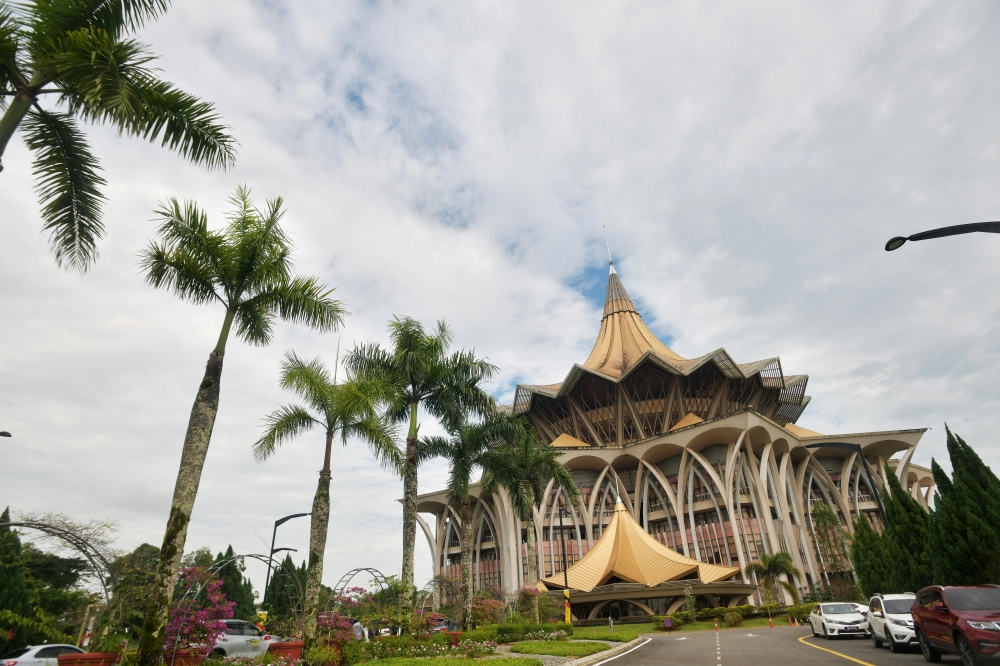
This file picture shows the Sarawak State Legislative Assembly building in Kuching, December 3, 2025. — Bernama pic
“After Malaysia Day however when Sarawak ceased to be a Crown Colony and became independent as a member state of Malaysia, Sarawak became voluntarily subject to the Malaysian constitution and under this constitution internal security is a federal subject, so that both legislative and executive authority over internal security is now vested in the Federation and in particular the Sarawak legislature no longer has power to make law on it. (See item 3, List I in the Ninth Schedule to the Constitution).
“But the advent of Malaysia Day did not however automatically repeal the Sarawak laws; on the contrary they were expressly saved by Section 73 of the Malaysia Act, which by subsection (5) provides that the Sarawak laws were ‘present laws’ and by subsection (1) that ‘they shall, on and after Malaysia Day, have effect according to their tenor, and be construed as if this Act had not been passed’.
“Further by subsection (3), the Section provides that as these Sarawak laws cannot be passed after Malaysia Day by the Sarawak legislature they ‘shall, on and after Malaysia Day, be treated as federal laws’.
“[Subsection] (1) of Section 73 which saved them from automatic repeal expressly says … that on and after Malaysia Day they shall have effect according to their tenor and as if the Malaysia Act had not been passed, i.e. within Sarawak only, as was the case before Malaysia Day. If that were not so, there would have been no necessity for Section 74 of the Malaysia Act, of which subsections (1) and (2) provide:
“(1) Subject to the provisions of this Section the Yang Di-Pertuan Agong may by order make such modifications as appear to him to be necessary or expedient in consequence of the passing of this Act in any present law relating to matters [such as internal security] about which Parliament has power to make laws.
“(2) Subject to subsection (3), the power to make orders under subsection (1) shall include power to extend throughout Malaysia or to any State or States thereof any present law in force in any part of Malaysia about any such matter; but except in consequence of the extension of any present law no such order shall modify any State law (this subsection is given as amended by Act 31/65).
“It is clear from these provisions that any Sarawak law passed before Malaysia Day on a matter which on and after Malaysia Day became a matter concerning which Parliament (not the Sarawak legislature) has power to make law, on and after Malaysia Day remains good law, but it continues to have effect only within Sarawak.
“[T]he Yang Di-Pertuan Agong may by order make such modifications as may appear to him necessary or expedient in that law, and this royal power includes power to extend throughout Malaysia that law.”
The second judge, Chief Justice of Borneo (as it was formerly known) Lee Hun Hoe too took time to explain the PPSO and PPSR. In the course of his judgment, the learned Chief Justice said as follows:
“In 1946 Sarawak became a Crown Colony after more than a century under Brooke Rule. The PPSO was enacted by the Council Negri (State Legislature) and came into force on May 18, 1962. Its operation was limited to Sarawak and had no extra-territorial effect. There were only eight sections.
“On December 8, 1962, the Governor declared the provisions of Section 4(2) to come into operation (See Part II of the Sarawak Government Gazette Notification No. S.220/62). Pursuant to Section 4 the Governor, on the same day, made the PPSR and the Preservation of Public Security (Detention Orders) Rules. The PPSO and subsidiary legislation made thereunder therefore remained in force when Sarawak joined Malaysia on September 16, 1963. This was also the operative date of the Malaysia Act, 1963. (See Federal Government Gazette L.N. No. 214/63).
“With the formation of Malaysia certain matters previously under State Control were transferred to Federal Control and listed under the Ninth Schedule of the Federal Constitution under Federal List. One of these matters is internal security which includes police, prisons, preventive detention, restriction of residence and so forth.
“By virtue of the Modification of Laws (Internal Security and Public Order) (Borneo States) Order 1963 certain present laws applicable to Malaya and enumerated under the First Schedule to the Order were extended to Sabah and Sarawak and called ‘the extension laws’. One of these is the Internal Security Act, 1960.
“In the same way, certain present laws of Sabah and Sarawak specified in the Second Schedule of the Order continued to have effect in the two States as ‘the continuing laws’.
“On May 25, 1965, the Yang Di-Pertuan Agong with the concurrence of the Governor in the exercise of his powers under Section 74 of the Malaysia Act made the Modification of Laws (Declaration of Federal Present Laws) (Sarawak) Order 1965 to come into force on Malaysia Day (see F.L.N. 200 of 1965) … under which State statutory instruments were declared to be federal laws … [including] the PPSO and subsidiary legislation made thereunder.”
According to the learned Chief Justice, to determine the legal effect of the PPSO and PPSR, it necessitated “looking into relevant provisions of the Malaysia Act, 1963 and of the Federal Constitution”.
The most appropriate provision to begin with is Article 159A of the Federal Constitution which reads as follows:
“The provisions of Part IV of the Malaysia Act (which contains temporary and transitional provisions in connection with the operation of that Act) shall have effect as if embodied in this Constitution, and shall have effect notwithstanding anything in this Constitution as amended by that Act; and the provisions of this Constitution, and in particular Clause (1) of Article 4 and Articles 159 and 161E shall have effect in relation thereto accordingly.”
Part IV of the Malaysia Act 1963 commences with Section 73 dealing with the continuation and effect of ‘present laws’. Section 74 deals with the temporary power to modify and apply present laws.
After setting out the provisions in extenso, the learned Chief Justice ruled that “the PPSO and subsidiary legislation made thereunder were ‘present laws’ of Sarawak” and declared federal laws.
The learned Chief Justice then cited the case of Assa Singh v Mentri Besar of Johore where the Federal Court held that the Restricted Residence Enactment, a pre-Merdeka law, must be applied with the necessary modifications to bring it into accord with the Federal Constitution.
The above explains further the legal effect of the laws of Sabah and Sarawak passed or made before Malaysia Day.
Article 159A of the Federal Constitution clearly states that Part IV of the Malaysia Act 1963 (which contains temporary and transitional provisions in connection with the operation of that Act) shall be embodied in the Federal Constitution.
The determination of the legal effect of the present laws of Sabah and Sarawak — that is, the laws of passed or made before Malaysia Day — such as the Oil Mining Ordinance 1958 (Sarawak) and Mining Ordinance 1960 (Sabah), necessitates looking into Article 159A of the Federal Constitution, among others, and Part IV of the Malaysia Act 1963.
* This is the personal opinion of the writer or publication and does not necessarily represent the views of Malay Mail.
KioskNews shows a cleaned-up reading view extracted from the publisher’s page — the original always lives on their site, not ours.