5 things to watch out for in 2027 US defence bill aimed at countering China

The measures could shape the Indo-Pacific security balance and US-China relations well into next year.
Trump rejects working with China on AI despite Xi’s recent visit
Lawmakers must pass the bill before the US Congress adjourns at the end of the year and reconcile differences between the two versions before sending it to Trump for his signature, amid uncertainty over the election results and a shifting geopolitical environment.
Here are five of the most notable and provocative provisions to watch, all likely to draw opposition from Beijing.
1. Support for Taiwan
Despite Trump’s recent remarks describing arms sales to Taiwan as “negotiating chips” to Beijing, the versions of the bill under discussion in both chambers would keep money flowing to Taiwan’s defence.
The House version would authorise up to US$1 billion for the Taiwan Security Cooperation Initiative – a US defence assistance programme – maintaining the previous financial year’s level, and create a US-Taiwan partnership on defence industrial priorities.
It would also establish a joint programme to develop and test drones and counter-drone systems, and require a plan for Taiwan’s navy to take part in the Rim of the Pacific Exercise by 2028 – a clause that was dropped in last year’s final compromise bill.
Further House provisions call for an annual report on Taiwan’s capabilities and a strategy to support its cyber defence through Five Eyes coordination.
The Senate version would authorise arms transfers to Taiwan from the US War Reserve Stockpile. It would also rename the Taiwan Security Cooperation Initiative the “First Island Chain Security Cooperation Initiative”.
Trump downplays Taiwan dispute in China talks
The Chinese embassy in Washington has told the South China Morning Post that it “strongly deplores and firmly opposes” Taiwan-related provisions in the bill that “grossly interfere” in China’s internal affairs, and that any attempt to arm Taiwan will face “grave consequences”.
SCMP Plus is a new premium news platform that gives you an
all-inclusive edge to stay ahead on China news.
To access our exclusive content you’ll need to subscribe.
Already a subscriber?
LOG IN
Beijing views Taiwan as part of China to be reunited with the mainland, by force if necessary. Most countries, including the US, do not recognise Taiwan as an independent state, but Washington opposes any attempt to change the status quo by force and is committed to supplying the island with defensive weapons.
2. Planning for a South China Sea crisis
The Senate version focuses far more on the first island chain, the arc of islands from Japan through Taiwan and the Philippines to Borneo that encloses the South China Sea.
It would require the Pentagon to draft a crisis-management strategy for the sea within a year, identify likely flashpoints short of war, and outline phased responses coordinated with partners.
The stated aim is to “deny the aim of the People’s Republic of China and deter further [PRC] provocation or actions that expand the crisis.” It would also order facilities planning for rotating US forces in the Philippines, which has clashed with Chinese vessels, and seek a report on Japan’s counterstrike capabilities.
The House version did not mention the South China Sea or the first island chain.
3. Countering China’s shipbuilding dominance
The Trump administration has been attempting to increase cooperation with allies with shipbuilding capacities, such as South Korea and Japan, to help revitalise depleted US naval shipbuilding capabilities.
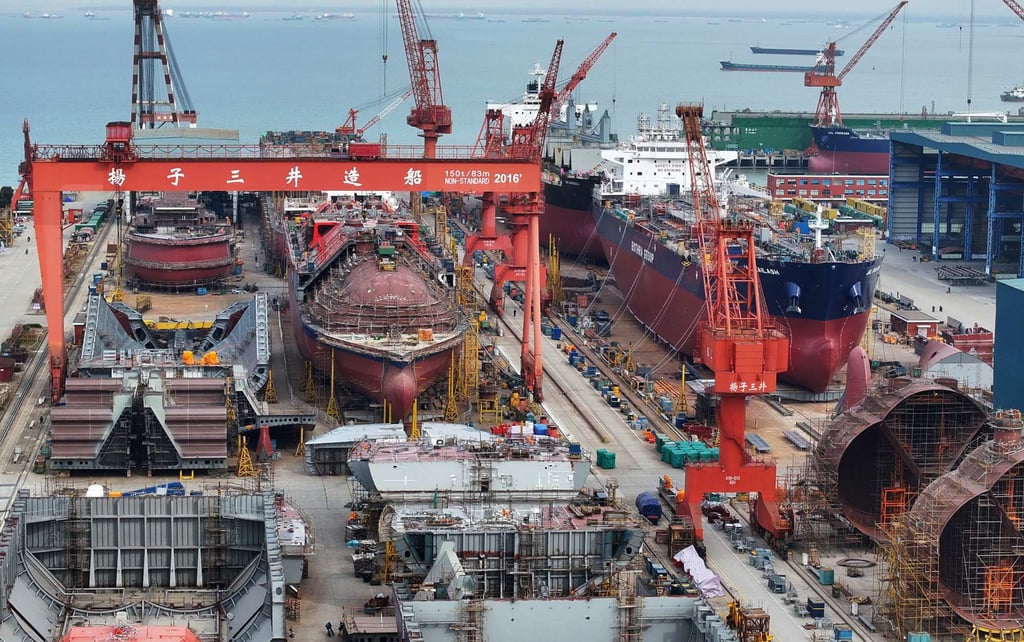
However, the House and Senate versions take contrasting approaches to foreign shipyard involvement in US Navy shipbuilding.
The House version prohibits using any funds to contract for or procure battle force or combat ships in a foreign shipyard, completely barring overseas construction for the combat fleet.
The Senate version amends the current law by allowing the Pentagon to procure up to two bulk fuel vessels and two strategic sealift/auxiliary non-combat ships from treaty-ally shipyards.
4. Tightening of tech restrictions
Both bills would prohibit the Pentagon from using Chinese-manufactured optical fibre and restrict purchases of certain used vessels built in China.
The House would also bar the procurement and use of humanoid robotic systems produced, developed or controlled by foreign adversaries, and restrict purchases of photovoltaic cells, modules and inverters from foreign entities of concern.
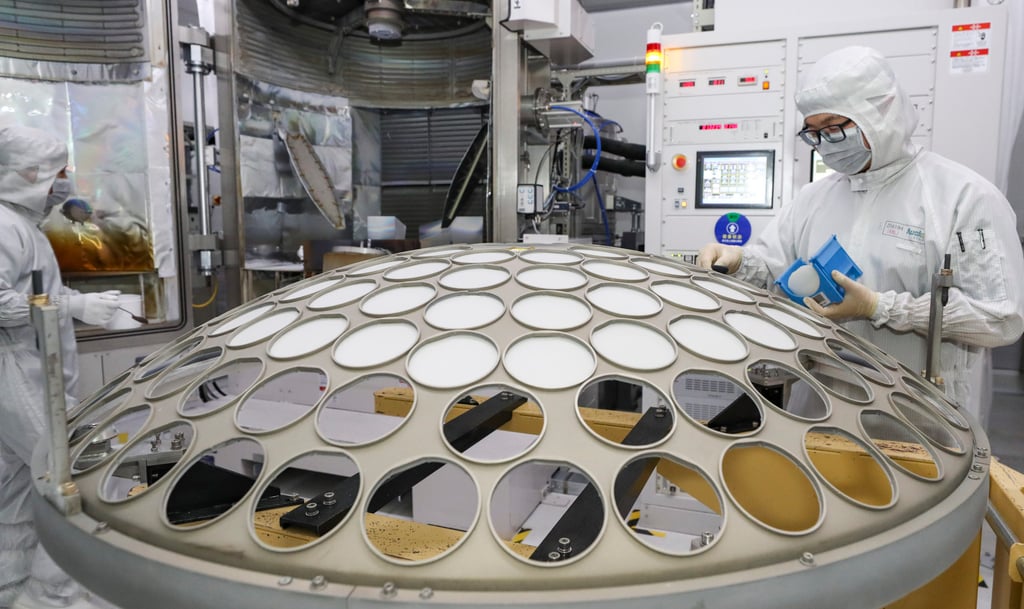
Tougher chip export controls, including the AI OVERWATCH Act, the Chip Security Act and the MATCH Act, could be added before final passage. Zack Cooper, a China expert and senior fellow of the American Enterprise Institute, said the three measures were “perhaps the most important portions related to China right now”.
Beijing has condemned plans, warning chip curbs would cause “arbitrary disruption and damage” to global supply chains.
5. Reducing reliance on China for critical minerals
Responding to China’s global dominance in critical mineral supplies that are essential for advanced military technology, the Senate bill would prohibit the Pentagon from buying certain minerals from non-allied nations and set up a pilot programme to restart antimony and copper production in the US.
It also orders an assessment of the Pentagon’s phosphate supply chain, including its dependence on China.
The House bill is broader. It would cap the share of metals the Pentagon can source from abroad and set up tiered sourcing restrictions for critical minerals from China and North Korea.
It would also ban silicon-carbide semiconductors made in China and order studies on reliance on Chinese processing and on aluminium and synthetic diamond supplies.
One report would examine whether US scrap exports are feeding rare-earth refining and magnet production in China. Another study would assess whether combatant commands should be able to buy critical minerals on their own.
KioskNews shows a cleaned-up reading view extracted from the publisher’s page — the original always lives on their site, not ours.