The start-up is just the excuse

‘The start-up isn’t the goal,” said Gadi Bahat, founding director of the Leaders program at Ben-Gurion University of the Negev. “The people are.”
It’s a deceptively simple distinction, but one that has shaped the program since its inception six years ago.
While many academic entrepreneurship initiatives operate as accelerators, bringing students together around promising business ideas in the hope of producing the next successful start-up, the Leaders program takes a different route. It operates as part of the university’s Yazamut 360 center, led by Dana Gavish and Prof. Carmel Sofer, whose joint vision has helped position entrepreneurship as a strategic pillar at BGU.
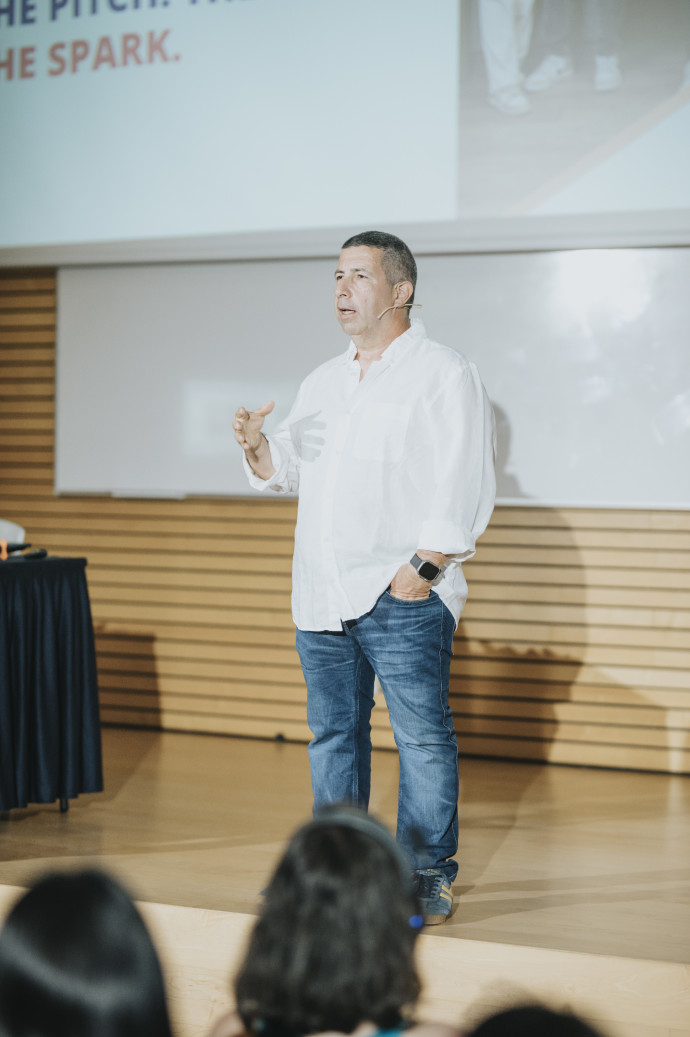
“We looked at the traditional model and said not every student wants to become a start-up founder,” Bahat recalled.
“Entrepreneurship is much more than creating companies. It’s a way of thinking, a mindset. It’s leadership combined with personal resilience. These are skills and personal qualities that today’s world demands, whether you launch a start-up or not.”
That philosophy has produced dozens of graduates who have carried those skills into industry, research, and the public sector.
It has also led to socially minded start-ups like ANNIE. Founded by Leaders alumni Ofek Eliasko, Idan Mizrahi, and Tal Ben-Lulu, the venture aims to improve the treatment of trauma casualties by connecting first responders, field medics, and hospitals through a real-time monitoring platform.
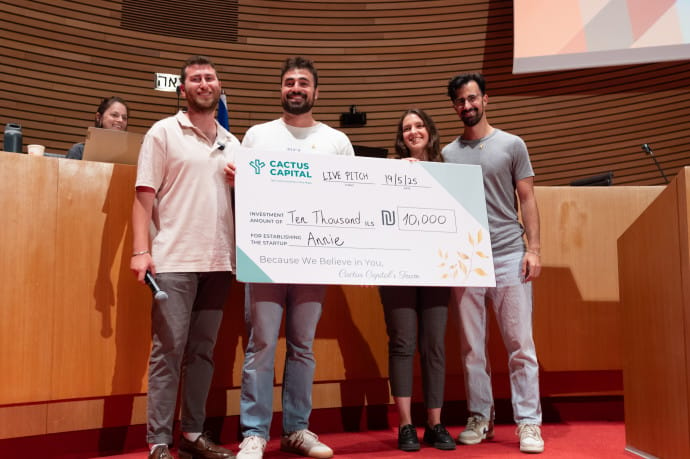
Like the Leaders program, the company’s origins are less about technology than about people.
“We didn’t focus on building a technological product,” Eliasko said. “We became passionate about solving a real human challenge.”
Bahat, in turn, never intended to work in academia. An electronics engineer with an MBA, he spent decades in Israel’s hi-tech industry, serving in senior executive positions at companies such as Comverse and Alvarion before leading two start-ups of his own.
Then came an unexpected phone call. A former colleague, BGU’s Sofer, asked him to step in for what was supposed to be a temporary assignment.
“I came for a few months, and I fell in love,” he laughed.
The value lies in doing
“We don’t teach entrepreneurship through theory,” Bahat explained. “We teach everything through practice.”
That practical experience unfolds as what Bahat described as an entrepreneurial journey built on three pillars: entrepreneurial knowledge, personal skills, and hands-on work.
Students are divided into teams and asked to build start-ups together. But unlike a traditional accelerator, success is measured less by the company’s future than by the individual’s development.
“The start-up is the learning tool,” Bahat explained. “Students encounter obstacle after obstacle. Every time they overcome one, they’re building an entrepreneurial mindset.”
Only later, while completing his master’s thesis, did Bahat discover the academic terminology describing what he had intuitively built.
“It’s called incidental learning,” he said. “Students come to learn entrepreneurship, but along the way, they leave with far more and acquire a completely complementary set of skills.”
Those skills range from negotiation and public speaking to resilience and what Bahat calls “entrepreneurial agency,” the confidence and ability to drive change independently.
“You’re the engine,” he said. “That’s exactly what the market is looking for.”
That philosophy would eventually help shape one of the program’s most ambitious ventures. Eliasko and Mizrahi first met through Leaders, though their company took shape elsewhere.
Amid the war and the mass-casualty events that followed, Eliasko experienced an event that would eventually become the foundation of ANNIE.

“We witnessed a highly complicated medical evacuation following a mass casualty event,” he recalled. “Tragically, one person died, while another recovered.”
What he observed stayed with him long afterward. “As we later examined what had happened, it became clear that there were significant gaps in the way trauma casualties are managed and evacuated in the field.”
Rather than accepting those failures as inevitable, the pair began asking what technology could do differently.
The result became ANNIE – a platform combining wearable hardware and software that can monitor critical vital signs in real time and transmit them continuously from the point of injury through emergency dispatch centers and eventually to hospitals.
Its ambition reaches beyond traditional emergency medicine.
“Our vision is for ANNIE to become as common as defibrillators,” Eliasko said. “Every rescue team, every disaster response unit, every emergency situation should have access to it. Ultimately, we want to integrate into existing emergency systems, not only in Israel but everywhere.”
Neither founder believes the company would exist without Leaders. “We actually built the foundations of ANNIE during the program,” Eliasko said.
“Leaders gave us a place to begin before we entered the real world.” Mizrahi agreed, arguing that the most valuable lessons had little to do with business models or investment pitches. “It challenged us professionally, but even more mentally,” he said.
Students were encouraged to leave the classroom, interview strangers, test assumptions, and, above all, make mistakes.
“Bahat always said, ‘Go wild,’” Mizrahi recalled. “‘There are no limits; take it wherever you want.’ We made plenty of mistakes, but we also succeeded.”
Some of the most lasting lessons had nothing to do with entrepreneurship.
“The academic degree doesn’t teach you how to stand in front of an audience in English,” Mizrahi said. “It doesn’t teach resilience. It doesn’t teach you how to communicate under pressure.”
Perhaps even more important were the relationships.
“We had incredible mentors,” Mizrahi noted, recalling his personal mentor, Yoram Yaacovi, a former Microsoft executive.
Beyond the BA
When asked how they fared once the program concluded, Mizrahi laughed. “Who says Leaders is over? Bahat still gets phone calls from us in the middle of the night.”
For the latter, those conversations are part of the program. “Students tell us this was one of the strongest experiences they’ve ever had,” he said. “And six years later they’re still using the tools.”
This ongoing connection is formalized through the Leaders Alumni Association. Upon completing the program, graduates join an exclusive, growing network of hundreds of alumni who hold highly sought-after positions across a wide range of industries. Through dedicated networking events and gatherings, the association ensures that the community continues to thrive, offering lifelong professional value, support, and collaboration opportunities long after the academic year ends.
This relationship has also shaped the program itself. Early cohorts were given almost complete independence, but after it proved overwhelming, changes were made so that every team is paired with alumni mentors.
“We threw them into the deep end,” Bahat admitted. “It was too much.”
Reflecting less on entrepreneurship than on humility, Bahat asserted that he has learned an enormous amount from his students. “If you’re open enough and humble enough, younger people will teach you far more than you expect.”
Eliasko offered similar advice to future participants. “Leaders is only a taste of the real world,” he said. “Push yourselves. Stay up late. Take yourselves to the limit. That’s where the real growth happens.”
Mizrahi is even more succinct. “It’s a place where you’re allowed to dream,” he said. “More importantly, it’s a place where you’re expected to make those dreams happen.”
Today, the program has also evolved alongside technology, with artificial intelligence becoming a growing part of the curriculum, and next year each student team will develop its own AI agents as collaborative teammates throughout the program.
Even so, those changes serve the same underlying objective. “The methodology changes; the person remains at the center,” Bahat said.
For a university program that insists start-ups are merely a means to an end, the emergence of ANNIE may seem like a remarkable success story. Bahat would probably disagree. The company, after all, is only evidence that the real experiment worked. The real product of Leaders isn’t a start-up, but the people capable of building one.
This article was written in cooperation with Ben-Gurion University.
KioskNews shows a cleaned-up reading view extracted from the publisher’s page — the original always lives on their site, not ours.