Exploring Jewish history on an Adriatic cruise - review

The Celestyal Journey was one of five cruise ships stranded in the Persian Gulf when the war broke out on February 28.
I was on its sister ship in Dubai – the Celestyal Discovery – as I wrote about it for The Jerusalem Post.
When the Strait of Hormuz briefly reopened for commercial activity in April, the Discovery was the first cruise ship to make it through, and the Journey followed the next day.
The passengers – me included – had long since returned home.
The cruise line has since pivoted toward Europe, and I joined the Celestyal Journey for a seven-night Adriatic cruise in August.

The Celestyal Journey
The Celestyal Journey is a mid-sized cruise ship that can accommodate 1,260 guests in 630 cabins.
It offers the full range of cruise ship amenities, including eight bars, seven restaurants, two swimming pools, a theater, a casino, basketball and tennis courts, a video arcade, a disco, duty-free shops, and a spa.
In the beauty salon, you can soak your feet in a huge opalescent glass basin and enjoy a pedicure while gazing out at the waves.
Our Grand Dream Suite, which sleeps four, was the largest cruise ship cabin I’ve ever stayed in, with 35 square meters of room plus an 18-square-meter balcony big enough to accommodate a dining table and two twin-bed-size loungers.
The Stargazer Suite is even bigger, at 88 square meters.
Suite passengers get perks like express check-in, access to a VIP sundeck and lounge, daily canapés delivered to the cabin, free access to the thermal suite (with heated ceramic chaises), and free happy hour drinks and hors d’oeuvres at one of the bars.
The cruise line’s Greek heritage is reflected in the design scheme, the restaurant menus, and the tiny live olive tree in our cabin.
The helpful staff went out of their way to cater to our every need, including finding me an adjustable desk chair so I could get some work done on board.
We embarked from Piraeus, the port of Athens, and spent our first day at sea before arriving at Kefalonia, the largest of Greece’s Ionian islands.
The novel and film Captain Corelli’s Mandolin are set on Kefalonia, and the movie was filmed there.
The island is known for Melissani Cave, with its underwater lake – known as the Cave of the Nymphs in Greek mythology. Cruise passengers can explore the cave via rowboat.
Most of the stores in the downtown area of Argostoli, the island’s capital, were closed on Sunday, but it was still possible to get a flaky spinach pie, hot from the oven, as well as feta and honey pastries from a bakery on the waterfront, near the spot where sea turtles congregate.
The excellent family-owned Gentilini Winery was also open for tastings.
Just a four-minute walk from the cruise terminal is the island’s Holocaust Memorial.
After the collapse of Italy’s fascist regime in 1943, the Nazis took over the Ionian islands. The remaining Jewish population of about 1,800 people was deported and murdered, although most of the Jewish community of 50,000 – mainly descendants of Sephardi Jews expelled from Spain in 1492 – had left before the war.
Dubrovnik
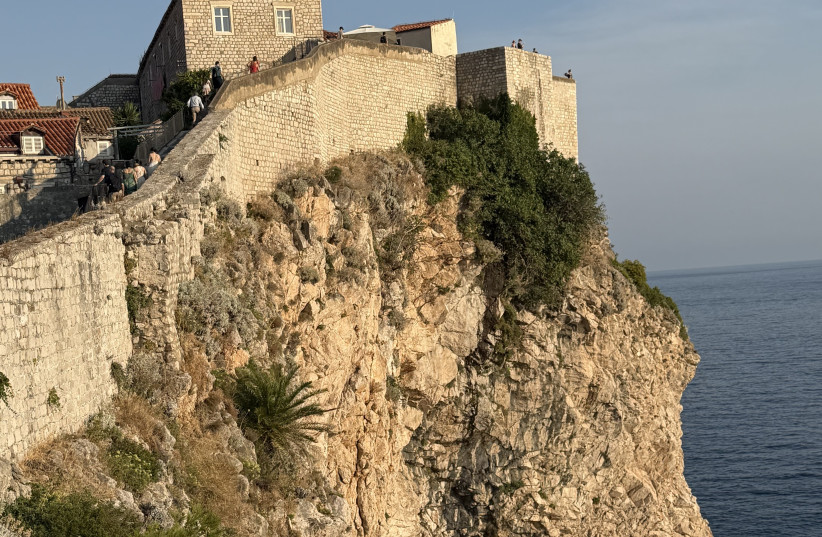
The next port was Dubrovnik, Croatia, a UNESCO World Heritage site with a beautifully preserved (and tourist-packed) Old Town.
I wrote about a previous visit for the Post here.
The Dubrovnik Synagogue, tucked away on a side street with stairs, is the oldest Sephardi synagogue in use in the world and the second oldest synagogue in Europe, established in 1352. It’s open to the public, along with its small museum.
Dubrovnik’s imposing city walls – dating from the 13th century – were a primary exterior location for the fictional city of King’s Landing in the Game of Thrones series.
The tour of the walls is scenic – and expensive: 40 euros for adults and 15 euros for children.
The hundreds of steps are steep and slippery, and sometimes lack handrails. In places, the parapets are lower than knee-high for an adult. (I wouldn’t take any children younger than draft age unless they can be carried in a backpack. Strollers are out of the question.)
The walls are less crowded in the early evenings, when influencers with gauzy gowns, bare midriffs, and camera boys wait for golden hour lighting.
It takes about 45 minutes to walk the walls at a moderate pace without stopping for refreshments or an excessive number of selfies.
The Journey’s late-night departure allowed for a sampling of the local nightlife and a visit to the Habitat Gin Lab Experience, right across from the port, where you can create your own botanical blend to take home.
Kotor
In Kotor, Montenegro, we escaped the heat and tourist crowds of the walled medieval town by taking an 11-minute gondola cable-car ride up to an elevation of 1,749 meters.
At the top, an amphitheater-style cafe faces the spectacular view and offers cool mountain breezes and excellent pizza.
The mountaintop also has a playground and thrill rides, including an alpine roller coaster that lets you control your own speed. The ride is only three minutes long, and it’s worth spending an extra eight euros for the fast-track lane that will save you an hour or more waiting in line.
Bari
Our next stop was Bari, Italy, a busy port city where nonnas (grandmothers) hand-roll orecchiette pasta in Old Town alleyways and will sell you a bag for a few euros.
I took a half-hour train ride to Trani, just up the coast, to visit the medieval Jewish quarter known as the Giudecca.
The Jewish community flourished there from the ninth to 14th centuries, as reported by Benjamin of Tudela, who visited around 1166. Jewish pilgrims bound for Jerusalem gathered in the port to meet their ships.
The Jewish quarter in Trani once had four synagogues, which were later converted to churches. The Jewish community was expelled in 1510.
However, the 13th-century Scolanova Synagogue was returned to the Jewish community in 2005, becoming the oldest active synagogue in Europe. Another synagogue, the Scola Grande, built in 1247, now functions as a Jewish history museum.
Corfu
We sailed back across the Adriatic to the Greek island of Corfu.
The main city’s old town, on the UNESCO World Heritage List, is a maze of narrow cobblestone streets and colonnaded shops. It’s also Greece’s greenest island and home to more than three million olive trees.
Corfu Town is overlooked by a towering Venetian fortress that fended off three major Ottoman sieges, leaving Corfu the only part of Greece not incorporated into the Ottoman Empire.
Many Italian Jews settled in Corfu when it was ruled by Venetian nobles from 1386 to 1797. They spoke their own language, Italkian: a mixture of Hebrew and Italian in a Venetian or Apulian dialect, with some Greek words mixed in.
In 1944, Nazi soldiers, aided by Greek police, rounded up Jewish community members and imprisoned them in the fortress, from where they were deported to the Birkenau death camp. Of the 1,700 community members, only 200 survived.
Jews from Corfu who made Aliyah to Israel established a monument in Holon, and hold a ceremony to commemorate the community on Tamuz 8 every year.
Katakolon
We next anchored near the Greek port village of Katakolon, the gateway to ancient Olympia – home of the original Olympic Games, which began there in 776 BCE.
You can still see – and even run from the starting blocks in – the ancient stadium. The torch-lighting relay for the modern Olympics starts at the ruins of the Temple of Hera in Olympia, although the ritual is a 20th-century invention.
The Archaeological Museum houses treasures from the site and the surrounding area, including a striking fourth-century BCE sculpture of Hermes attributed to Praxiteles.
The journey also offered wine and olive-oil-tasting excursions in the region.
Athens
We returned to Athens for a final tour that included the Acropolis. After two decades, the Parthenon (the ancient temple to Athena atop the Acropolis) was freed of exterior scaffolding late in 2025, providing a much-improved view.
Nearby, the modern Acropolis Museum makes its case for the return of the fifth-century BCE statues that once adorned the Parthenon, known as the “Elgin Marbles,” and are now held in the British Museum.
Celestyal offers seven-night winter Mediterranean cruises starting from 469 euros per person – about the cost of one night in a five-star hotel in Eilat.
A dedicated kids’ club program is available for children aged 3-16 on selected sailings.
The cruise line says that there’s little demand for kosher food on board, but airplane-style packaged meals, with dishes like beef casserole “stifado” and vegetarian options, are available on one month’s advance request at an additional charge. All kosher dairy is Chalav Israel.
KioskNews shows a cleaned-up reading view extracted from the publisher’s page — the original always lives on their site, not ours.