Man United fans must accept reality, which is both better and worse than they think

Ryan O'HanlonOct 13, 2026, 04:28 AM ET
- Ryan O'Hanlon is a staff writer for ESPN.com. He's also the author of "Net Gains: Inside the Beautiful Game's Analytics Revolution."
If you've followed Manchester United for the past 10 years or so, you know the story by now. It goes something like this.
First, there's a bad season. The richest team in the Premier League somehow finishes too low to qualify for the Champions League. A previously beloved manager suddenly looks clueless. A bunch of highly paid, previously successful players barely look good enough to play in the Premier League, let alone for a team that wants to compete for every major trophy.
Inevitably, the manager is fired -- either before the season ends, over the summer, or just a couple of weeks into the new season. Then, a new guy comes in, the results get better, a lot of those inept players suddenly look capable, and the team finishes way above where it landed under the previous guy.
The team qualifies for the Champions League, then it spends a ton of money on a bunch of players, and the whispers begin: I kind of think United could win the league. And then the whispers turn into shouts, given so many of England's former-players-turned-pundits used to play for the club.
Inevitably, the cycle then restarts anew. Not only does the club fail to meet the unrealistic expectations but doesn't even come close. Everyone turns on the coach they said was a savior six months ago. All of those new players who were going to push them to their first title since 2013 struggle to even keep them afloat.
The coach gets fired, they hire someone new, the results improve, a title is suddenly on the cards, and then it all falls apart -- again and again.
And again: like, right now. After finishing third last season, Man United have earned only six points from their first six matches. This past weekend's draw against 10-man Tottenham condemned the club to their worst league start since 1986.
The club looks as if it's going to get lost in its vicious cycle once again -- but how might United, uh, not do that?
First, they'd need to figure out how to create realistic expectations for the immediate future -- unadorned and uncomplicated by what all the fans and former players want the club to be. And then they'd need to find a new way to assess team performance beyond what the table says.
If there's any club that should be aware that past point totals don't predict future point totals, it's the one that has finished sixth, third, eighth, 15th and third over the past three years.
And once Man United figured out how to do both of those things? Everyone at the club might realize that things aren't that far off from what they should've expected.
Why Man United haven't been title contenders and fans should stop expecting it
Analyzing Manchester United used to be pretty simple. This was one of the three richest clubs in the world, and this club was consistently not even finishing inside the top three of its own domestic league. A robot, a child using video-game ratings from FIFA, a random fan, even Gary Neville -- they could all have produced similar results from that massive resource advantage.
But despite the efforts of various American owners to build new stadiums, create "matchday experiences," raise ticket prices, and convince English fans that they need an All-Star game, there is still only one tried-and-true way of increasing revenues.
OK fine, there are two, and I'll quickly address the $1 billion elephant in the room. One way you can boost your revenue is by implementing, as the Premier League put it, "sham contracts" and "sham agreements" ... "to artificially inflate [your] club's revenues." What Manchester City did to cheat the rules and what the Premier League is going to do about it will, unfortunately, be hanging over everything you're about to read and everything we're going to watch this season.
But beyond the Man City method, there's one main way to make your soccer club richer: win more soccer games.
You win more prize money by finishing higher in the table. You give your club the kind of advertising no billboard can match. You qualify for European tournaments, like the Champions League, which earn you extra broadcast revenue and matchday revenue.
We've slowly seen this all play out at Old Trafford -- in the opposite direction. As Manchester United's performance level has steadily dropped over time, so too have the club's revenues.
For the 24 seasons from 1996-97 to 2019-20, United never ranked lower than fourth, globally, in annual revenue. And in most years, they were significantly higher than that. Over those 24 seasons, United recorded the highest revenues of any club 10 times -- bested only by Real Madrid's 12. Barcelona were the only other club to nab the top spot: twice.
But since 2019-20, United haven't landed higher than fourth, and they've fallen outside of the top four three times: fifth twice and then, in the most recent accounting year, eighth.
This chart shows the revenue rankings of the so-called Big Six since 2003-04, when Manchester City broke into Deloitte's annual Money League ranking:
That massive upward spike from the bottom, of course, is the 10-year period for which Man City were just found guilty. But with Man United, you can see that they were the highest-ranked Premier League club until 2019-20. If in 2010, you told the owners of Liverpool and Arsenal that their clubs would eventually make more money than Manchester United, they would've laughed in your face. Well, in 2024-25, they both did.
Another way to look at this is to see just how high United's floor is. In the 2024-25 season, they literally finished in 17th place. Despite that, they still brought in top-10 revenues globally. This goes a long way to explaining the on-field volatility over the past 10 years: The club has been managed terribly, so they have bad seasons, but they also have so much money that they also have a couple of decent seasons.
The main takeaway, though, is that United are no longer the standalone richest Premier League club. They are one of the richest Premier League clubs. On top of that, they've come back to the super-club pack right when the rest of the Premier League -- the other 14 teams -- have ascended to a new level.
The players who don't sign with a top-10 team in the world are no longer joining AC Milan or Borussia Dortmund -- no, they're going to Aston Villa and Nottingham Forest. So, not only do United no longer have a built-in revenue advantage over their closest competitors, the rest of the league has also seen its talent level rise.
What should United's expectations be, then? Per the site Transfermarkt, they have the fifth-most valuable squad in the Premier League. Per the estimates from the site FBref, they have the fourth-highest wage bill. And per the most recent accounting, they have the fourth-highest revenues.
Given all of that, their baseline expectation at the current moment should be around fourth or fifth place in the Premier League.
Why Man United are better than they seem right now -- and whether it matters
Manchester United, of course, are currently in 13th place. But we know that there's a lot of noise over the first six matches of the season. Or, at least, we know that the Premier League table after six games isn't a great predictor of what the Premier League table will look like after 38 games.
Take last season: Liverpool had a three-point lead atop the table, and Tottenham were in fourth. Over the next year, the clubs combined to fire three different managers and neither team finished anywhere near where they were through six games.
If we just look at goals scored and conceded, it already looks a tiny bit better for United: tied for the ninth-best mark in the league with Liverpool. Granted, a neutral goal differential still isn't great for either of those clubs, but it's at least better than where United currently sit in the table.
If we take it a step further and look at all of the shots every team in the league has conceded -- close to 1,200 so far this season -- instead of just the 170-plus that have crossed the goal line, then things improve even more.
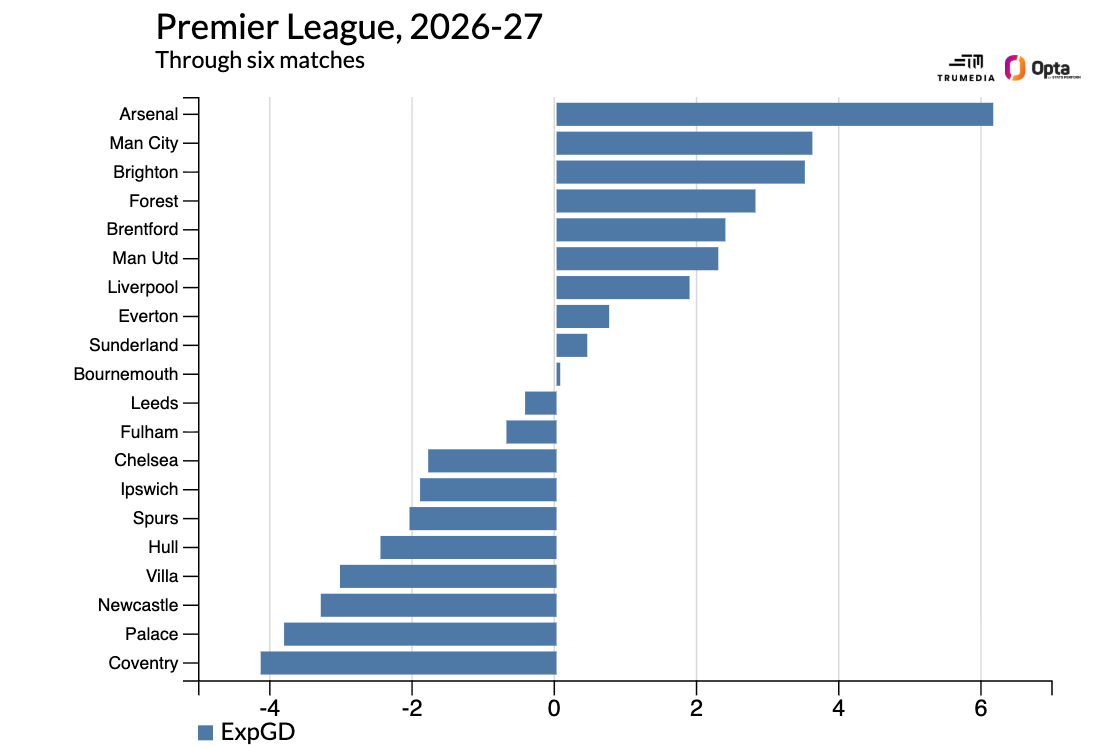
Through six games, Man United have the league's sixth-best expected goal (xG) differential -- from the fifth-most xG created and the seventh-fewest xG conceded. Through Michael Carrick's first 17 matches as head coach in charge last season? United had the fifth-best xG differential -- from the sixth-most xG created and the fourth-fewest xG conceded.
Though the performances have been a bit worse -- against one of the easiest schedules in the league -- the biggest reason, by far, for why the vibes have shifted so suddenly is the mostly random nature of what happens once a player's foot or head comes into contact with the ball. A team with the fifth-ish most talented team in the league is playing like the sixth-ish best team in the league, and the variance of finishing chances has pushed United down the table.
This is not to say that United have been great or anything like that. They really struggled against Tottenham before they went up a man, and in the previous match against Man City, they really struggled even after they went up a man.
Based on how United are playing, there are reasons to be optimistic and pessimistic -- at the same time.
They have attempted 17 more shots (125) than any team in the league, and they're only one behind (65) Arsenal and Bournemouth for fewest conceded. They have taken 64% of the final-third touches in their matches -- most in the league. And they've taken 62.4% of the penalty-area touches in their matches -- second only to Manchester City.
Teams that dominate all of those areas of play tend to finish near the top of the table -- not with neutral goal differentials and down near the bottom half.
At the same time, United do frequently look like a team that wants to dominate the ball but without a real plan for what to do with it -- or for what happens when they lose it.
Per Gradient Sports, United lead the league in both the number and percentage of shots attempted with a better passing option available. They're crossing the ball more often than any team in the league. And despite dominating territory, they sit in the middle of the pack for just about every pressing metric. That suggests that their opponents are happy to let them have the ball.
United know what to do but not how to do it -- something you might expect from a team coached by someone with no top-level experience.
But this also was all true under Carrick last season. We knew United were boosted by being eliminated from both cup competitions early in the season and by not qualifying for Europe. Now, after the disappointing draw with Tottenham, they have to fly to Spain and go play Diego Simeone's Atletico Madrid. Last season, they would've had a full week to regroup.
Not only that, but now Carrick has to deal with the kind of situation that separates top coaches from average, replaceable ones: figuring out whether something needs to change or whether something will change as long as you convince your players that you actually don't need to change anything.
If you took a step back and tried to analyze last season objectively, there wasn't a particularly strong argument for hiring or replacing Carrick. United kept him, and then the same thing happened that always happens.
If they decide to move on from Carrick, then we can all probably guess what might come next: things will get better, then they'll get worse. And in another year or two, we'll get to do it all over again.
KioskNews shows a cleaned-up reading view extracted from the publisher’s page — the original always lives on their site, not ours.