ANALYSIS: Inside the big shiny plan to change how local government works
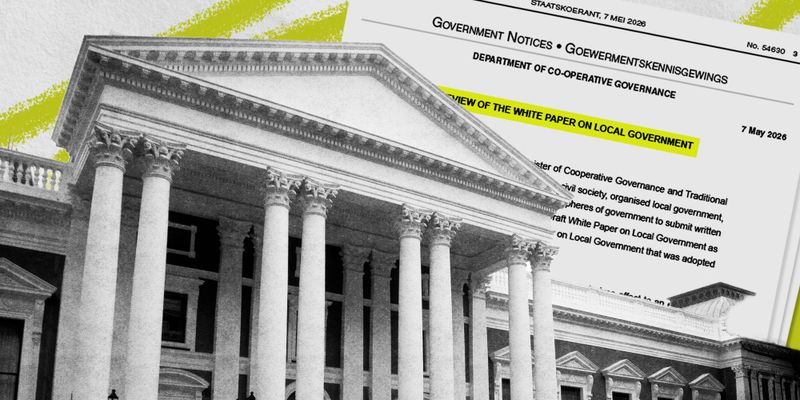
If implemented, the revised White Paper on Local Government would change the face of our councils and of service delivery. It would significantly stop financial mismanagement and largely depoliticise many of the aspects of local governance. And force parties to sign public coalition agreements.
Nothing should concentrate the mind more for a politician than an election.
On Thursday, 22 October, President Cyril Ramaphosa officially launched the Department of Cooperative Governance and Traditional Affairs’ (Cogta) proposals to fix our councils.
While the 192-page document itself is stinging about our local government failures, his language was even more damning.
He told the assembled audience that “we underestimated how politicised appointments would open the door to corruption, malfeasance and a lack of accountability”.
Despite that comment, the party he leads still has a formal policy of cadre deployment.
The white paper says all appointments should be depoliticised, and that “appointments to senior management and key technical posts must take proper account of the disciplines on which municipal performance depends, including finance, engineering, planning, infrastructure management […]”.
It also wants to make all councillors involved in the appointment of these officials responsible, saying: “Government will strengthen consequences for knowingly making unlawful or clearly unsuitable appointments, including collective or individual liability and possible disqualification for councillors who knowingly approve unlawful appointments.”
This would surely mean that some currently sitting councillors would be held liable for some appointments to their councils, including the current Johannesburg city manager Floyd Brink, who was found by an investigation to be guilty of “gross misconduct”.
Subsequent comments by National Treasury officials suggest legal changes would force appointed officials to report any verbal instructions from politicians to another authority. This would essentially end a widely reported practice.
The real power of this change would be to remove the direct link between party interests and the interests of top managers. The white paper wants to create a professional class of top city administrators, people who would be able to serve no matter who was in power in a particular place.
This is underscored by the statement by National Treasury director-general Duncan Pieterse on The Money Show last Wednesday, 21 October, that the Treasury would have a veto on the appointment of a council’s chief financial officer.
As Ntiyiso Consulting local governance expert Miyelani Holeni has also explained, this would provide a way for officials to work their way up to the top job in an apolitical way. That would mean someone would start their career in smaller rural municipalities until taking some of the top jobs in a metro.
Control over local government budgets
In addition the National Treasury says it will be able to insist that councils pass only budgets that are funded.
Several councils, including Johannesburg (again…) have passed budgets in which money has been allocated to be spent, but revenue has not been allocated to pay for that spending.
The obvious result is financial disaster.
It also led to the Treasury’s decision to temporarily suspend some payments to councils earlier in the year.
One of the fruits of the bitter experience of the current model is the white paper’s suggestion of a completely new and apolitical system to allow provincial and national government to intervene in a council.
It says there would first be a coordinating centre, a technical coordination unit acting as the “engine room of system coherence, but not as a decision-making authority. It would have no executive power over departments and would coordinate through evidence, persuasion and escalation”.
It also calls for Parliament or the Cabinet to create a “political escalation mechanism”, which would then deal with cases where some kind of national or provincial intervention was required.
Obviously the aim would be to prevent situations such as the one in Tshwane where the DA-led administration was taken over by the ANC-led province of Gauteng. The fact that decision was eventually overturned by the Constitutional Court suggests it was an entirely political decision.
A useful test of such a system would be whether it would in fact prevent something similar to the water crisis in Bronkhorstpruit. There, it has now emerged the officials running the Bronkhorstpruit Water Works did in fact tell their seniors in the administration they were running into problems with chlorine supplies.
While this new system might not prevent that kind of situation, it may prevent longer-running problems such as the historic under-investment in water systems in most metros, by demanding increased spending earlier.
Ethical leadership and accountability
The white paper makes several suggestions that “places ethical leadership and ethical culture at the centre of political reform”.
It wants to “strengthen the integrity and accountability duties of councillors, office-bearers and councils through clearer conduct rules, enforceable separation between political office and administration, and a firmer accountability chain for misconduct, criminality, procurement interference, intimidation and repeat governance failure”.
It wants to achieve some of this through requiring “clearer delegations, stronger council rules, stronger committee practice, role-based councillor induction and development”. It says councillors would have to stay out of procurement and that there would be more transparency with the tender process.
One of the most crucial proposals in the white paper is that where a coalition agreement is being reached, any type of “coalition or support agreements that affect the formation or sustainability of the municipal executive must be written, signed and made public”. This could include the decision-making principles, commitments to lawful conduct and continuity of essential governance and service delivery functions.
This is a huge change, and something that many observers of our current situation have been calling for.
The lack of public agreements makes it impossible to know what is keeping certain arrangements together and gives rise to the well-founded suspicion that it is simple patronage.
However, despite such public written agreements, it will still be difficult for communities or anyone else to make those parties stick to them.
In Johannesburg for example, Colleen Makhubele, as the sole councillor for Cope, appeared to be able to dictate which grouping was in power simply by changing her own individual stance.
Her party, such as it was at the time, was unable to stop her.
This kind of public agreement may still mean personal self-interest would be at the heart of many decisions.
The white paper does not make a determination on whether parties should have to meet certain thresholds to be represented in council.
Missed opportunity
This is a reminder of the massive opportunity that has been missed by the current national coalition. Both the ANC and the DA have an interest in introducing some kind of threshold to prevent a situation where eight parties have just one councillor.
This element of our current situation creates huge instability. And yet these parties have done nothing about it, despite having the political power to try to push through some change.
The result of this is that after these elections we are likely to have more, not fewer, such situations in different councils. Leading to a repeat of this kind of chaos.
There are many other elements being introduced in this lengthy white paper that suggest, if it goes through, big changes could be coming.
Most of them are overwhelmingly positive. On paper, this could be a game-changer for local politics.
But, in a political culture where wrongdoing has become almost institutionalised, improvements are not about what is written down. They are also about institutionalising practices and a different culture.
And it probably requires a major political change of some sort that would be agreed to by all of the parties representing all of our constituencies. DM
KioskNews shows a cleaned-up reading view extracted from the publisher’s page — the original always lives on their site, not ours.