Eish and Malḥ Between Us: a Musician on Cairo’s Shared Jewish Traditions
I first stepped foot in Sha’ar HaShamayim Synagogue in fall of 2021, on the eve of the Jewish New Year.
Sha’ar HaShamayim means “The Gate of Heaven” in Hebrew (Genesis 28:17). It refers to a place where one feels a strong connection to the divine. Stepping through the massive doors felt like crossing a spiritual and historical portal.
I had come to the synagogue to celebrate the Jewish New Year, Rosh Hashanah, with the Drop of Milk Association. Drop of Milk is a non-governmental organization based in Cairo (founded 1921) that serves to preserve Egyptian Jewish heritage and promote interfaith dialogue and understanding.
I arrived at the downtown synagogue 20 minutes late, underestimating Cairo’s traffic, and found that the ceremony had already ended. Magda Haroun, the head of the Drop of Milk Association and the heart of the Jewish community in Egypt, shared that there are no official religious services in Cairo given the absence of a rabbi. Instead, attendees lead brief prayers.
Given this, I was surprised to hear the sound of the shofar (a ram’s horn) reverberating through the synagogue. This tradition rings in the new year, along with the tradition of eating apples, honey, and pomegranate seeds––symbols of hope for a sweet and fruitful new year. Drop of Milk added a local twist by serving pastries from Simonds, a historic bakery founded in 1898 when the Jewish community was flourishing in Cairo.
Shortly after Rosh Hashanah, I went back to the United States. Little did I know that I would return to the “gate of heaven” again and again.
Exactly one year later, I returned to Sha’ar HaShamayim. This time, I had my cello on my back. I had been asked to share music for the new year, and I chose the song “al-Dunya Ghinwa” (The World is a Song) sung by Egyptian Jewish-born Leila Mourad in the 1949 film Ghazal al-Banāt.
Magda Haroun and her family led the event, with the help of several Jewish foreigners. Along with Drop of Milk members, researchers, and journalists, there were several embassy officials who came to bear witness to Egypt’s cultural and religious legacy.
Sha’ar HaShamayim is located directly across the street from the restaurant ‘Eish wa-Malḥ, which means bread and salt. ‘Eish wa-malḥ is a common expression meaning that when bread and salt are offered to a stranger, an unspoken bond or alliance is formed. It is like the English expression “to break bread.” Gathered to share prayers, music, and sweets, I felt that there was ‘eish and malḥ between us, the way there had been between Egyptian Jews, Muslims, and Christians historically.
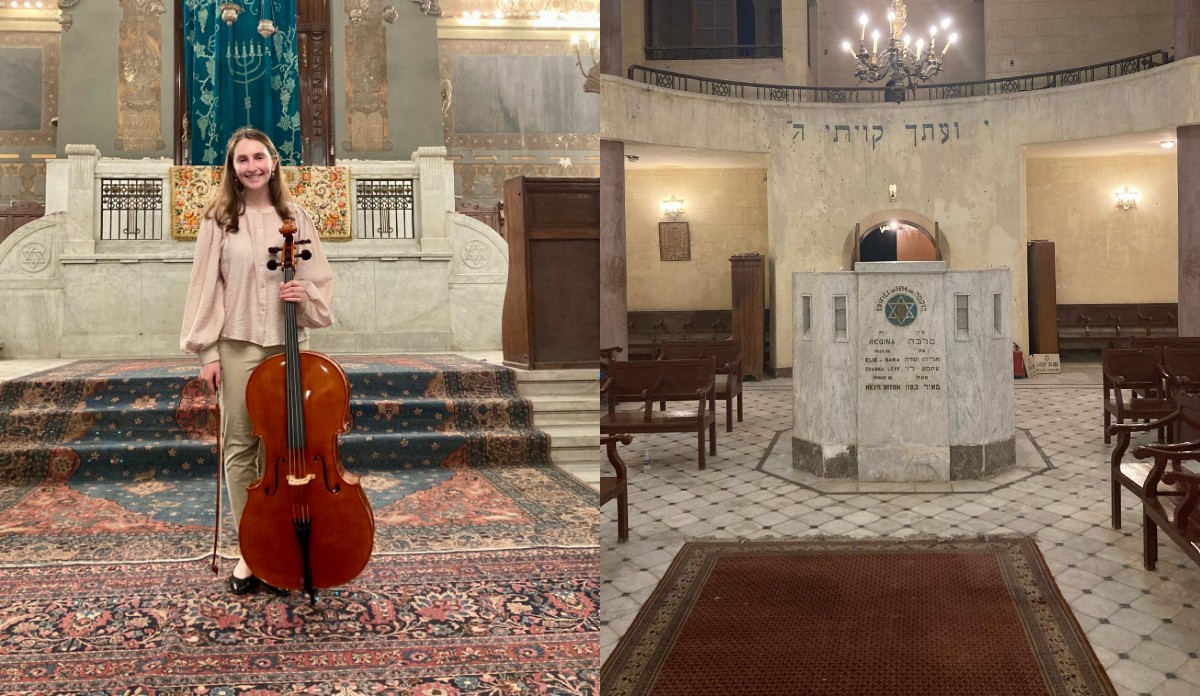
From 2022–2023, I attended many Drop of Milk events. A lecture at Sha’ar HaShamayim. The opening of the renovated Basatin Karaite Jewish Cemetery, which is the second oldest operational Jewish cemetery in the world. A talk at the American Research Center in Egypt (ARCE) delivered by the President of the Karaite Jews of America, an Egyptian Jewish man who left Cairo in 1962 at age twelve.
That year, I played music at synagogues in Maadi and al-Korba (Heliopolis). I led a group singalong for Hannukah, a Jewish holiday. Much to my surprise, one of my long-time music idols Lena Chamamyan was in attendance along with the renowned jazz musician Yehya Khalil.
In 2023, my husband Ahmed and I performed songs together at the al-Korba synagogue. It was a momentous occasion; the first time Rosh Hashanah had been celebrated at this synagogue in 70 years. We played songs by Leila Mourad, Daoud Hosni, and other prominent Jewish figures in Egyptian music history. Afterward, a woman thanked us and shared that she had grown up attending this synagogue before relocating to Europe.
That year, I also played music for an International Holocaust Remembrance Day event in Cairo. Ruth Cohen, a Holocaust survivor, had flown to Cairo to address around 150 foreign dignitaries and implore them to learn from the past and educate the public. I played Ernest Bloch’s “Prayer from Jewish Life,” and in my heart, I held a prayer for genuine peace.
Peace was not on the horizon. I never could have imagined the genocide in Gaza that ensued. The constant heartbreak.
Everything came to a halt. Holiday celebrations ceased because Drop of Milk President Magda Haroun decided that it would not be appropriate to celebrate given the regional political circumstances. I began to hear “al-yahūd” (“the Jews”) used in reference to the Israeli government and military. I am strongly anti-Zionist, as is Magda Haroun. Yet, it became clear that many people conflate Judaism with Zionism, unaware of the strong contingent of anti-Zionist Jews around the world.
Over the past year, I was a fellow at the Center for Arabic Studies Abroad (CASA) program at the American University in Cairo (AUC). In the program, we watched the film Salaṭa Baladī (2007), a film documenting an Egyptian family with mixed Jewish, Muslim, and Christian heritage. The director and writer of the documentary Nadia Kamel came to AUC Tahrir to discuss the film with us.
After the talk, I began reading Nadia Kamel’s book al-Mawlūda (The Newborn) written about her mother. This book is written in Egyptian colloquial Arabic, lending authenticity to the everyday life described. I continue to educate myself by reading, visiting historical sites, and following Egyptian Jewish heritage groups. Although holidays are not currently being observed, some of the Egyptians I met at the synagogues still send holiday greetings. There is ‘eish wa-malḥ between us.
This entry is a top ten place winner of Egyptian Streets’ 2025 “Timeless Tales: Cultural Heritage Writing Competition,” in partnership with FairTrade Egypt and Bibliothek Egypt. Entries featured first-person narratives of Egypt’s cultural heritage through Ancient Egypt, Coptic, Islamic, Jewish traditions, and tangible/intangible expressions. Winners were celebrated at Bibliothek Egypt in October 2025, with 13 top stories published on our platform.
KioskNews shows a cleaned-up reading view extracted from the publisher’s page — the original always lives on their site, not ours.