Hay Fever review – Richard E Grant and Christine Baranski host Coward’s country house shenanigans
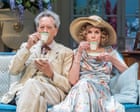
Hay Fever, now one of Noël Coward’s best-known and most-performed works, hasn’t always been a smash hit. British critics who found its West End debut in 1925 amusing enough nevertheless noted its lack of plot, and the first Broadway production was a flop. A critic for Vogue called it “funny in places”, which sounds like the kind of stinging putdown you’d expect from the playwright’s own hand.
A century of performances have proved the play’s lasting power, but its comic effect has always lain less in the words as written than their delivery – it is, after all, about a family that is “artificial to the point of lunacy”. At their centre is diva Judith Bliss, who has retired from the stage to take up the role of country hostess. When she, her husband and their self-consciously bohemian children Sorel and Simon all invite surprise guests for the weekend, the unfortunate attendees find themselves embroiled in a self-serving drama of exquisite embarrassment.
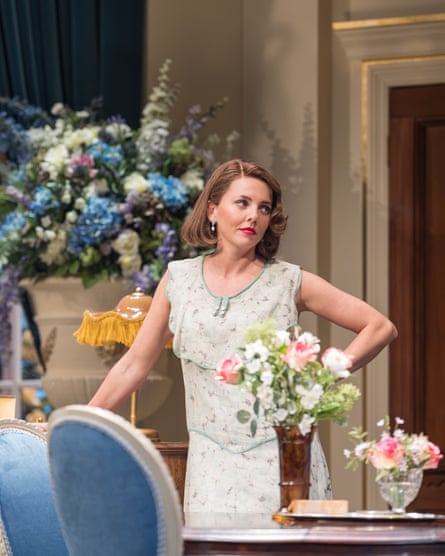
The action takes place on Frankie Bradshaw’s sumptuous set, with corniced ceilings and French windows at the Blisses’ Berkshire pile that are almost an extension of the Wyndham’s ornate interior. The stage is populated with effusions of flowers and a fine cast, not least Richard E Grant who seems to be having a heyday of robe-and-slipper roles. He brings his trademark shock-haired vigour to the narcissist-novelist David, bounding down a grand staircase to read his latest work to his family.
Will Close’s Simon swings from pretentious artiste – in paint-stained plus-fours and buttoned boots – to Tiggerish lover at the arrival of the experienced Myra (a statuesque Nancy Carroll). And even the seen-it-all-seductress is less in command than she thought as the games progress from after-dinner entertainments to more overtly saucy ones. Charles Edwards, meanwhile, maintains an endless gallantry as the visiting diplomat whose social skills are strained to the limit as he falls beneath Judith’s spell.
Judith was inspired by real-life American actor Laurette Taylor – excuse enough, should Christine Baranski have chosen, to play the part in her own accent. Instead, a technically sound RP oddly constrains her. Judith’s combination of pretend languor and genuine vagueness mean that jokes go begging and some lines land too earnestly, as when she tells her daughter: “I’m very glad you’re pretty.” The squabbles and blow-ups are comically theatrical enough, but there’s not enough of Judith’s much-vaunted “vitality” to entirely make sense of them when they come.
Instead it’s Ophelia Lovibond’s Sorel who emerges as the most vital character. She’s the only one of the bunch with any self-awareness, a smile half-playing on her lips, radiating charm that makes even her own selfishness seem forgivable. Director Emily Burns’s CV majors in farce and she stages some lovely bits of business, including a scene when a servant silently lays a breakfast table to a swellingly romantic soundtrack and a Gone With the Wind-crimson backdrop. On the first of multiple press nights, some of the comic timing isn’t quite up and running – but a stronger second half suggests that when the production beds in, there will be plenty of classic Coward to enjoy.
KioskNews shows a cleaned-up reading view extracted from the publisher’s page — the original always lives on their site, not ours.