[Column] What it will take to make a US-North Korea summit happen
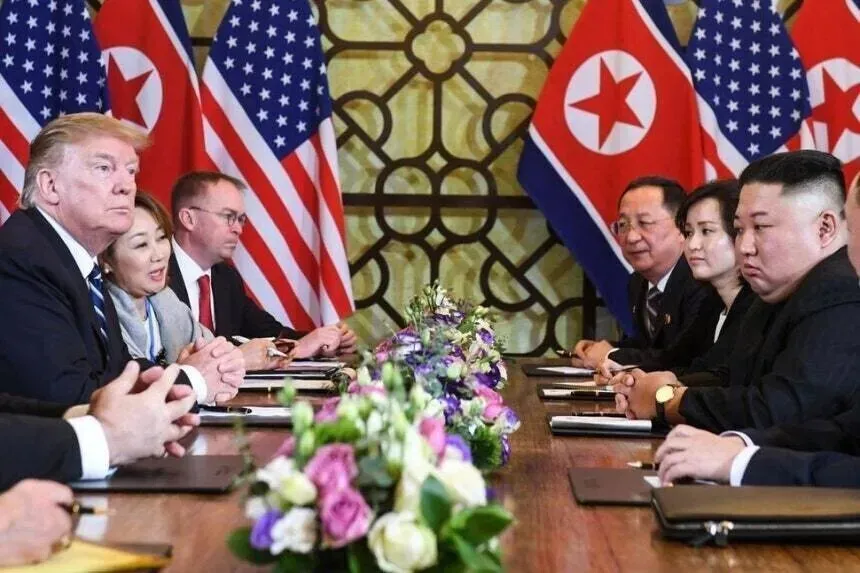
US President Donald Trump and North Korean leader Kim Jong-un sit across from one another during their bilateral meeting in Hanoi, Vietnam, on Feb. 28, 2019. (Yonhap)
By Chung-in Moon, James Laney Distinguished Professor at Yonsei University
Only a month remains before the Asia-Pacific Economic Cooperation (APEC) summit in the Chinese city of Shenzhen.
While the agenda will cover a range of topics, Koreans are undoubtedly most interested in the possibility of a summit between the North Korean and American leaders. US President Donald Trump has expressed confidence that North Korean leader Kim Jong-un will accept his proposal for dialogue.
The South Korean intelligence community gives the Trump-Kim summit 50:50 odds, while Chinese experts I met on the ground last week said there is a greater-than-50% chance of the summit taking place.
But hopes were deflated when Trump told a reporter on Oct. 19 that he was unsure about the chances of a summit with Kim. For the moment, prospects are unclear.
The fact is that, for Kim Jong-un, a reunion with Trump might be attractive for a number of reasons. Along with reinforcing his personal ties with Trump, such a summit could serve to greatly elevate his international prestige, as well as that of North Korea.
Given North Korea’s aspirations of becoming a “normal state” with a seat in the international community, just standing shoulder to shoulder with the leaders of world powers such as the US, China and Russia is itself a source of national pride. On top of that, moving closer to Washington could give Pyongyang a strategic opportunity to brush off Seoul and Tokyo.
So in terms of strategic calculations and buffing his reputation, and the reputation of the North Korean state, Kim could certainly decide to sit down with Trump.
But under Kim, North Korea puts as much importance on practical gains as on propaganda coups. Kim is still recovering from his Hanoi hangover, and he surely wants not just a diplomatic dog-and-pony show but meaningful results as well.
North Korea’s Foreign Ministry has an even bigger reason to insist on a positive outcome.
Let us rewind the tape to Kim’s summit with Trump in Hanoi back in 2019. Late at night on Feb. 28, 2019, North Korean Foreign Minister Ri Yong-ho convened a last-minute press conference, in which he detailed the reasons for the breakdown in negotiations.
According to Ri, North Korea had sought relief from sanctions in five areas affecting the civilian economy under 11 UN Security Council resolutions adopted in 2016 and 2017 — namely, restrictions on exports of iron ore, coal, seafood and textiles; on imports of crude and refined oil; and on investment and joint ventures in North Korea.
In exchange, Pyongyang offered to permanently and completely dismantle nuclear production facilities at Yongbyon and to permanently suspend nuclear weapon tests and test launches of intercontinental ballistic missiles (ICBM). But Ri said that the US had rejected that proposal, demanding more concessions from North Korea than simply dismantling the Yongbyon complex.
Ri, who was held responsible for the summit’s failure, was later dismissed and reportedly purged.
That makes it extremely unlikely that North Korea will engage in dialogue or negotiations unless success is guaranteed.
A potential alternative lies in the two proposals that South Korean President Lee Jae Myung put forward in his September speech at the UN General Assembly.
Lee proposed first that, instead of treating denuclearization as a prerequisite, Seoul and Washington could shift to a phased approach that would begin with a freeze on nuclear and missile capabilities, followed by reductions and ultimately their complete elimination. Second, he proposed holding talks with no preconditions in which North Korea could offer to suspend development of nuclear weapons and long-range missile technology in exchange for partial sanctions relief.
Given its similarity with North Korea’s proposal in Hanoi, that does sound like a practical proposal, but the chances of American buy-in are low.
Let us assume that North Korea offers to close its Yongbyon facility, along with something extra — such as shutting down facilities that produce highly enriched uranium at Kangson or Kusong, for example. Let us further assume, in this hypothetical scenario, that the US makes a really surprising offer: shelving its “policy of hostility” against North Korea, normalizing bilateral relations, suspending joint military exercises with the South, lifting its unilateral sanctions in finance and other areas, guaranteeing the peaceful use of nuclear energy, and clearing the way for overseas investment in North Korea.
Under those conditions, Pyongyang might indeed be keen to engage in dialogue with Washington.
There are procedural issues that need to be addressed as well. If Trump really wanted to pursue dialogue with Kim, he ought to have appointed a special envoy to hold off-the-record deliberations while also setting up a task force to send an unmistakable signal about specific incentives. But instead of such measures, Trump has improvised with vague, off-the-cuff remarks, giving Pyongyang ample reason to doubt his sincerity.
Finally, the idea that any dialogue or negotiations with North Korea must be predicated on its complete, verifiable and irreversible denuclearization remains dominant in both South Korea and the US.
In addition, it is widely believed that sanctions relief cannot be used to bring North Korea to the negotiating table and that both sanctions and pressure are needed to hold the upper hand in negotiations with the North. Under this view, the ROK-US joint military exercises are not up for negotiation either.
As long as such thinking holds sway, Kim has no reason to engage in dialogue.
Even if he did, and even if an agreement were reached, the resulting agreement’s implementation might well run aground because of domestic politics. That is why a deal needs to be preceded by a paradigm shift on denuclearization.
The ball is in Pyongyang’s court, to be sure. But to instill confidence in Kim’s choice, Trump needs the boldness to make an irresistible offer with incentives that are not only symbolic, but also substantive.
There is still time to achieve that, and I will keep my fingers crossed for a game-changing offer.
KioskNews shows a cleaned-up reading view extracted from the publisher’s page — the original always lives on their site, not ours.