Can Australia’s Pacific diplomacy with Solomon deal match China’s enduring influence?
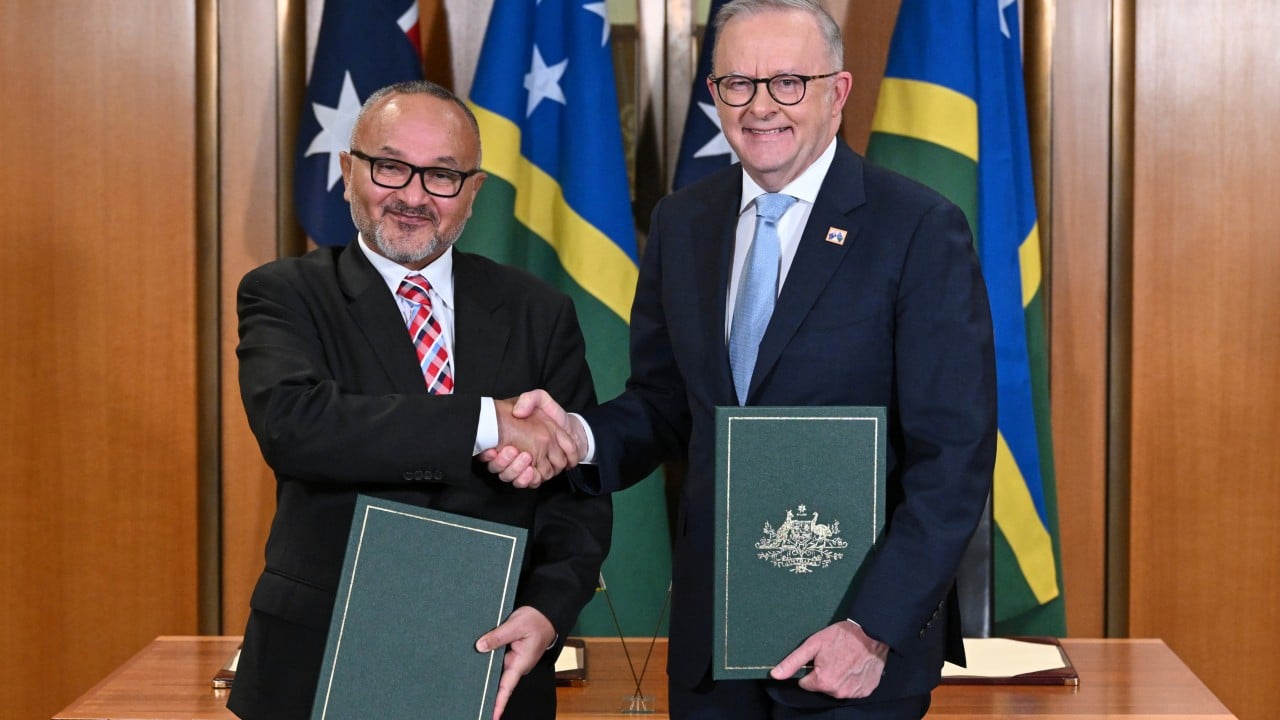
Australia’s new bilateral treaty with the Solomon Islands is seen as a significant victory for Canberra’s strategy of banking on development aid, economic sweeteners and long-standing defence ties to assert influence in the Pacific.
But analysts say the durability of such gains for Australia will hinge on whether it can deliver on development commitments and address the needs of Pacific island nations, which remain keen to diversify partnerships and not risk jeopardising ties with China.
On Wednesday, Australia and the Solomon Islands signed a security pact that makes Canberra the country’s defence partner of choice, marking a shift for the Pacific archipelago after it previously signed a similar deal with China.
The agreement would see Canberra shoulder a greater role in the Solomon Islands’ police and border force, the leaders of the two countries said in a joint statement, and require Honiara to consult its partner on critical infrastructure.
“Australia is proud to be the Solomon Islands’ main security partner, and that’s a responsibility that we take seriously,” Australian Prime Minister Anthony Albanese said at a news conference with his counterpart, Matthew Wale.
Wale said the treaty provided a reset after several years in which the Solomon Islands had been a point of “uncertainty and doubt in the region”.
“Those days are done, gone,” said Wale, who was elected in May and had been highly critical of the 2022 security deal with China, warning it would affect regional security and could jeopardise relationships with existing partners.
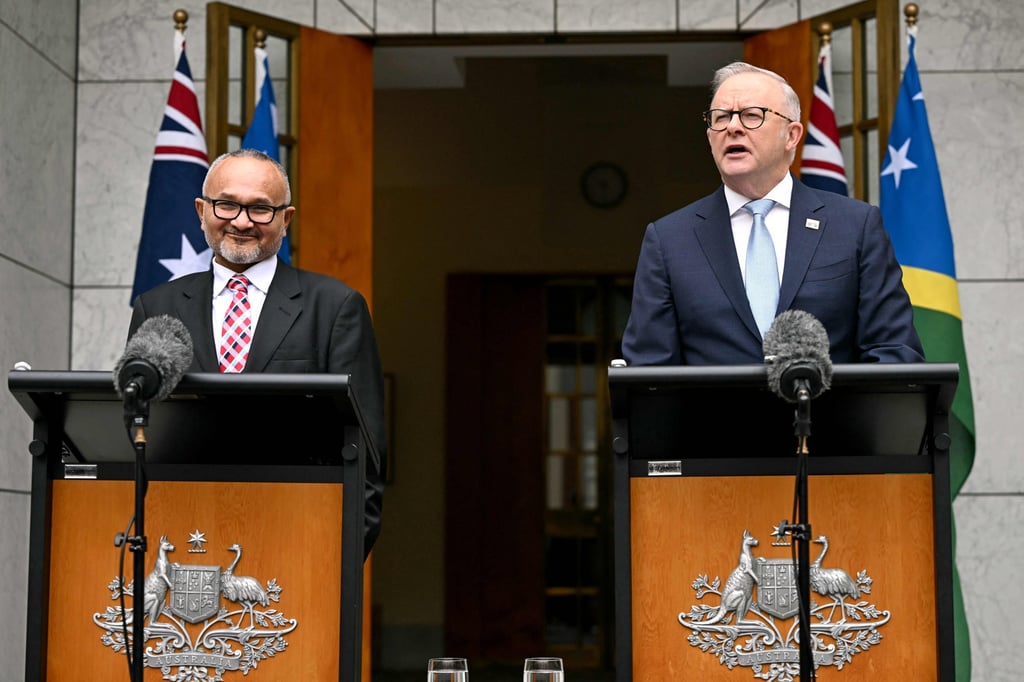
The deal is seen as a major diplomatic win for Canberra, which in recent years has been battling Beijing for influence in its own backyard.
The 2022 China-Solomon Islands security pact, which was never officially released in full, authorised security, policing and naval logistics cooperation for five years.
Apart from allowing Honiara to request Chinese police, armed police, military personnel and law enforcement to help maintain social order, the deal also allowed Beijing to make naval ship visits and conduct stopovers and transits in the Solomon Islands.
Bernard Yegiora, an international relations lecturer at Divine Word University in Papua New Guinea, warned that allowing the security pact with China to lapse risked straining ties with Beijing.
“I expect Wale will want to reassure China that the Solomon Islands still values its development partnership,” he said, noting that development projects under China’s Belt and Road Initiative were separate from the 2022 security pact.
“Wale has room to continue working with Beijing on development projects even as he gives Australia a more prominent security role.
“Australia’s ability to deliver on its commitments, including infrastructure and development funding, will matter to how much room Honiara has to manage both relationships,” Yegiora said.
While former Solomon Islands leader Manasseh Sogavare saw China as a partner that could help address security needs, Yegiora said Wale appeared to lend greater weight to Australia’s record as a defence partner.
In particular, he pointed to Canberra’s role in the Regional Assistance Mission to Solomon Islands, a multinational intervention and stabilisation mission that ran from 2003 to 2017.
Australian media outlets reported that Wale’s government had informed China it would not renew their security pact when the five-year term ends in April.
At China’s foreign ministry regular press briefing on Wednesday, spokesperson Guo Jiakun did not confirm if the deal had been dropped.
Guo reiterated that in developing relations with Pacific island countries, all countries needed to respect their independence, put development first and uphold openness and inclusiveness.
“Relevant cooperation should not target any third party,” Guo added.
Since establishing diplomatic ties in 2019, Beijing and Honiara have cooperated on a wide range of infrastructure, energy, healthcare, education, agriculture and policing projects.
Ying Zhu, a professor in the College of Business and Law at Adelaide University, said that apart from taking a greater role in the Solomon Islands’ police and border force, Australia had likely pledged “substantial support” for Honiara’s free education policy while supporting development and investment in local communities.
Canberra also increased ongoing investment in sustainable infrastructure, including roads and renewable energy, Zhu said, noting that its contribution will amount to A$740 million (US$491 million).
“Canberra will also open up new migration pathways for Solomon Islanders who want to work in Australia in aged care and child care, as well as liberalise visa arrangements for its citizens.”
“These favourable offerings had sweetened the deal,” Zhu said, adding that since being elected, Wale had tried to rebalance the country’s relationship with more focus on traditional partners such as the US, Australia and New Zealand.
“However, the reality is that China is the major trading partner of both countries and other countries in this region.”
“Any treaty between them cannot be explicitly aimed against China’s interests,” Zhu added.
Alan Tidwell, director of the Centre for Australian, New Zealand and Pacific Studies at Georgetown University, said the term “defence partner of choice” echoed the recent deal between New Zealand and the Cook Islands.
Signed in April by New Zealand Foreign Minister Winston Peters and Cook Islands Prime Minister Mark Brown, the declaration eased tensions following a 2025 Avarua agreement with Beijing and led to the resumption of roughly NZ$30 million (US$16.5 million) in annual funding from Wellington.
Pointing to the long and deep relationship between Australia and the Solomon Islands, Tidwell said the agreement “speaks volumes” about the push by Australian Foreign Minister Penny Wong and Minister for Pacific Island Affairs Pat Conroy.
“Australia has secured agreements with Tuvalu, Nauru, Fiji, Vanuatu and now the Solomon Islands,” Tidwell said, referring to the deals secured since 2023.
KioskNews shows a cleaned-up reading view extracted from the publisher’s page — the original always lives on their site, not ours.