CULTURAL PHENOMENON: Star Trek at 60 and the optimistic future it still dares us to imagine
Years ago when I served in Washington for a few years between overseas assignments in Pretoria and Tokyo, I backstopped our embassies in Tokyo and Seoul to solve bureaucratic snarls on international exchanges, media relations and related concerns.
One of the US government bodies I dealt with was the smallest agency of the government, the Japan-US Friendship Commission. Despite having only four full-time staff members, it actually was in a crucial position to nurture connections across the spectrum of relationships between the two nations.
One day I learned there was a new vacancy on its governing commission (after all, what’s a commission without commissioners), and the vacancy needed to be filled with the right kind of person. I was tasked to think of an appropriate individual who could be appointed to that body.
As a true fan of the Star Trek universe of television shows and films, it was almost instantly clear to me that helmsman Hikaru Sulu was the right man for the job. In the real world, of course, Hikaru Sulu was the Japanese-American actor and social activist, George Takei.
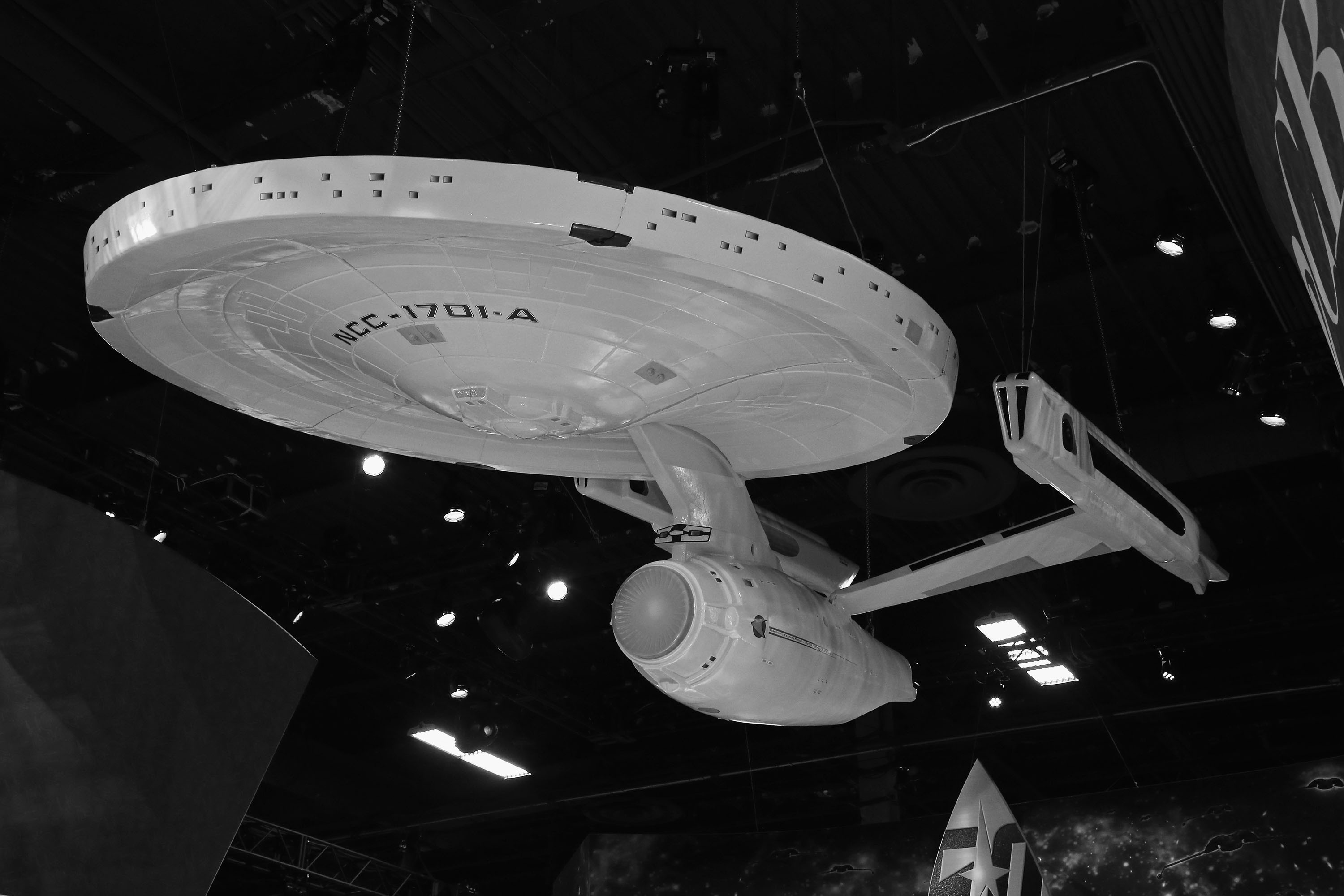
/file/attachments/orphans/Brooks-StarTrek-60b_763695.jpg "(L-R) Sharon Dunlap, \"Scottie\" Ron Warren, and \"Lt. Uhura\" Lenora Brown pose for photographs before a model of the Starship Enterprise during Trek Fest XIX June 28, 2003 in Riverside, Iowa. Nearly 20 years ago the small town was recognized as the official \"future\" birthplace of James T. Kirk by Star Trek producers after it was written in an episode that he is born in a small Iowa town March 22, 2228. The annual event draws Trekkers from around the world. (Photo: David Greedy/Getty Images)")
Finder’s fee
I tracked down his home phone number, called him, and explained who I was and how he could help his personal and the country’s interests by being available for consideration for this appointment. Intrigued by the idea, Takei agreed I could send his name forward to the senior types who would make the final decision. My superiors enthusiastically agreed and Takei was appointed. My price for reaching out to him was simple: just a signed photograph of him in full Star Trek regalia. (Note my big smile right about now.)
Such was his public visibility role as the Enterprise’s helmsman that eventually he also became a board member of the Japanese American National Museum in Los Angeles, a spokesperson for LGBTI rights, as well as an influential activist regarding the treatment of Japanese Americans during World War 2 in internment camps. All this was in addition to his growing body of television and film work, including reprising his Star Trek role.
But we must now celebrate the rise of Star Trek on the 60th anniversary of its first television broadcasts. Yes, there were – before and after Star Trek – a variety of television series featuring extraterrestrial figures such as My Favorite Martian, Battlestar Galactica, Mork and Mindy, and Babylon 5, as well as a vast catalogue of science fiction films. But Star Trek was different.
/file/attachments/orphans/Brooks-StarTrek-60d_964890.jpg "William Shatner, \"Star Trek\" creator Gene Roddenberry and Patrick Stewart (Photo: Albert L. Ortega/WireImage)")
At its centre was an interplanetary federation comprising beings from vastly different backgrounds, planets, and biologies and that would be both normal and inevitable, and they co-existed as a cohesive team aboard a massive spaceship.
Crucial to the uniqueness of this concept was that this series was being watched amid the international tensions at the peak of the US-USSR Cold War. Moreover, the series came along just as the race to land (and successfully return) a manned mission to the surface of the Moon was close to achieving its goal. Viewer interest on space exploration was at its peak.
The concept for Star Trek was Gene Roddenberry’s. He was a World War 2 bomber pilot who had seen combat, became a peacetime policeman, and eventually worked his way into television show production. None of the leaders at the three networks (ABC, NBC and CBS) were really keen on the concept of this show, but it was relentlessly supported by Lucille Ball, the sitcom star and (behind the scenes) power in her and her husband’s successful independent television production house, Desilu Studios.
/file/attachments/orphans/Brooks-StarTrek-60f_451734.jpg "Pan American airways pilot, third officer E W Roddenberry, better known as Gene Roddenberry, creator of the Star Trek television series and franchise, circa 1947. (Photo: Keystone/Archive Photos/Getty Images)")
Cast of relatively unknown actors
A cast of relatively unknown actors was brought together, and after some initial hiccups, it settled into an increasingly solid rhythm with William Shatner and Leonard Nimoy delivering their interplanetary brothers-from-different-mothers partnership. The cast of characters incorporated Nichelle Nichols as Nyota Uhura from the African continent, as well as a would-be Russian, Pavel Chekov, chief engineer Montgomery Scott, Dr Leonard “Bones” McCoy, and Hikaru Sulu, among others.
The centre of the storyline was the partnership of the indomitable, iron willed but impetuous ladies man, Captain James T Kirk, and Mr Spock. The latter was a half-Vulcan/half-human chief science officer whose core was the Vulcan belief in the primacy of logic. The longer the show ran, the more tightly knit those two characters became as crew comrades and friends.
/file/attachments/orphans/Brooks-StarTrek-60m_893497.jpg "Kino, Star Trek - Der Film, 1970er, 1970s, Film, Science Fiction, Star Trek: The Motion Picture, Star Trek - Der Film, 1970er, 1970s, Film, Science Fiction, Star Trek: The Motion Picture, DeForest Kelly, William Shatner, Leonard Nimoy Capt. Kirk (William Shatner,m) und 'Pille' Dr. McCoy (DeForest Kelly,l) sorgen sich um den Vulkanier Mr. Spock (Leonard Nimoy)., 1978. (Photo: FilmPublicityArchive/United Archives via Getty Images)")
One lesser-known feature in the show was the impact of both Shatner and Nimoy’s Jewish religious background. That now nearly universally known Vulcan phrase, “Live long and prosper”, and the hand sign that accompanied it with its two sets of fingers each joined together and an outstretched thumb had been derived from Nimoy’s childhood exposure to the birkat kohanim (the priests’ blessing) hand sign of religious, orthodox Jews.
By the end of the third season of Star Trek, though, none of the national television networks were prepared to commission a fourth season and the crew of the Enterprise dispersed to other acting pursuits. Captain Kirk, er, William Shatner, even found himself in debt and living in a camper van.
But then something strange happened. The show kept running on local television stations in syndication (as opposed to first-run broadcasts by a network) to eager audiences. Soon enough, too, informal gatherings of fans became conventions with speakers and former cast members putting in cameo appearances.
Hunger for the storyline
Eventually, the hunger for the storyline resonated with producers and the cast was reassembled for cinematic feature films. Soon enough, too, work began on a sequel series, Star Trek, The Next Generation. A Shakespearean actor, Patrick Stewart, was signed on as the captain of the new Enterprise. (Most fans managed to get past the slight weirdness of a Shakespearean actor speaking with a Received Pronunciation accent but with French roots and a brother caring for the family’s vineyards back on Earth.)
This crew of this Enterprise now included a member – Worf – a Klingon, a species generally the sworn enemy of humans, Guinan from an ancient non-human lineage (played by Whoopi Goldberg), as well as a range of other non-human crew members.
This time around, the opponents to the Federation were alien races such as the Borg (short for the Cyborg, an amalgam of biological and electronic entities whose catch phrases were: “Resistance is futile; You will be assimilated”), Romulans and Cardassians. This show, in turn, spawned yet another stream of episodes, Deep Space 9, with new races to contend with such as Bajorans and Ferengi – as well as more than a touch of the beliefs found in New Age spiritualism and mysticism.
/file/attachments/orphans/Brooks-StarTrek-60a_307641.jpg "Leonard Nimoy as Mr. Spock in the television series, \"Star Trek.\" (Photo: Getty Images/ TV stills)")
/file/attachments/orphans/Brooks-StarTrek-60j_705706.jpg "Actor William Shatner attends 'Star Trek Mission: New York' at The Jacob K. Javits Convention Center on September 4, 2016 in New York City. (Photo: Noam Galai/WireImage)")
Still more spinoff programmes followed such as Star Trek Voyager with its mixed crew of Federation officers, once-and-former rebels, and an AI hologram as the ship’s doctor. Then came Enterprise, the precursor to the entire original story line, placed in the time shortly after the Vulcans and Earthlings had first met, once humans had invented the faster-than-the-speed-of-light warp drive.
There were animated TV series, comic books and graphic novels, and a whole slew of novelisations of the basic story line.
Most recently there has been the Star Fleet Academy series, although it has presumably just been cancelled in response to some not-so-veiled protests by MAGA folks citing too much diversity in the cast and story lines.
/file/attachments/orphans/Brooks-StarTrek-60i_930827.jpg "A life-size replica of the bridge from the USS Enterprise from the \"Star Trek\" television franchise is displayed during the 15th annual official Star Trek convention at the Rio Hotel & Casino on August 3, 2016 in Las Vegas, Nevada. (Photo: Gabe Ginsberg/Getty Images)")
With the right streaming platforms loaded, it is likely someone could watch virtually every episode from each of these different series 24/7, plus all the movies and cartoons. The Smithsonian Institution had the original flight deck of the Enterprise installed in its exhibition halls a few years ago.
Meanwhile, the Star Trek universe received a magnificent send-up in the film Galaxy Quest, with a cast featuring Sigourney Weaver, Tim Allen, Alan Rickman, and Tony Shalhoub. The crux of this film had a gentle, credulous alien race, the Thermians, being attacked by a monstrous one, with the Thermians believing television broadcasts of the old TV series they had monitored from afar were depicting actual events.
And so, what is the reason for the phenomenal success and longevity of the Star Trek universe? In fact, it took time for some of the cast members, especially Leonard Nimoy, to accept the reality of their Star Trek characters’ fame. After the original series ended, Nimoy had written a memoir, I Am Not Spock, even as he had gone on to direct several feature films, including two of the Star Trek features.
I Am Spock
Eventually, though, he came to embrace his status with a follow-on memoir, I Am Spock, recognising the importance of the character he had given life to.
The impact of the Star Trek universe may be explained, at least in part, because so many of its story lines are deeply aspirational, a subliminal mixture of idealistic Marxism and Benthamism (striving for the maximum benefit for the maximum number of people).
/file/attachments/orphans/Brooks-StarTrek-60k_282802.jpg "Photocall with actor Nichelle Nichols, Star Trek's original Lieutenant Uhura part of Star Trek at 50 at BFI Southbank on October 1, 2016 in London, England. (Photo: Mike Marsland/WireImage)")
Values like tolerance, cooperation (inter-racial and inter-species, including the first interracial kiss on broadcast television between Captain Kirk and Uhura), a universe virtually free from want or incurable illness, restraints on the use of force except in extremis, the use of science and technology for the good, a requirement to protect and tolerate the mores of societies the crew comes into contact with, and an explicit awareness of the need to protect the environment all underpin the stories.
But back here in the real world – where wars, famines, humanitarian catastrophes, the threat of disastrous climate change, and now the growing possibility of runaway technologies such as AI are the content of daily news broadcasts – the Star Trek universe is, by contrast, a resolutely optimistic one that asserts we will overcome these dangers, but only if we work thoughtfully enough to harness our knowledge, talents and skills for the betterment of everyone.
The dualities of Kirk and Spock in the original series and Captain Jean-Luc Picard and Data the android in The Next Generation both seem to represent a marriage of head and heart, logic and humanity – both are necessary qualities. Thus we can applaud the predictions in the Star Trek universe that we shall survive and that we will, as the Vulcans say, “Live long and prosper.”
KioskNews shows a cleaned-up reading view extracted from the publisher’s page — the original always lives on their site, not ours.