‘Each artist on their own terms’: why Lee Krasner was every bit the equal to husband Jackson Pollock
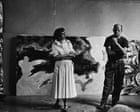
In addition to managing her own career as an artist and being a devoted partner to an often unpredictable and tumultuous Jackson Pollock, Lee Krasner had at least one other duty – acting as the unofficial publicist to her husband’s career.
“She was a great champion of Pollock’s work, but also so aware of the gender politics of the time,” says curator David Breslin, who alongside Brinda Kumar worked for three long years to bring a new blockbuster dual show, exploring the arc of Pollock’s and Krasner’s careers, to the public at New York’s Metropolitan Museum of Art. “She was such a realist, she knew if there was one person in the couple who would sell, it was him. She wanted to pay the bills.
“She did it all, right down to down to folding the programs in the gallery,” adds Kumar. “When Pollock was taking off, Krasner’s career was static.”
Gender politics is one of the reasons that Krasner remains in Pollock’s shadow to this day, despite many accolades – she was one of vanishingly few female artists granted a solo retrospective at the Museum of Modern Art, and prices for her work on the art market have vaulted up to as much as $10m.
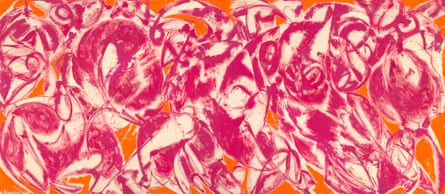
The differences between these two careers were something that Breslin and Kumar grappled with while curating this massive venture, which saw loans from over 80 institutions worldwide and spans over 120 paintings, including work from Modigliani, Matisse, Picasso and de Kooning. While Pollock’s rise was meteoric and his fame immense, Krasner created steadily for a much longer time period, working for two full decades after her husband’s death in a driving accident in 1956.
“We don’t try to make balances where they aren’t there,” says Breslin. “We let it show that the disparity was real.” Kumar adds, “We found it productive to think in terms of the creative adjacency that informs their practice, a looking back and forth.”
Pollock and Krasner happened to meet at a pivotal New York exhibition curated by the artist John Graham at McMillen Inc. The show has become storied for launching the careers of both Pollock and de Kooning, while also juxtaposing leaders of the New York School with Parisian greats.
At the time of that meeting, the socially adroit Krasner was by far the better connected of the two, whereas Pollock was something of a recluse. “Krasner knew everybody at the time, Pollock wasn’t such a mixer,” says Kumar. “The one person she didn’t know at that show was Pollock.”
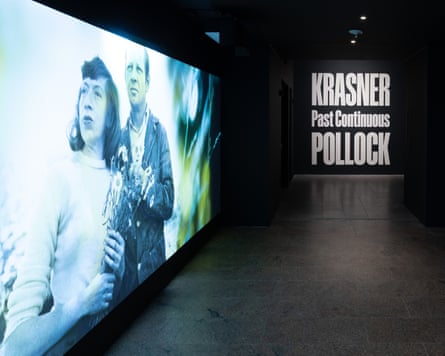
This groundbreaking exhibition is re-created in part in the Met’s show in a gallery that seeks to let audiences feel as though they are walking through that gallery itself, intermingling Pollock and Krasner with many of Europe’s great artists “We wanted to give a sense of what was up for grabs at the time,” says Breslin.
“Both how much they were a product of the time and how much they diverged and went away from what was typical of the era’s styles.”
After moving to Long Island together in 1945, the two artists would spend years creating alongside one another, seeing their creativity refracted and reflected through each other’s work. Coming from vastly different traditions – Krasner was a consummate New Yorker with an impeccable scholarly pedigree, whereas Pollock was a creature of the untamed west, profoundly influenced by Mexican muralism, Indigenous artists – they found ways to support one another’s development as artists.
“Krasner had the best art training that anyone in America could have had at that moment,” says Kumar. “But when you become too schooled you can lose yourself. Her encounter with Pollock gave the freedom to break away – once she found that freedom she was so free.”
According to Breslin and Kumar, Krasner introducted Pollock to the work of Matisse, who was to become a major influence for both artists, particularly through the MoMA’s enormous 1951 Matisse retrospective, where they were especially inspired by the Frenchman’s late career cutout works. “Krasner and Matisse give Pollock permission to use color in a different way,” says Breslin.
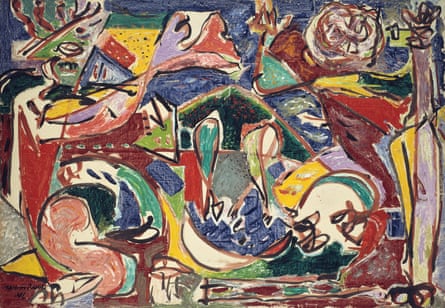
The Met is not the first institution to showcase both artists together, but it has taken a number of steps to distinguish its exhibition from earlier shows. By extending their time frame to the periods both before and after they were together, Breslin and Kumar are able to tell the story of each’s career, while also showing work that isn’t always curated into exhibitions of these artists.
For as much as they explore their mutual influence on one another, Breslin and Kumar were also careful to avoid doing a “compare and contrast” of the two artists. “There’s so much focus on ‘who did what first?’, ‘who did the drip first?’” says Breslin.
“We wanted to undo this. These ideas were in the air, they worked in a circle of other artists.” Kumar adds: “We create moments of encountering each artist on their own terms.”
The show’s name, Past Continuous, is derived from a group of paintings that Krasner made late in her career, each one titled for a different verb tense: Future Indicative, Imperative, Imperfect Indicative, Past Continuous. Breslin explained that the idea of a continuous past became a metaphor for each artist, since they never refuse their individual and collective pasts, but rather let them keep coming back forward in their lives and art. “To have that past continue into the present and into the future is something that we wanted to have in the exhibition,” he says.
“Krasner said it,” adds Kumar. “‘I believe in continuity. The past is part of the present, which becomes part of the future.’”
-
Krasner and Pollock: Past Continuous is at the Metropolitan Museum of Art, New York, until 31 January 2017
KioskNews shows a cleaned-up reading view extracted from the publisher’s page — the original always lives on their site, not ours.