New festival on racial and religious harmony allows youth to learn about different scents, tastes
SINGAPORE – Despite being Buddhist, undergraduates Evlin Woo and Chloe Chua did not know the origins of the familiar scents that form part of their religious heritage.
At a festival celebrating racial and religious harmony held at the Singapore Management University on Sept 18, they got up close and personal with Bodhi leaves, mani pills and joss sticks made from sandalwood and agarwood.
These items were part of experiential booths meant to help young people understand different cultures and beliefs.
The event was jointly developed by 80 youths from the Youth Leaders @ Harmony Circle (YLHC) with 15 student cultural, faith-based and interfaith clubs across four institutes of higher learning (IHL) and other youth groups.
The festival, led by the YLHC and supported by the Ministry of Culture, Community and Youth, will be held every two years at a different institute of higher learning.
On Sept 18, more than 600 attendees got intimate with the tastes and scents of different cultures.
Chua, who studies accountancy, said: “A lot of the scents were familiar, but I think we never heard of the origin.”
In addition to the different tastes and aromas from different cultures, attendees also got to touch objects, as prayer beads, sacred threads and cloths.
Woo and Chua said they also learnt about the different objects belonging to the Judaic faith, such as tefillin – two black leather boxes with straps worn by men each weekday morning before prayer – and tallit, a fringed prayer shawl.
“They also shared about their culture and their beliefs and how they don’t use their phones or any devices on Saturday. It was nice to hear that it was part of their culture,” said Chua.
Software engineer Fathima Raeesah learnt that Taoism and Hinduism share common beliefs when it comes to incense. Both religions believe that rising incense smoke represents the ascension of prayer towards God.
“I was able to see how the different religions have a lot of similarities between different aspects such as their flavours and scents. While learning about the differences, it is also a way to embrace the similarities they share,” said the 25-year-old.
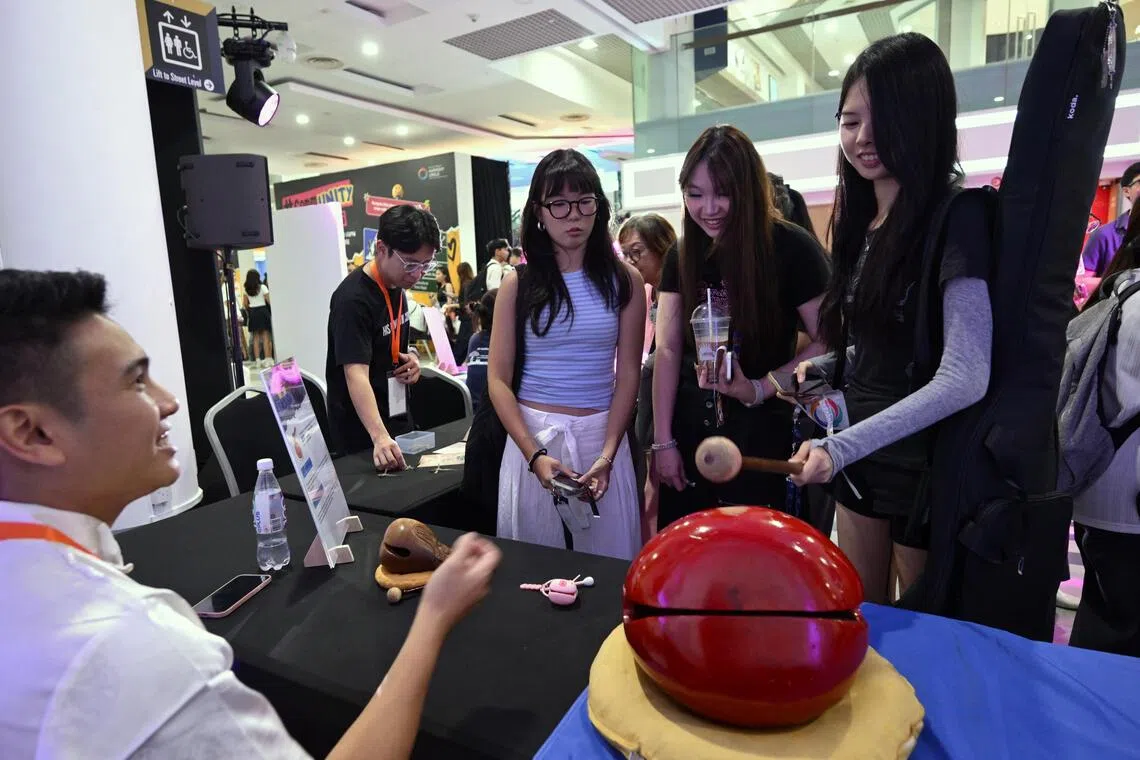
Edmund Zhang (left), a representative from the Singapore Taoist Federation, sharing information about the wooden fish, a ritual percussion instrument, at the festival on Sept 18.
ST PHOTO: NG SOR LUAN
Derek Tan, who co-led the organising committee of the festival, said the event brings different cultures and traditions together in a more relaxed and engaging way, which is useful as people may not always have the opportunity to have conversations across communities.
The other co-lead of the organising committee, Ismail Meera Begum, said the experiential booths let attendees understand first-hand the common ground between different cultures.
For example, talbina, which is a traditional food recommended by Prophet Muhammad in Islam, is similar to tea in Sikh tradition in that they are both symbols of hospitality.
“This festival gives people insight into the meaning behind certain food and beverages. They may not realise there is actually a deeper meaning behind such traditional food,” said Meera.
She added that the festival is catered towards youth because when they enter the workforce, they will encounter a world that is different from schooling life.
“Racial and religious harmony is a very important aspect which we need to cultivate in young people so that when they face the world, they know what to expect and how to handle certain differences that may come about.”
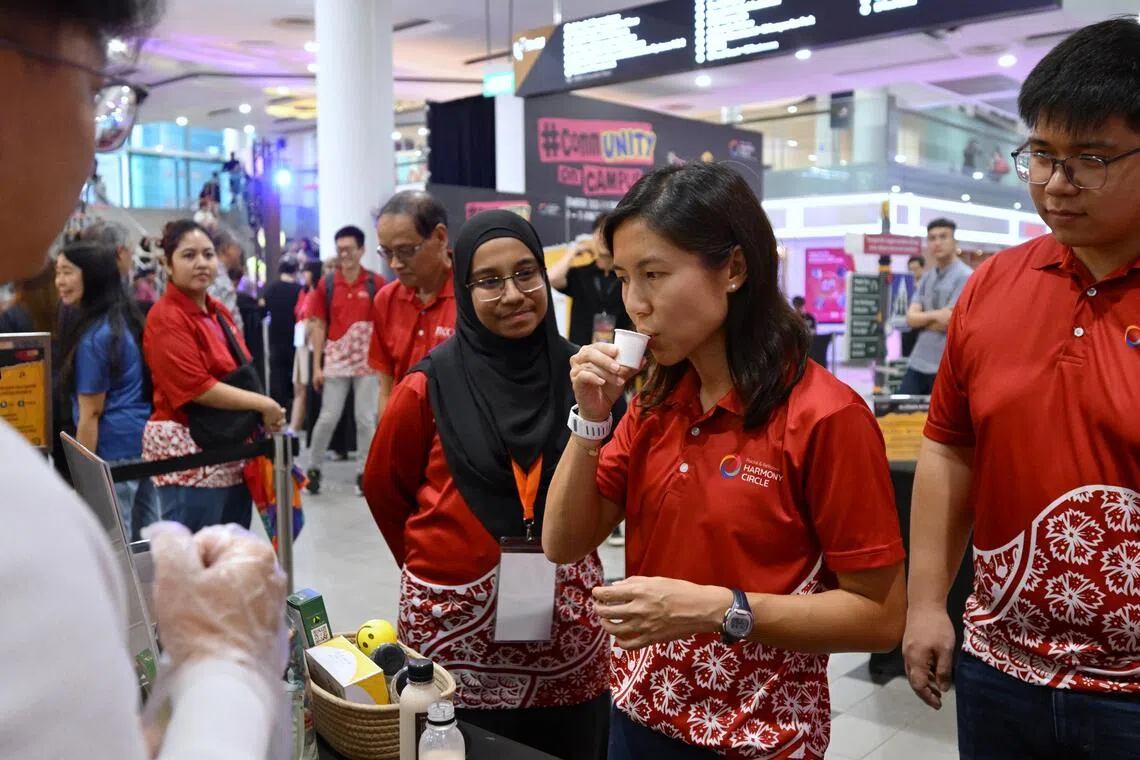
Senior Parliamentary Secretary for Culture, Community and Youth Goh Hanyan trying talbina at the festival on Sept 18.
ST PHOTO: NG SOR LUAN
Speaking at the festival, Senior Parliamentary Secretary for Culture, Community and Youth Goh Hanyan said Singapore cannot take racial and religious harmony for granted.
She said: “We have to continue to update what it means to all of us. For the younger generation, you all have a very different perspective, probably, of what it means to be a multiracial, multireligious society in Singapore.
“I’m very happy that you have taken interest in such an important theme, and taking it on your own to try to update this unique brand that we have in Singapore of being multiracial and multireligious.”
KioskNews shows a cleaned-up reading view extracted from the publisher’s page — the original always lives on their site, not ours.