Big Build royal commission LIVE updates: Gap Road level project hears submissions as CFMEU comes under microscope in long-awaited construction royal commission
Updated ,first published
Below is a delayed livestream of the royal commission proceedings, if you would like to make a submission to the inquiry click here.
Latest Posts
Young highlighted a briefing for then minister for transport and infrastructure Jacinta Allan, which he said flagged a number of the issues that would be relevant to the Gap Road case.
The note, tendered through the commission is attached below.
Young has told the hearing that seven themes that emerged from the responses the commission had gathered noting the responses were submissions, and not evidence.
“Most of what follows is an allegation, and some of it is expressly denied,” he said.
The seven themes as outlined by Young, were:
- Health and safety: The use of safety and entry powers on sites as industrial leverage. “It is said that rights given to protect the safety of workers and rights of entry were used to stop critical works and to secure demand,” he said. The commission had been told these representatives were often appointed at the CFMEU’s request without an election.
- Labour hire: Labour hire will also be examined partly as they were said “to have been the means by which non-working …health and safety representatives were placed on sites and paid.” An enterprise agreement was considered to have “real commercial value” to a labour hire company, he said. There are few barriers to entering the labour hire market, and some companies denied the allegations against them.
- CFMEU power: Young said the responses the commission received “point to … a tight labour market created in part by the scale of public works”. He said there were contractual penalties for missed deadlines, and the way contracts allocated industrial relations risk and limits or absence of regulators and law enforcement. “It is said that entries and stoppages increased after the Australian Building and Construction Commission was defunded in late 2022 and abolished in February of 2023,” he said.
- State action and inaction: Young said contractors said they reported conduct they considered unlawful or corrupt through formal notices, project items and progress reports. “Some say they gave many formal notices over several years and can identify no response from the state to many of them”.
- Paying for peace: Contractors were left to manage disruption themselves. “Some say they paid claims they had disputed during disruption on site. Others say they replaced subcontractors and paid significantly more for labor because the CFMEU demanded it,” Young said.
- Contract design: Some of the cost of industrial disruption was “shared with the state or passed to it”, Young said. Some respondents said this reduced the contractor’s incentive to resist. “Contractors were pushed to accept demands to protect the program and priced the costs into their bids,” he said.
- Reform: Options put forward include; a licensing of industry or labour hire, a “fit and proper person test” for industrial and safety roles, integrity processes for how health and safety representatives are elected, validation by the regulator before a disputed direction to cease work takes place, a dedicated regulator and protection for those who report.
Young told the commission it would hear evidence from more than 20 witnesses and that every one of them had been compelled to testify.
Likewise, he said, the documents he would reference were gathered using the commission’s compulsory powers to produce.
To repeat, every witness in this case study has been compelled to attend. They have no choice about giving evidence, and the law protects them for doing so.
It is a serious criminal offence to threaten or intimidate a witness, to punish a worker for giving evidence or information to this commission, to pressure a witness to give false evidence or to destroy evidence. Some of those offences carry long terms of imprisonment.
Counsel assisting will not wait for a formal complaint. If we learn that a witness has been threatened, punished, or warned off, we will ask you to act to protect that witness, and we will ask that the matter be immediately referred to Victoria Police.
Young also pointed out that the inquiry would operate with a requirement for procedural fairness, meaning that “no adverse finding can be made about anyone unless that person knows what the finding is based on and has had an opportunity to respond”.
Counsel Assisting Chris Young told the hearing in his opening that the commission wrote to 99 companies, organisations and other entities, inviting them to make early written submissions.
The commission asked them to voluntarily tell it about “any corruption, criminal conduct or serious misconduct” relevant to the work of the royal commission.
As of last week, 45 companies responded and three declined, he said.
The ones who responded ranged from head contractors and joint venture participants on projects, subcontractors, labour hire companies, industry bodies and unions.
Some of those responses have been frank and helpful. Most were detailed and answered the specific questions the commission had asked. Several disclosed conduct that appears to be misconduct, corruption, or crime.
They include allegations of the involvement of organised crime on projects and of fraud, including invoices for shifts that weren’t worked. Other responses were not printed or helpful. Some appear on their face to be untrue. Others show a surprising lack of knowledge in matters the submitter should have known about.
In at least one case, a company’s response cannot be reconciled with what one of its directors later said under compulsion.
Below is a delayed livestream of the royal commission proceedings, if you would like to make a submission to the inquiry click here.
The first day of public hearings in the Royal Commission is about to get under way in Melbourne.
The commissioner is Christopher Kourakis, who will detail how the hearings will run, before Counsel Assisting Chris Young KC begins with an opening.
There are also lawyers representing former premiers Jacinta Allan and Daniel Andrews.
The commission released statistics on Friday, showing it has already done plenty of work in private ahead of this week’s public hearing block.
- Public submissions received: 28
- Hearings held: 24
- Notices to produce: 121
- Enquiries received: 51
- Documents received: 110,688
Former premier Jacinta Allan could be called to give evidence to the commission at some stage. Allan was minister for transport when the CFMEU took over the Gap Road project.
The project was completed by an alliance that included infrastructure construction companies CPB and John Holland. Insiders told this masthead earlier this year that Allan’s office placed implied pressure on the consortium to work with the CFMEU.
“We definitely got a call saying: ‘Can you work with the union or not? The minister wants to know’,” one source involved in the project reportedly said.
The consortium insisted that requests to meet with the union be put in writing, after which a meeting with union leader Joe Myles took place and a deal was made.
The deal included the use of B K Labour, a hire firm favoured by the CFMEU whose owners were later charged with financial crimes but avoided conviction, and were instead fined $3000 in court for creating a false document.
Allan has steadfastly denied she or her office intervened in the project to support the CFMEU.
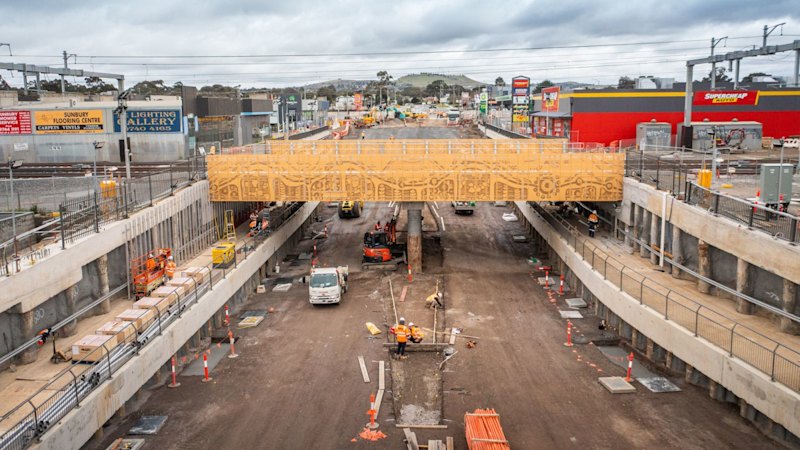
What happened at Gap Road, and why has the commission focused its first public hearings on this project?
Workers on the level crossing removal project were initially covered by an enterprise agreement negotiated by the Australian Workers Union.
But following a two-day work stoppage on June 6 and 7, 2022, rival union the CFMEU wrenched control of the project from the AWU.
The rail consortium building the project then acceded to CFMEU demands that it employ the union’s favoured labour hire firm and its health and safety representatives on site.
Good morning. Welcome to our live coverage of the first day of hearings for the Royal Commission into the Integrity of Major Public and Civil Infrastructure Construction Projects in Victoria.
For the next two weeks, Commissioner Christopher Kourakis AC and his team will grill a string of witnesses as they seek to uncover the extent of alleged corrupt conduct that infiltrated the Victorian Labor government’s Big Build, how much the state knew and what it did about it.
The hearings come at a pivotal time in Victorian politics. Premier Ben Carroll called the commission in August, days after rolling his predecessor Jacinta Allan as leader.
Today he leads a caretaker government that is trailing the Coalition and just two points ahead of One Nation in recently published opinion polls. The election is less than three weeks away.
KioskNews shows a cleaned-up reading view extracted from the publisher’s page — the original always lives on their site, not ours.