Rare Chinese calligraphy scroll resurfaces after 81 years, sells for US$22.6 million
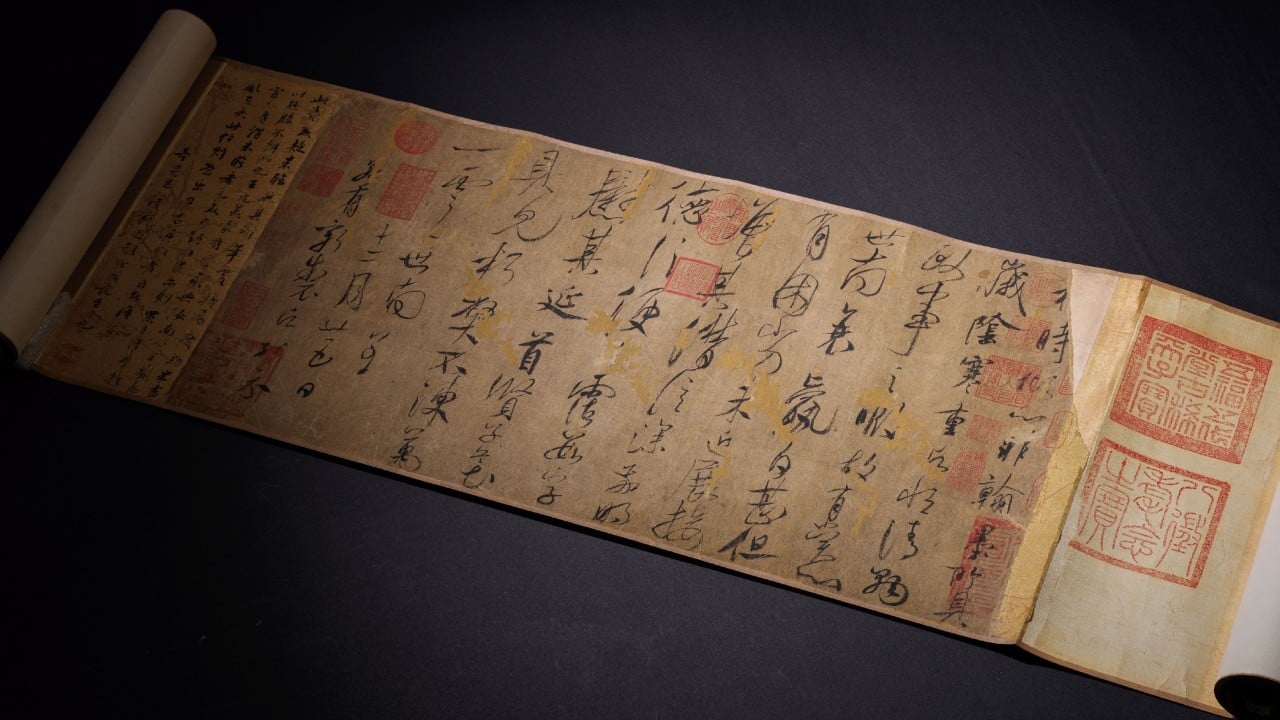
A rare work of Chinese calligraphy long presumed destroyed in the chaos of 1945 only to resurface 81 years later, fetched HK$177.45 million (US$22.6 million) in Hong Kong on Wednesday.
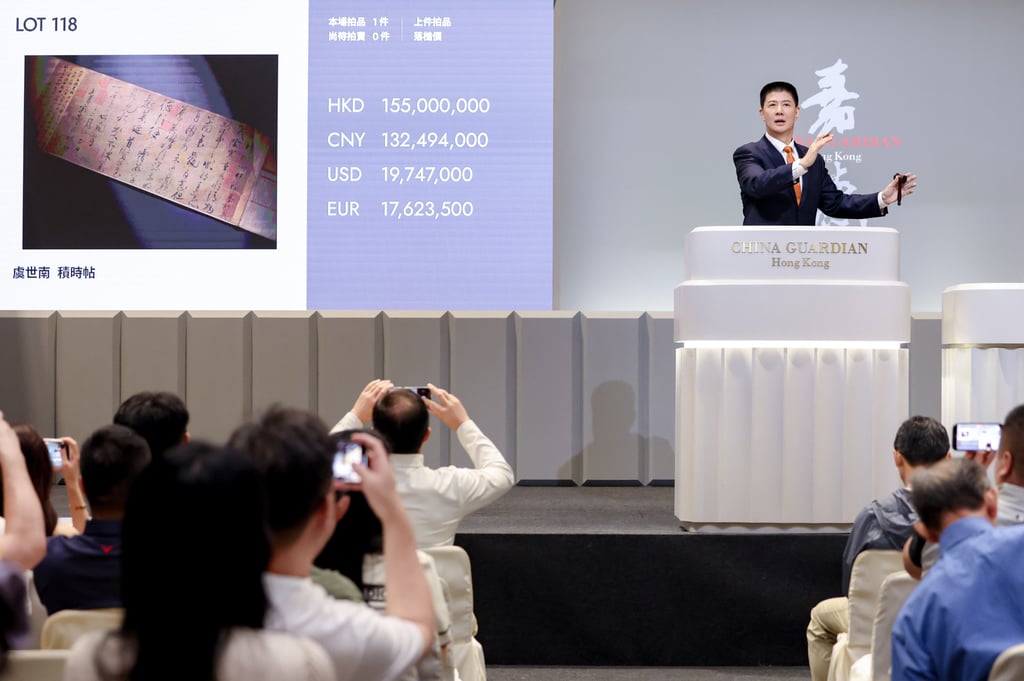
The work called Jishi Tie, or Accumulated Time Letter, by early Tang dynasty (618-907) calligrapher Yu Shinan, went under the hammer at China Guardian Hong Kong’s autumn auction at the Hong Kong Convention and Exhibition Centre.
It fetched HK$155 million at the hammer, with the final price including the buyer’s premium reaching HK$177.45 million.
“Today, it is a valuable auction lot, while one day it will be a priceless classic,” Jin Yunchang, a member of the Palace Museum’s cultural relics acquisition and appraisal committee, said at a symposium on the work in September, according to China Guardian.
Known as one of the four great calligraphers of the early Tang dynasty, Yu was a calligraphy tutor to Emperor Taizong and a leading heir to the Wang Xizhi tradition, helping carry the legacy of China’s most revered calligrapher into the Tang dynasty.
“In the history of Chinese calligraphy, Yu Shinan is a name that defines an era,” the auction description read.
Historical records list more than 30 works attributed to Yu, but few of his original pieces have survived. Much of what later generations could see of his calligraphy came through stone inscriptions, rubbings and later copies.
Zhu Peier, editor-in-chief of Chinese Calligraphy, said at the symposium that Jishi Tie revealed differences in the energy of the lines and dry-brush transitions, offering a rare glimpse into the movement and pressure of the brush on paper.
Studying the work could help scholars “rethink Yu Shinan”, Zhu said in September.
Before Jishi Tie resurfaced, Epitaph for Princess Runan, held by the Shanghai Museum, was the “only surviving work” that offered a glimpse of Yu’s calligraphic hand, according to China Guardian.
Unlike the restrained style of his formal and imperial works, the letter “shows Yu’s natural and spontaneous hand used in his everyday correspondence”, China Guardian said.
Jishi Tie, a private letter Yu wrote to a friend, takes its name from the opening words, “ji shi qing xin”, roughly meaning “I have long thought of you”.
Written at the end of winter, the letter runs to only a few dozen words. Yu asks how his friend is faring in the cold, mentions that his own health is declining and asks to see his friend’s latest work.
The 27cm-by-52.5cm (10.63 inches by 20.67 inches) handscroll comes with a long chain of collectors’ seals and inscriptions.
Among them are marks associated with the imperial collections of the Ming dynasty (1368-1644), including seals also found on masterpieces such as the Shenlong copy of Wang Xizhi’s Preface to the Poems Composed at the Orchid Pavilion.
One of its most notable inscriptions was added in 1598 by Dong Qichang, a leading calligrapher and art critic of the Ming dynasty.
Dong praised the handscroll’s “slender yet powerful” brushwork and said the work was by Yu, although scholars still debate whether it was actually a copy by Song dynasty calligrapher Mi Fu.
By the Qing dynasty (1644-1911), the work had entered the imperial collection, bearing the collection and appreciation seals of emperors Qianlong, Jiaqing and Xuantong.
01:09
Melania Trump, Peng Liyuan visit Smithsonian museum during Xi’s US state visit
Emperors and collectors often stamped their seals on works they owned or admired, leaving behind records that can help scholars today trace a work’s passage through different collections.
But that record runs cold in the 20th century.
In the 1930s, China’s last emperor, Puyi, took part of the Qing imperial collection to the northeastern city of Changchun, where it was kept at Xiaobailou, or “Little White House”, on the grounds of Puyi’s imperial palace complex.
As the Japanese occupation collapsed in 1945, he fled with several paintings and treasures, leaving the rest behind, including Jishi Tie.
With the collection left unguarded, soldiers who remained behind looted the artworks. Many works were torn apart, cut up or burned.
Jishi Tie was never traced after the looting. For decades, researchers assumed it had been lost.
“Yu Shinan’s original Jishi Tie was destroyed at Xiaobailou, and the original work was therefore lost,” Chinese calligrapher Yang Renkai wrote in a book in 1991. “It is a pity that this work by Yu Shinan no longer exists.”
Decades later, in September, China Guardian announced the work’s reappearance, saying it would be offered at its autumn auction in Hong Kong.
The handscroll is not complete. Parts of the work, including its title and the opening two characters were lost. But the calligraphy, along with an inscription by calligrapher Dong Qichang of the Ming dynasty, survived.
The surviving sections were later pieced together to form the handscroll as it appears today.
China Guardian exhibited the work at the Guardian Art Centre in Beijing on September 12 and 13. Multiple social media posts said the organisers limited each visitor to two minutes as crowds queued to see the work.
“Even at the fastest, it takes at least half an hour to get in,” one commenter said.
KioskNews shows a cleaned-up reading view extracted from the publisher’s page — the original always lives on their site, not ours.