Rival ports 'fast catching up': SM Lee warns against complacency, says port workers must not face shift alone
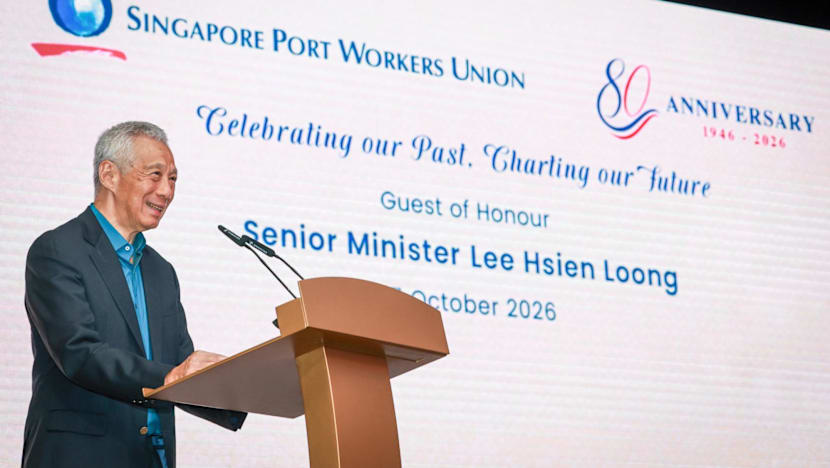
SINGAPORE: Singapore's port risks being left behind by its rivals that are "fast catching up, and in some respects quite possibly ahead of us", said Senior Minister Lee Hsien Loong on Saturday (Oct 17), as he called for technological transformation while not leaving workers to face the challenges alone.
He also highlighted the importance of strong tripartism to enable PSA's management team, the unions and the workers to work together in a "relationship of trust" to build a "disciplined and skilled workforce".
Mr Lee was speaking at a dinner celebration for the 80th anniversary of the Singapore Port Workers Union (SPWU), which represents PSA employees.
"PSA has done well, adopting technology and upgrading your operations to keep our port efficient and competitive. But other ports in the region are making progress digitalising and automating too," said Mr Lee.
"If PSA slackens or becomes complacent, we risk being left behind and losing our business."
To outsiders, Mr Lee said the past six decades "look like an unbroken string of successes".
"But those of us who have participated in this journey know just how much hard work actually went into it – how many difficult strategic choices we faced along the way; how many times we needed to transform the way we operate; and how from time to time we made missteps, and painfully corrected them," he said.
Giving an example, he noted how advancements in technology allowed PSA to move from the manual loading and unloading of ship cargo to the use of quayside and yard cranes, and then to operators controlling multiple cranes simultaneously and remotely from a control centre "in a more comfortable setting" today.
"In the container yard, instead of people manually driving prime movers hauling containers under sun and rain, we have remotely-operated automated guided vehicles (AGVs) performing the task.
"Each time the jobs changed, PSA sought to retrain existing workers to take up these new roles, rather than to hire afresh," said Mr Lee, noting that the company developed structured training programmes to help workers upskill while the unions persuaded workers to adopt a flexible mindset and to take up training opportunities.
"Each episode was a challenging and laborious process of organisational change and personal adjustment. Each required close coordination between port management and the unions – to help workers accept radical changes in their work processes, to upgrade themselves as their roles changed, and then safely and successfully adopt new ways of working, sometimes in new places."
"PAINFUL DECISIONS"
There were also many port moves – including to Keppel, Brani, Pasir Panjang and Tuas Port – that needed workers to adjust to different work environments and commuting arrangements.
In particular, the move to Tuas lengthened commuting for workers significantly, said Mr Lee. As a result, government agencies are working with SPWU and PSA management to increase bus services to Tuas South, and are also looking at building a Bus Rapid Transit system.
Other times, "painful decisions" had to be made, said Mr Lee, citing the example of PSA losing several major shipping customers to Malaysia's Port of Tanjung Pelepas in the early 2000s.
PSA had to change strategy and cut costs decisively to restore its competitiveness and win the business back, leading to retrenchments and wage cuts.
"PSA management took pains to explain to the unions why these drastic steps were necessary," said Mr Lee, adding that SPWU also "negotiated hard with management to secure the best possible deal for the workers who had to leave".
The result was a retrenchment and wage-reduction package that would "save the company" and at the same time was "fair to the affected workers".
"Nevertheless, it was a wrenching and painful experience, not only for the affected workers, but for all those who had to deal with the issue, both on the union and management sides," said Mr Lee.
However, when PSA did well, the management was also fair to its workers and unions in ensuring that everyone shared in the company's success, he noted.
PSA had in 2005 paid a special gain-sharing payout to workers, rewarding them for meeting cost-reduction and performance targets. That was also a "gesture of appreciation for the workers' contributions and sacrifices", said Mr Lee.
"Such intimate cooperation between management and the unions, through both ups and downs, was instrumental in building trust between them, and a key reason for PSA’s sustained success."
He added that SPWU's approach "contrasts sharply" with that of some other port worker unions, which resist technology and progress as they believe this is the way to protect their workers' jobs and interests. "But over time their ports suffered, and so did their members."
LOOKING AHEAD
Beyond competition from other ports, Mr Lee added that the industry is transforming in fundamental ways, with supply chain disruptions, climate change and geopolitical tensions affecting shippers and port operators.
For instance, green fuels such as ammonia and methanol will mandate new processes, skills and safety protocols.
Rapid advances in artificial intelligence, autonomous technology, sensors and robotics are also already drastically changing port operations, while embodied AI may also automate repetitive physical tasks such as coning and de-coning.
"These developments present new challenges, but also new opportunities," said Mr Lee.
"There will be higher-value tasks which are less physically demanding; better jobs, centred on data, judgment and decision-making; and even completely new roles that do not yet exist – in areas like sustainability management and alternative fuel options."
Skilled roles will allow workers to deepen their expertise, grow their responsibilities and build meaningful careers, and PSA must stay on top of these changes and turn new challenges into opportunities, said Mr Lee.
"As in past waves of transformation, we must not leave workers to face these challenges alone."
KioskNews shows a cleaned-up reading view extracted from the publisher’s page — the original always lives on their site, not ours.