Gilgamesh by Simon Armitage review – an ancient epic is brilliantly translated for our times
The poet laureate is paid a salary of £5,750 per annum plus a barrel of sherry. No specific duties are attached to the role, but there is an expectation that poets will write verse for public occasions and royal events, a duty that Simon Armitage has fulfilled by writing a poem on the death of Elizabeth II, Floral Tribute, and another to mark the coronation of Charles and Camilla in 2023. Though it’s an awkward time for the royals, no laureate is going to write about them behaving badly (it wasn’t John Dryden, the first laureate, who wrote about Charles II’s bedroom habits, but John Wilmot, Earl of Rochester). And yet with Gilgamesh, Armitage does deliver a poem about royalty’s misdeeds, at least in part.
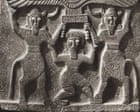
The epic originated in ancient Mesopotamia (modern-day Iraq) at least 4,000 years ago, and it begins with the eponymous demigod, king of Uruk, lording it over his subjects. Among other bad habits, he exercises the “right of the first night”, which allows him to bed newlywed brides before their husbands. To check his powers, the gods create his counterpart, the wild man Enkidu, who confronts Gilgamesh outside the house of one of these brides. The two rivals turned comrades then embark on a series of extraordinary adventures, including battles with Humbaba, guardian of the Cedar Forest, and with the winged Bull of Heaven, sent by the goddess Ishtar in revenge after Gilgamesh rejects her marriage proposal. Following Enkidu’s death, Gilgamesh sets out alone on a desperate quest for immortality that leads him to the very edge of the world.
In his introduction Armitage draws our attention to the poem’s rich modern resonance, including its frankness about sex workers, who play a key role in bringing Enkidu to Uruk, its ecological dimension – Enkidu’s death is a punishment for cutting down the forest guarded by Humbaba – and the way the relationship of Gilgamesh and Enkidu can be seen as a celebration of same-sex physical love (Gilgamesh loves his companion “like a wife”). Most striking of all is the way the heroes’ fight with Humbaba echoes modern resource wars. The Gulf wars took place in the same geographical region, though the commodity in question was not timber – the prime building material at the time of the poem – but oil.
The poem’s uniquely fragmented history makes it both ancient and modern. Sumerian sources date back to 2000BC, but it remained lost until fragments of cuneiform tablets in a later Akkadian form were discovered by archaeologists in the 19th century. A tablet on display in the British Museum drew the attention of George Smith, employed by a firm that designed bank notes, and he repeatedly visited the museum in his lunch hour to gaze at it. When the keeper of Babylonian antiquities asked him what he was doing, Smith replied that he was reading it. Later, now in the employ of the British Museum, Smith was excited to discover a tablet describing a great flood. Crying “I am the first person to read that after 2000 years of oblivion,” he rushed about the room in a state of great excitation, and to the astonishment of those present began to undress. The passage Smith had deciphered comes towards the end of the poem, where Gilgamesh visits the now-immortal flood survivor Uta-napishtim – the poem’s Noah character – in an attempt to find immortality himself. It caused a sensation in Victorian England because of its similarity to the flood story in the Book of Genesis: here perhaps was evidence of the historical veracity of the event.
This fragmented history of the poem is reflected in the way it has come down to us in broken tablet form, which Armitage compares to a vast jigsaw with pieces still missing. Readers who see this fragmentation as integral to the poem may be disappointed with Armitage’s approach, which is generally to paper over the cracks, as he puts it (though he does present passages that have been restored from later sources in prose, and occasionally leaves gaps whose contents he speculates on in detailed footnotes). One feature Armitage is very faithful to is the incantatory use of repetition, as in the journey to meet Humbaba – “After forty leagues they stopped and broke bread. / After sixty leagues they stopped and pitched camp” – which he says “enacts the mundane regularity of a long slog across featureless terrain”. Generally, the results are fresh and impressive, as in the poem’s opening lines, as solid as the rock they were once carved on:
He witnessed great depths, saw the land’s bedrock.
Astute in all subjects, wise in every matter,
Gilgamesh glimpsed the foundations of life.
Nothing escaped him; he possessed all knowledge,
had learned each discipline in equal measure,
understood completely the ways of the world.
He uncovered secrets, revealed what was hidden,
brought back word from before the Great Flood,
trudged distant paths, earned his rest.
He carved his trials and travails in a stone.
Armitage wisely avoids rhyme, unlike some recent versions – there is no evidence of rhyme in the original text – but he knits his poem together tightly with a standard four-beat line, a fine-spun mixture of the modern and the archaic, and a smattering of the alliteration he employed in his translation of Sir Gawain and the Green Knight. Some of the finest passages have a sumptuousness you can almost taste and touch – Gilgamesh’s mother Ninsun, “She-Wild-Cow”, purifies herself with “tamarisk and soapwort”. Others have a delicious contemporaneity, as Humbaba calls Enkidu, created by the gods out of a lump of clay, a “half-wit”, a “crossbred freak” who “never sucked milk from his mother’s tit”. Of all the scenes, it is those in the forest, as the heroes make their way towards the home of Humbaba, that bring out Armitage’s best poetry, which sings and clatters its way through the undergrowth:
The canopy was knitted and knotted with creepers;
sap and resin came raining down
and flowed away through channels and gorges.
A bird called out, then the forest echoed
with the racket of more birds calling in answer.
A lone cicada sounded its note,
triggering a chorus of piping and hymning.
A turtle dove answered the cries of a pigeon.
after newsletter promotion
The register of Gilgamesh remains one of the great unknowns of the poem. Given the nature of its content – often violent, mocking and sexually explicit – there is no reason to assume it should, as it generally is, be translated into elevated language. Armitage tackles this head on by mixing different registers and idiolects. His tactile, visceral version is a tour de force, combining careful scholarship with poetic verve and deft linguistic meldings, and it is likely to become one of the standard renditions in English. It cannot, though, be the last word on this continuingly resonant poem, whose fragments are still coming to light in museum collections, fresh excavations and accidental finds.
KioskNews shows a cleaned-up reading view extracted from the publisher’s page — the original always lives on their site, not ours.