LOCAL ELECTIONS 2026: Deep disparity in voter turnout still reflected between townships and suburbs

Although voter turnout was higher than in the 2021 elections, data from Gauteng indicate significant differences between turnout in townships and rural areas, and turnout in suburbs. Further, only around 35.4% of eligible voters turned up at the polls.
On Sunday, 8 November, the Independent Electoral Commission (IEC) confirmed that 15.9 million South Africans cast their vote during the local government elections, equating to a registered voter turnout of 52%.

These figures put the 2026 voter turnout higher than the 2021 turnout of 45.86%, which was affected by the Covid-19 pandemic. These figures are still lower than the 2016 local government elections, which had a turnout of 57.95%. Voter turnout figures are trending higher across all provinces than during the 2021 elections. In 2021, provinces recorded an average turnout of 46.2%, while in 2026, the average turnout climbed to 50.57%.
Elections analyst Wayne Sussman told Daily Maverick that the higher turnout compared with the previous election was a cause for celebration.
“We’re back over the 50% mark. Turnout in South Africa has been on a downward trajectory in the last two national elections, the last two local elections, and here in this election we see that turnout grows by a number of percentage points, well back above the 50% mark,” he said.
“This needs to be celebrated. South Africans came out and voted. All South Africans came out, and a large proportion of South Africans came out and voted, and this is very, very encouraging.”
While the voting turnout was higher, the number of eligible voters who turned up to the polls remained low. Market research company Ipsos estimates that 44.9 million South Africans were eligible to vote.
According to the IEC, 29.23 million South Africans registered to vote, amounting to 65.1% of the eligible voter population. This means that about two-thirds of eligible voters did not cast their ballots.
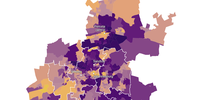
Data from Gauteng indicates significant differences in voter turnout between suburbs and townships.
Suburbs recorded higher voter turnout
Data from the Gauteng City-Region Observatory (GCRO) indicates voter turnout tended to be higher in suburban wards with strong DA support, reaching up to 73.31% in Ward 85, which covers Tshwane’s eastern suburbs including Willow Park Manor, De Wilgers and Equestria.
The turnout trended lower in townships such as Ward 24, which includes Devland, Eldorado Park, Naturena, Power Park, Diepkloof and Pimville, which recorded a voter turnout of 44%.
Graeme Gotz, research director at the Gauteng City-Region Observatory, told Daily Maverick that this pattern was also recorded in the 2021 local government elections.
Although turnout was higher across the board in 2026, wards in Soweto averaged around 50%, up from 40% in 2021, while wards in the northern suburbs of Johannesburg averaged well above 60%.
In the wealthy Tshwane suburbs of Centurion and Pretoria East, turnout reached 70% on average.
Incomplete story
Gotz said that while the differential was “significant”, it was not easy to account for.
“We know from our own Quality of Life Survey data that township residents see local government as less important than national and provincial government, and are also less satisfied with municipal governance than their suburban counterparts. So apathy and disaffection may drive lower interest in these areas,” he said.
“On the other hand, it may be that suburban voters are deeply concerned about the value of their residential properties, and recognise that property values depend on what municipal governments do in terms of local service delivery.
“We also know from our survey data and everyday media reporting that suburban residents have become incredibly anxious about the declining state of their neighbourhoods. Even higher than normal turnout in these areas may have been the result.”
Although the turnout differential benefited the DA, as many of the wards with higher voter turnouts were DA strongholds, while relatively lower voter turnouts in ANC strongholds pulled down the party’s overall voter share, he warned that voter turnout was only one factor worth considering.
“The switch to ActionSA in many township areas is very significant. And it is remarkable that in the Vaal townships of Sebokeng, Evaton and Sharpeville, many wards were narrowly won by the DA. The relatively low turnout in these areas doesn’t tell the whole story of a profound shift in voter sentiment,” he said. DM
KioskNews shows a cleaned-up reading view extracted from the publisher’s page — the original always lives on their site, not ours.