Could Pakistan’s Chinese-made weapons help protect Saudi Arabia from Houthi attacks?
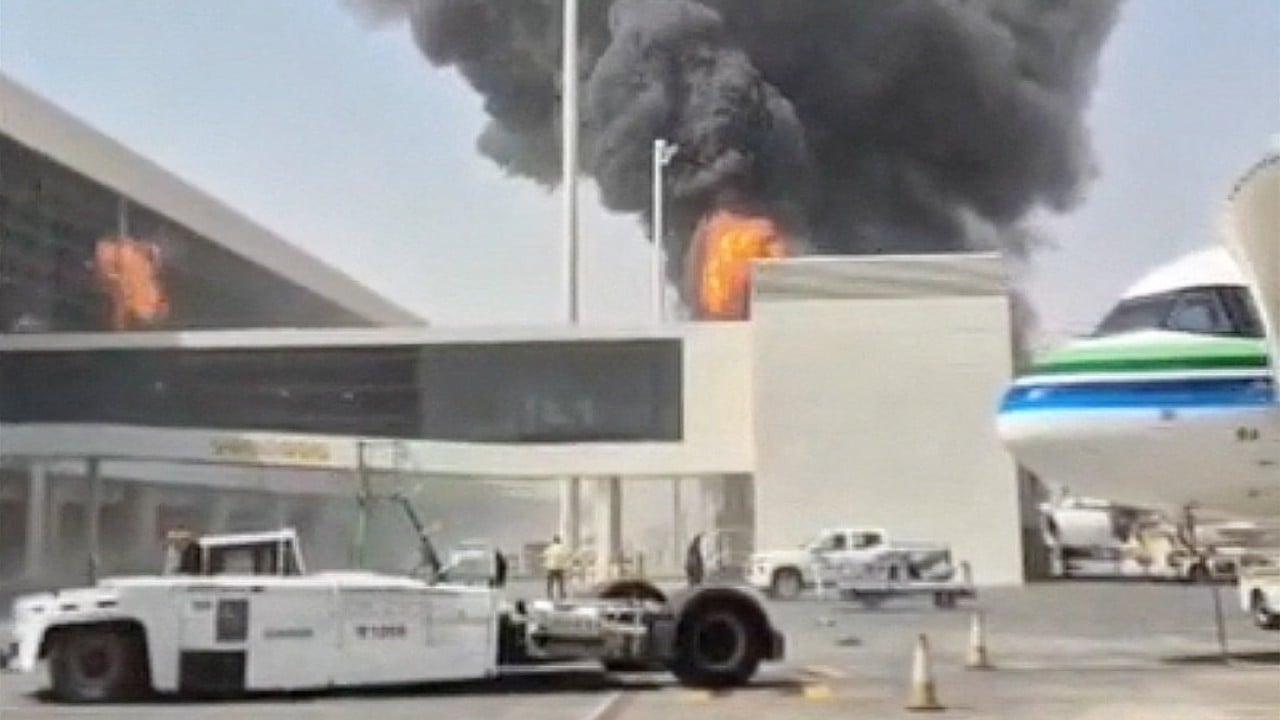
Chinese-Pakistani fighter jets and a China-made air-defence system reportedly deployed to Saudi Arabia could be brought into action following Pakistan’s renewed pledge to defend the kingdom after deadly Houthi attacks on Riyadh.
Pakistani Prime Minister Shehbaz Sharif said on Sunday that Islamabad would cooperate with Riyadh “in every possible way” under their defence agreements, after Houthi strikes on the Saudi capital’s main airport the previous day killed at least 13 people and wounded hundreds.
A further attack on Sunday killed a Pakistani national and injured 11 others, Saudi authorities said.
Sharif’s pledge follows an October 5 emergency meeting in Riyadh, where Pakistan, Saudi Arabia and Turkey agreed to implement their collective-defence commitments and prepare for the rapid deployment of military forces and capabilities to the kingdom.
A joint statement released after that meeting did not specify troop numbers or weapons.
01:01
Houthi attack on Saudi airport kills 12, injures hundreds
The military commitments stem from the Mecca Joint Defence Agreement signed in August, under which an armed attack on one alliance member is considered an attack on all three. The pact builds on an earlier bilateral defence agreement signed between Islamabad and Riyadh in September last year.
A Reuters report in May citing security and government sources said that Pakistan had deployed around 16 aircraft, mostly JF-17 fighters jointly developed with China, and a Chinese-made HQ-9 surface-to-air missile system to Saudi Arabia.
It remains unclear whether the systems would be used to counter further Houthi attacks. But if brought into action, they could provide another opportunity to assess the performance of Chinese-origin military equipment under combat conditions, following Pakistan’s use of Chinese-made J-10CE fighters and related weapons during its May 2025 conflict with India.
The sources quoted by Reuters said the JF-17s were dispatched in early April and that the deployment also included around 8,000 troops, while two security officials also reported two drone squadrons. While Pakistani personnel handle the operation of the equipment, its deployment is reportedly funded by Riyadh.
Neither government responded to requests for comment from Reuters at the time, and there is currently no public evidence that either the JF-17s or HQ-9 have been used against the Houthis.
Meanwhile, Saudi Arabia is investigating why its air defences failed to stop the airport attacks, in which multiple drones were reportedly launched first to pave the way for cruise and ballistic missiles.
Associated Press reported in September that the kingdom had sought air-defence support from Pakistan and other countries as interceptor stocks dwindled. But any role for Pakistan’s HQ-9 would raise questions about how effectively it could operate alongside Saudi Arabia’s existing air defences.
Pakistan’s Dawn newspaper reported last week that there was no public evidence of arrangements allowing Pakistani or Turkish sensors to routinely “cue” Saudi weapons – passing information about a detected threat to help another system track or engage it.
Although the HQ-9 can operate using its own radar, sharing such information could help the allies coordinate interceptions. Yet, having additional weapons available does not necessarily mean they can operate as a single defensive force.
That coordination challenge is particularly relevant because Saudi Arabia still relies heavily on American military systems. An analysis in August by the think tank Arab Centre Washington DC said US weapons, intelligence and integrated air-defence systems remained central to the kingdom’s military capabilities, even as Pakistani-operated Chinese equipment helped diversify its defences.
Pakistan has described its role as defensive, saying that it was providing support including reconnaissance while Saudi forces conducted combat operations. Islamabad has also denied reports of Pakistani jets striking the Houthis in Yemen.
Experts say closer defence cooperation between Pakistan and Saudi Arabia could create opportunities for Chinese arms manufacturers.
The ChinaMed Project cited Liu Zongyi of the Shanghai Institutes for International Studies as saying that Pakistan could connect Chinese weapons suppliers with Middle Eastern buyers – giving Beijing a potential route to expand sales without joining the Mecca alliance.
KioskNews shows a cleaned-up reading view extracted from the publisher’s page — the original always lives on their site, not ours.