Activists call for S Korea to recognize cancer cases
South Korean activists campaigning for workplace safety in the nation’s booming semiconductor industry yesterday called on the government to recognize the cancer diagnoses of three former SK Hynix employees as work-related illnesses.
SK Hynix, along with fellow South Korean tech giant Samsung Electronics, has emerged as a key player in the booming artificial intelligence (AI) industry, with its cutting-edge memory chips crucial to powering the sector’s rapid growth.
Establishing direct links between semiconductor work and certain cancers can be contentious, with research inconclusive, but fabrication and assembly plant workers can face exposure to solvents, acids, toxic metals and chemical gases, the US Occupational Safety and Health Administration said.
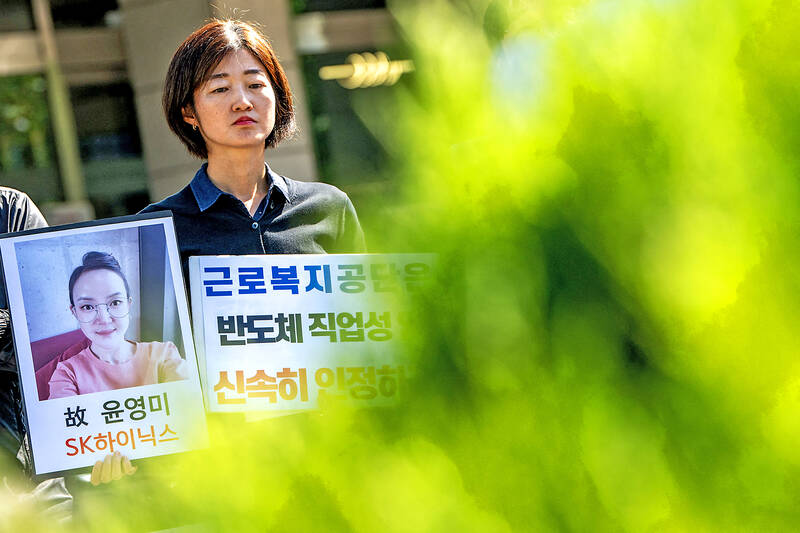
A protester holds a sign next to a portrait of a late SK Hynix employee outside the Seoul Southern Branch of the Korea Workers’ Compensation and Welfare Service yesterday.
Photo: AFP
Samsung issued a public apology in 2018 to workers — many of them young women — who had developed cancer after working at some of its factories, paying out 150 million won per case (US$112,055 at the current exchange rate) after a decade-long dispute.
Supporters for the Health and Rights of People in the Semiconductor Industry (SHARPS), one of the groups that had pressured Samsung, yesterday said that chemicals classified as carcinogens were being used by SK Hynix.
“We have confirmed that several substances on SK Hynix’s own list of prohibited chemicals are in fact being used, including nickel and its compounds,” SHARPS activist Lee Sang-soo told a news conference, citing data reported by SK Hynix to the South Korean Ministry of Climate, Energy and Environment.
SK Hynix said in a statement it was “taking various measures to more objectively identify the characteristics of disease occurrence” and was fully cooperating with government inquiries.
The company, which did not address the specific claims, said it had taken “proactive industrial health measures including the development of a comprehensive support and compensation plan.” The husband of a former SK Hynix worker who died from breast cancer called on the Korea Workers’ Compensation and Welfare Service to recognize his wife’s illness as work-related.
“I believe the nature of her job meant that she was inevitably exposed to various hazardous substances,” Kim Yong-il, the husband of Yoon Young-mi, told the briefing outside the offices of the service, which is a government agency.
Yoon began working at SK Hynix’s Icheon chip plant in 1996 and was diagnosed with cancer in 2018. She died in April.
“The company and the relevant authorities must protect workers’ right to health when it comes to occupational diseases in the semiconductor industry,” Kim said.
Korea Workers’ Compensation & Welfare Service representative Ko Seong-yong said that authorities would “process their cases as fast as possible.”
“An epidemiological investigation is necessary. While it is difficult to give an exact timeframe, it could take around a year before a decision is made,” he said.
KioskNews shows a cleaned-up reading view extracted from the publisher’s page — the original always lives on their site, not ours.