Home is where the jellyfish glows: Finland finally warms to nature-loving modernist Alvar Aalto

In the early 1950s, Alvar Aalto built a boat to get to his remote summer residence on an island in Lake Päijänne, about 200km north of Helsinki. But the celebrated Finnish architect was not a happy skipper. He named the boat – a title as cumbersome as his buildings were elegant – Nemo prophet in patria: “No man is a prophet in his own land”.
The name was a dig at Finland, which the architectural maestro believed had taken him for granted. Other nations, he moaned, recognised his talent more than his own. Today, arriving in Helsinki, I find that Finland doesn’t just love Aalto, he’s a national treasure.
Last month, 13 Alvar sites dotted around Finland gained Unesco world heritage status. In addition to this international honour, vast quantities of Finnish public funding are being spent on the restoration of his buildings, and his designs are currently being celebrated in the Aalto Design – Shapes of Wellbeing exhibition at Helsinki’s Architecture & Design Museum. Norman Foster could but dream of such public adoration. For many Finns today, Aalto’s buildings – light-filled, harmonious habitats created from the mid-1920s to his death in 1976 – speak of national pride at a time of geopolitical tension with Russia and, further afield, connect to global considerations about “wellness” in the built environment.
But was it true that Aalto was once underappreciated at home? “The boat’s name wasn’t entirely in jest,” notes Sofia Nivarti, author of Studio Aalto, a new survey of his work to be published later this month. “The more he succeeded internationally, the more a local audience turned against him – steeped in a social-democratic ethos of egalitarianism, Finnish architectural circles worried about the dominance of one name over all others.”
In the first half of the 1950s, Aalto “wasn’t able to get a professorship from his alma mater, the Helsinki University of Technology,” explains Tommi Lindh, CEO of the Alvar Aalto Foundation. And a starchitect’s ego is a fragile thing, even in the cool egalitarian north.
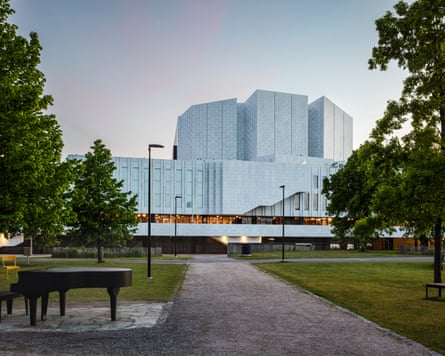
In Helsinki, Lindh gives me a tour of the National Pensions Institute – now home to the Finns’ social security system – a vast brick building designed by Aalto between 1953 and 1957. It is perfectly preserved, right down to its ingenious overhead heating panels, angled skylights and working paternoster lift. This monumental brick building is one of five Aalto sites in Helsinki to gain Unesco recognition, alongside the House of Culture (commissioned by the Finnish Communist party in 1952, with the goal of “making culture the property of the entire nation”), Finlandia Hall, the vast, glacier-like concert and conference centre, and both Aalto’s home and his studio.
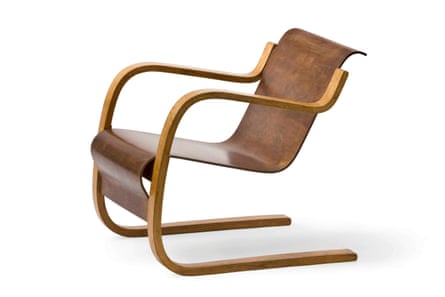
At the Shapes of Wellbeing exhibition, curators have broadened out the Aalto story to include the work of Alvar’s first wife, Aino, and second wife, Elissa, both skilled architects in their own right. It also shows that the experiential – and nature-loving – considerations Aalto brought to buildings also shaped his approach to furniture and lighting systems: his pendant lights recall beehives and jellyfish, his wooden chairs look as if they have been bent by the wind. “As we reconsider our relationship with nature and seek more sustainable ways of living, Aalto Studio’s work offers a valuable perspective,” says Pilvi Kalhama, director of the Architecture & Design Museum.
Naturally, Aalto’s domestic flourishes can also be found at his home in Munkkiniemi, Helsinki’s leafy, classy, equivalent of Hampstead. Completed in 1936, the Aalto House is a series of light-boxes overlooking a sports field, quiet but for birdsong and rippling with daylight. Aalto’s monochromatic abstract paintings still hang on the walls, his Homburg still sits in a wardrobe.

In contrast, Finlandia Hall – completed in 1971 and arguably his greatest masterpiece – introduces visitors to Aalto at his most symphonic. Standing in its concert hall – a jagged collection of white-on-white geometric planes – is like being inside an ice cube. A €136m renovation between 2022 and 2024 saw the building’s facade reclad in pristine Lasa Bianco Nuvolato marble and the opening of a permanent exhibition space dedicated to Aalto’s life and times.
Following Finland’s independence from Russia in 1917, the built environment – and Aalto’s mark on it – played a significant role in the shaping a new national identity. “Aalto did not set out simply to create a national style, but through his work he expressed values that became closely associated with modern Finland,” says Pilvi Kalhama. “Functionality, purpose, aesthetic quality and a progressive outlook were all central to his architecture and design. These qualities still reflect a broader Finnish attitude towards everyday life.”
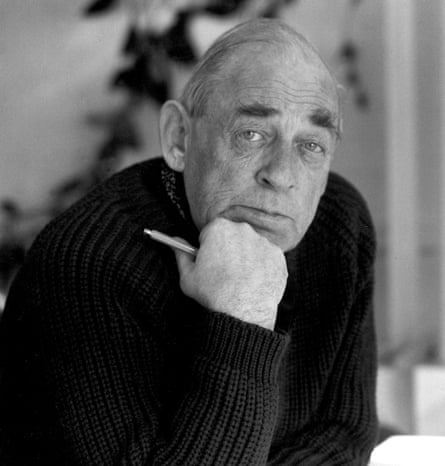
As his compatriots once feared, Aalto’s international success has largely overshadowed the achievements of other Finnish architects. But these days, Finns seem less oppressed by his legacy. “You can’t really grow up as a Finnish architect without Aalto being part of your thinking. But that doesn’t mean we all want to design like him,” says Asmo Jaaksi, founding partner of JKMM Architects, which refurbished and restored Aalto’s House of Culture and has won the international competition to design a new Museum of Architecture and Design on Helsinki’s South Harbour (planned to open in 2030). “What I admire most is Aalto’s independence of thought, his willingness to experiment and his instinct for putting people and nature first. I think he’d be rather disappointed if we were all still copying him.”
At the height of Aalto’s career in the mid-20th century, he may have been sore at perceived slights, but his disgruntled state proved short-lived. “Aalto was a chameleonic persona,” says Sofia Nivarti. “Grumpy at times, yet bubbly and joyful to his core; moody and hilarious in turn; at times egotistical and at others deeply self-sacrificing and generous.” He was impossible to pigeonhole and his buildings embraced the contradictions of the human experience.
Soon enough, the Finns acknowledged his vision. In 1955, just as he launched his scornfully named boat, Aalto was elected as a member of the Finnish Academy. “He is the only architect in Finland to have received this position,” says Lindh. “Meaning the nemo prophet in patria days were over.”
-
Aalto Design – Shapes of Wellbeing is at the Architecture and Design Museum Helsinki until 3 January 2027. Studio Aalto by Sofia Nivarti is published by Yale University Press on 27 October 2026
KioskNews shows a cleaned-up reading view extracted from the publisher’s page — the original always lives on their site, not ours.