China-US astronomy team may have found possible relic of a recent ‘gold factory’
A mysterious glow of high-energy light in our Milky Way galaxy could be the remains of an extremely rare cosmic “gold factory”, according to a new study by Chinese and US researchers.
The collision of two orbiting neutron stars – dead stars so dense that a teaspoon of their matter would weigh a billion tonnes – may have shone as brightly as Jupiter in the sky, they wrote in a paper posted last week on the preprint server arXiv, which has yet to be peer-reviewed.
The violent smash spewed out atoms and a flood of neutrons, which the atoms soaked up to form some of the universe’s heaviest elements, such as gold, platinum and uranium, while the wreckage collapsed into a black hole.
The blast probably happened less than 1,000 years ago, as the glowing cloud it left behind is still small and bright, signs of a young remnant, wrote the researchers from the Chinese Academy of Sciences in Beijing and the University of Notre Dame in Indiana.
However, no one seems to have recorded it – not even Chinese astronomers, who kept some of the world’s most careful sky records from the Song dynasty onwards and famously noted the 1054 “guest star”, a supernova that left behind what is known today as the Crab Nebula.
The team, led by Prantik Sarmah, of the Institute of High Energy Physics under the Chinese Academy of Sciences, noted that the flash was probably very brief and faded within days.
Although the researchers noted such an event “would, in principle, have been readily visible to the naked eye”, it sat so far south in the sky that it would have been hard to see from China, Japan, Europe and other places that kept detailed records of the night sky at the time.
03:54
The race for the moon’s south pole: can China beat Nasa’s 2028 deadline?
Though bright, the blast would have posed no danger to people on Earth. A 2024 study led by US scientists found that such a collision would need to happen within about 36 light-years to threaten life, and this one would have been many thousands of light years away.
Neutron star collisions are believed to happen in a galaxy like the Milky Way only once every tens of thousands of years. If confirmed, the glow would be the first known remains of such a collision within our galaxy.
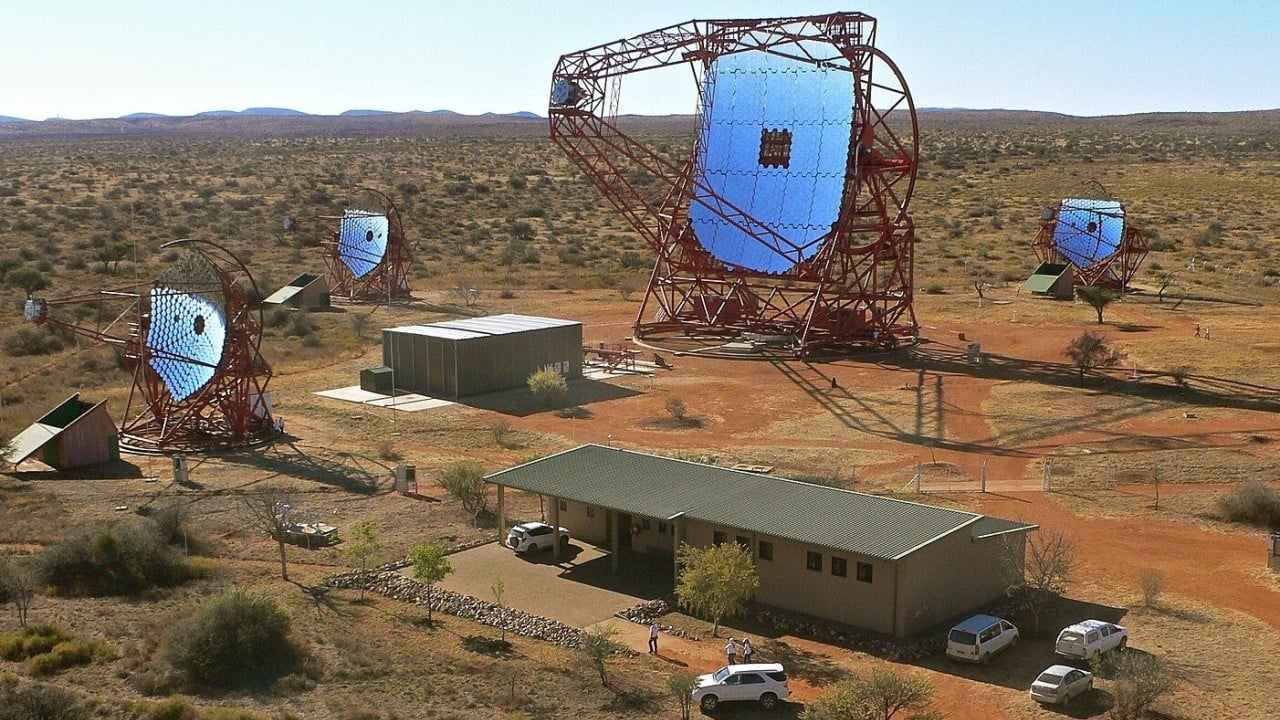
First spotted by the High Energy Stereoscopic System (HESS) gamma-ray telescopes in Namibia, it has puzzled astronomers for years. Most such sources lie along the flat disc of the Milky Way, where stars are born and die. This one sits well below it.
Scientists have blamed it on either a spinning dead star known as a pulsar or the debris of an ordinary exploding star. But no pulsar has been found nearby and there is no sign of the shell-shaped cloud a supernova leaves behind, the team wrote.
A neutron star collision would solve that puzzle, they proposed. The explosions that create neutron stars can kick a pair out of the galaxy’s crowded disc and it can drift for millions of years before the two finally merge far from where they started.
The team said the idea can be tested. The heavy elements made in the collision are radioactive and as they decay, they should still give off a faint glow of gamma rays. Current telescopes are not sensitive enough to see it, but future ones, such as a proposed Chinese space telescope called the MeV Gamma-Ray Observatory, could.
Astronomers could also look for light from the original flash that bounced off dust and is only now reaching Earth. Big telescopes in the southern hemisphere, such as the US-funded Vera C. Rubin Observatory in Chile, should be able to spot it, they wrote, letting scientists see the flash and look for signs of the heavy elements it made.
KioskNews shows a cleaned-up reading view extracted from the publisher’s page — the original always lives on their site, not ours.