2-year-old S’pore boy is one of estimated 400 in world with disease caused by single altered gene
SINGAPORE – During Tizane Woo’s 20-week prenatal scan, her doctor noticed something was not right with her child, Teyden Hamilton Ho.
“They told us that his head was smaller than average. The circumference of his hindbrain (cerebellum) was too small,” said the 26-year-old housewife.
“A week after I went for amniocentesis in the 22nd week of my pregnancy, I was told that Teyden has an additional chromosome, which was inherited from me.”
She and her husband were asked if they would like to abort the child because of all the issues he could face.
“But never once did we think of doing so because he was ours,” Woo said.
When Teyden was 15 months old, he was diagnosed with Zhu-Tokita-Takenouchi-Kim (ZTTK) syndrome after blood samples from all three of them were sent to the US for testing.
The condition, named after the four doctors and researchers who first identified it in 2016, is a rare hereditary disease caused by a single altered gene on a non-sex chromosome.
Broadly speaking, it affects brain development.
There is no figure available for how many people in the world have the condition, as it was only recently recognised, said geneticist Jeannette Goh, a consultant in the Department of Genomic Medicine at KK Women’s and Children’s Hospital (KKH).
She said it is believed that there are about 400 people who have the disease.
Woo’s obstetrician and gynaecologist Tony Tan had referred her to Goh.
“The symptoms of ZTTK syndrome are related to what the SON gene does. The gene acts like an editor for other genes and helps the body to read other gene instructions and many of these other genes are related to brain development,” said Goh.
“When the instructions get disrupted, we do get issues in intellectual and cognitive functions. Together with that, we see many developmental delays such as in their motor skills, breathing and speech. That is why we put (patients) into learning intervention programmes early.”
Goh said the possibility of the condition being missed, misdiagnosed or even undiagnosed is high because ZTTK syndrome is very rare and its symptoms overlap with other neurological conditions.
Genetic counsellor Priscella Chia from KKH, who also attends to Teyden, said it is “entirely normal for the first few tests to come back inconclusive”.
“About 80 per cent of rare diseases present with vague, overlapping symptoms. Standard medical tests (like basic blood work or imaging) usually rule out common conditions rather than pinpoint a rare one,” she added.
Woo said it was an emotional rollercoaster for her and her husband when Teyden was first diagnosed.
“I felt sad that I was the one who gave him his condition. At the same time, we were happy that we finally had a diagnosis for Teyden’s condition. We also had a lot of help from his physiotherapists who have taught us how to manage him,” she said.
“It helps also that Teyden is a super happy child and it made it easy for us to take care of him.”
Teyden now goes for physiotherapy twice a week at the Wings Therapy and Learning Centre in Singapore, to work on his posture, trunk control, and overall motor function.
“We started intensive sessions in June and it helped him a lot. Now he is able to sit up on his own for a period of time, which he could not do the last time. He was really floppy and his head control was very weak,” Woo said.
Teyden also tends to shake his arms and move his head to hit against the back of his high chair, a known neurological manifestation of ZTTK syndrome associated with several central nervous system anomalies.
“He cries when we stop him. To prevent him from hurting himself, we have put a cushion behind him. (But) he seems to know it is soft so he goes at it harder. He is cheeky that way,” Woo said.
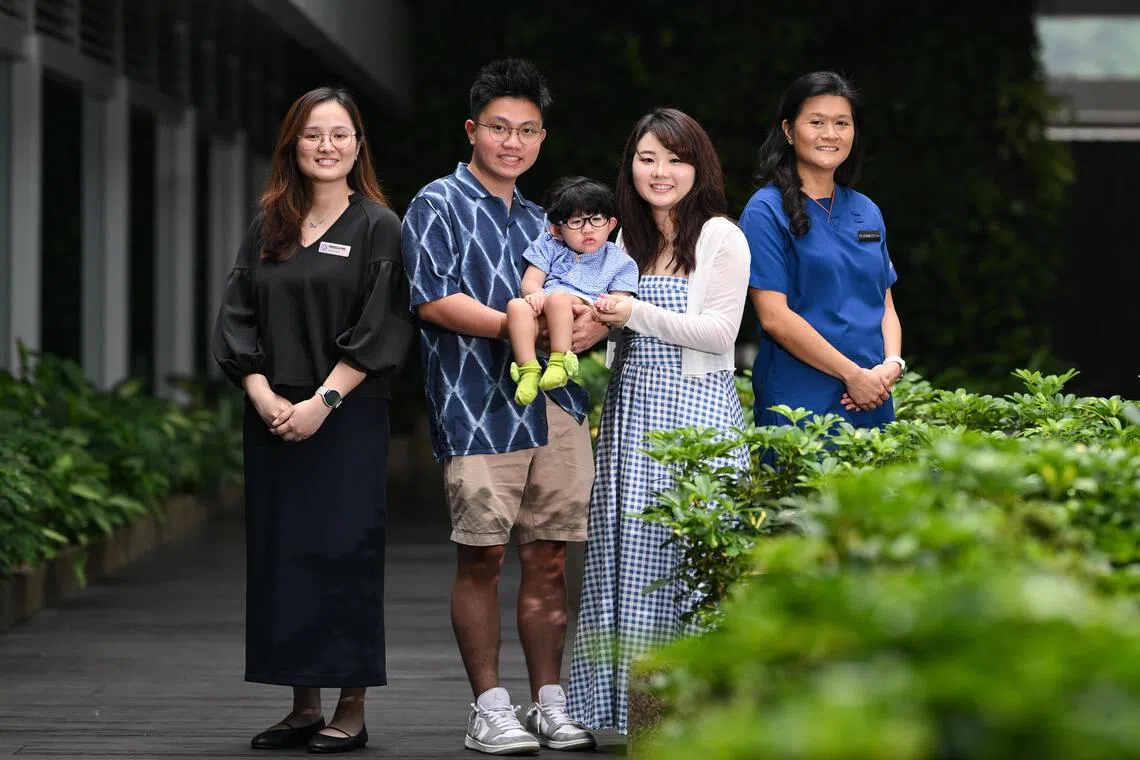
Teyden Hamilton Ho (centre) with (from left) genetic counsellor Priscella Chia, father Ho Jun Han, mother Tizane Woo and geneticist Jeannette Goh.
ST PHOTO: LIM YAOHUI
The seizures start
At the end of May, Teyden started having seizures, a sign of the condition that affects between 50 and 55 per cent of ZTTK syndrome patients.
“We did not know they were seizures. He was still on the BiPAP. He was still asleep, jerking. There was foam coming from his mouth and he was slowly turning blue. We called the ambulance,” Woo said.
A BiPAP machine is a non-invasive ventilator used to help with breathing by delivering pressurised air through a mask: higher pressure for inhalation and lower pressure for exhalation.
When Teyden had another seizure weeks later, his parents were ready with the video camera and they managed to capture the 11-minute incident and report it to the attending doctor at the emergency room in KKH.
Teyden is currently on anti-seizure medication. But it did not prevent another episode – this time brought on by fever and Covid-19, which meant he could have faced a significantly higher risk of presenting severe symptoms or respiratory complications.
“It was the scariest point of the two years of his life,” his mother said.

Teyden with family pets Momo (left) and Ming Ming.
PHOTO: COURTESY OF TIZANE WOO
Having recovered, Teyden is back to playing with the two family pets and attending classes at Fei Yue EIPIC Centre in Upper Thomson Road, which offers early intervention programme for young children with developmental and special needs.
“He is the youngest there, and the loudest in class,” Woo said, laughing.
Teyden’s father Ho Jun Han, 27, a data centre operator, said the boy likes to be involved in conversations and babbles a lot, even though he cannot form words.
They have joined a Facebook support group for the condition that is based in the US.
“Apart from Teyden, there is no one else in Singapore with his condition. It was here in this Facebook page that we got to see other kids with ZTTK, contact parents dealing with the condition and perhaps provide support for each other,” Woo said.
“We do not know what holds for him in the future because this condition is super rare... We are managing and trying to stay as positive as much as possible.”
KioskNews shows a cleaned-up reading view extracted from the publisher’s page — the original always lives on their site, not ours.