'Stop Taxing Growth': Top CEO Says Middle Class Stock Market Investors Need Relief In Viral Post
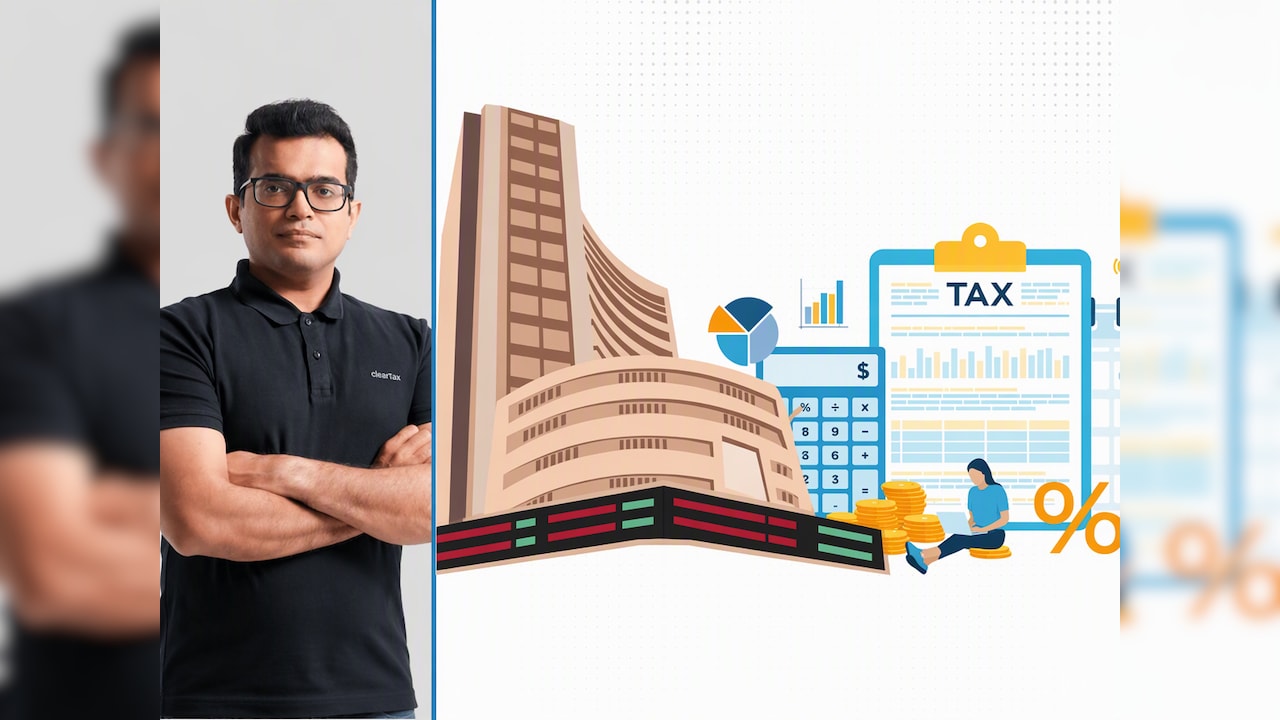
Stock Market Investing: A tax cut can mean more than a few thousand rupees saved on an income tax return. For India's growing pool of stock market investors, it could also mean more money staying invested and compounding over the years. That is the argument Archit Gupta, Founder and CEO of ClearTax, has made in a LinkedIn post calling for a rethink of the long-term capital gains (LTCG) tax regime.
His comments come after Finance Minister Nirmala Sitharaman said the government would hear views on LTCG tax and the securities transaction tax (STT) as preparations for the Union Budget 2027-28 get underway. She did not commit to any changes, but kept the door open to discussions on the issue. FOLLOW LIVE MARKETS UPDATES
Gupta believes the government has an opportunity to encourage more Indians to invest in capital markets by leaving them with a larger share of their returns. "Every major financial shift in India happens when the middle class moves its money," he wrote.
Also Read | Layoffs Are Rising In Tech, But These Skills Are Helping People Unlock Better Pay
Why ClearTax CEO Wants LTCG Tax Relief
Gupta drew a parallel with the increase in the income tax rebate limit to Rs 7 lakh under the new tax regime, arguing that leaving more money in people's hands can help them build wealth. He said the additional financial room had helped retail participation in capital markets grow, as households had more money to invest.
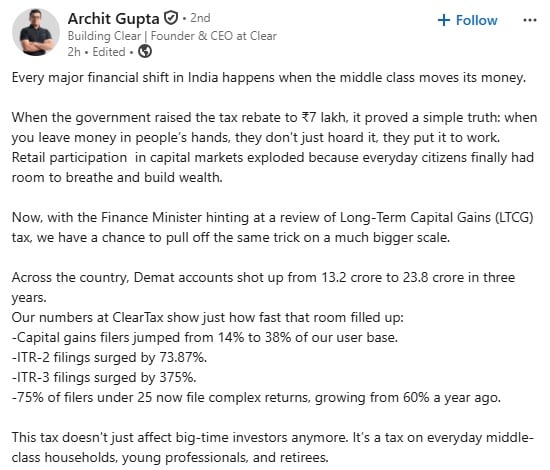
Now, he believes, a rethink of LTCG tax could offer another push to this trend. The scale of India's retail investing boom is reflected in the rise in Demat accounts. According to Gupta's post, their number increased from 13.2 crore to 23.8 crore in three years.
ClearTax's own data also points to a growing number of users reporting capital gains and filing more complex income tax returns.
| Indicator | Change |
| Demat accounts | 13.2 crore to 23.8 crore in three years |
| Capital gains filers as a share of ClearTax's user base | 14% to 38% |
| ITR-2 filings | Up 73.87% |
| ITR-3 filings | Up 375% |
| Filers under 25 filing complex returns | 60% to 75% in a year |
These figures, Gupta argued, show that capital market participation is no longer limited to a small group of wealthy investors. Young professionals, middle-class households and retirees are also investing in financial markets. As a result, he believes, the tax on long-term gains has become an issue for a much wider section of society.
'A Small Dent' For Government, More Wealth For Investors
Gupta also made a fiscal argument for reviewing the tax. Citing collections of roughly Rs 1.29 lakh crore from LTCG tax in the previous year, he said the amount accounted for around 9.4 per cent of India's total direct tax revenue.
In his view, rationalising the tax could have a limited impact on the government's overall revenue but make a significant difference to household wealth over time. "A 9.4 per cent dent in tax collections is a tiny price to pay for a massive, permanent jump in retail participation," Gupta wrote. He argued that allowing investors to retain more of their gains could help them reinvest the money and benefit from compounding over the long term.
However, the fiscal impact of any change would depend on the extent of relief offered, its effect on investment behaviour and the revenue the government gives up. A lower tax rate would not automatically translate into a permanent increase in retail participation.
What Is The Current LTCG Tax Rate?
Under the current rules, long-term capital gains on listed equity shares and equity-oriented mutual funds held for more than 12 months are taxed at 12.5%. An annual exemption of Rs 1.25 lakh applies to eligible gains. The government raised the LTCG tax rate from 10 per cent to 12.5 per cent and increased the exemption limit from Rs 1 lakh to Rs 1.25 lakh in the July 2024 Budget.
Investors have since raised concerns about the tax burden, alongside STT, which is levied on specified securities transactions. The two taxes affect investors differently. LTCG tax applies to eligible profits when investments are sold, while STT is charged on specified transactions. Any changes could therefore have different implications for long-term investors and frequent traders.
Can LTCG And STT Relief Bring Investors Back?
Divam Sharma, Co-founder of Green Portfolio, believes moderation in LTCG tax and STT could give India's capital markets a boost. "A moderation in LTCG and STT would be more than a tax cut. It would be one of the most powerful catalysts the government can deliver to Indian capital markets at this point in the cycle," Sharma said.
He argued that reducing the tax burden on capital gains and transactions could make Indian equities more attractive to global investors. "For a market that has been thin on foreign participation for two years, that would be a decisive sentiment shift, with the potential to draw meaningful FII and FDI flows back to India over the coming years," he said.
Sharma, however, cautioned that tax relief alone would not address the wider challenges facing the economy and markets. Oil prices remain elevated, fertiliser supply chains are fragile and the rupee is under pressure, he said. These factors could continue to influence investor sentiment even if the government eases capital market taxes.
A reduction in taxes could improve sentiment and liquidity, Sharma said, while giving corporate earnings growth and macroeconomic conditions time to catch up.
KioskNews shows a cleaned-up reading view extracted from the publisher’s page — the original always lives on their site, not ours.