After US$474m gamble flops, what happens now to Elon Musk’s Tesla, SpaceX and China ties?
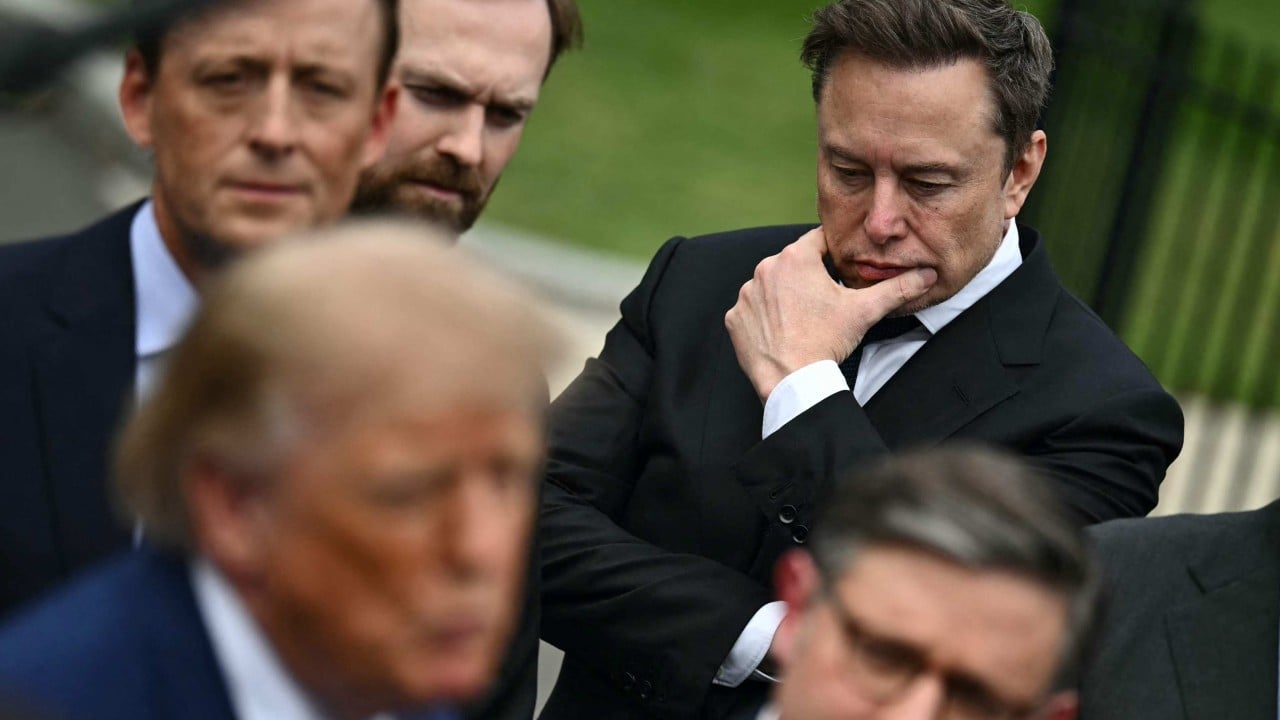
Elon Musk bet nearly half a billion dollars that political spending could keep Washington friendly to his sprawling business empire. On Tuesday, that bet came up short.
As Democrats recaptured control of the US Congress in the midterm elections, the world’s richest man found himself facing an abruptly altered political landscape.
After pouring a record-breaking US$474 million into political groups – overwhelmingly backing Republicans – Musk now faces a divided Washington keen to examine his sprawling web of domestic government contracts and deep commercial links to China.
The political shift threatens to complicate operations across Musk’s corporate universe just as his enterprises, from Tesla and SpaceX to xAI, have become deeply intertwined with both Washington and Beijing.
Markets reacted swiftly on Wednesday morning. SpaceX shares fell 4 per cent and Tesla tumbled 5 per cent shortly after the opening bell.
Musk attempted to laugh off the setback on social media, writing: “Guess my election-interfering space lasers didn’t work this time.”
He said in another post: “Data centres in space looking pretty appealing right now.”
Behind the bravado, billions of dollars are on the line. Under US President Donald Trump’s second administration, Musk’s ventures flourished on the back of major federal contracts and swift regulatory approvals.
Since stepping down from his controversial post heading the Department of Government Efficiency (Doge) in May 2025, his companies had secured at least US$10 billion in new federal deals, according to an October report by the Democracy Defenders Fund, a non-profit watchdog.
Nowhere is the scrutiny expected to bite harder than at SpaceX, whose role as a major defence contractor makes it a particularly obvious target for congressional oversight.
Democrats have already said they want to examine Musk’s government contracts and potential conflicts of interest involving SpaceX and Tesla, so expect Shanghai to be framed as a security question rather than a cost advantage
In May alone, SpaceX won two US Space Force contracts worth a combined US$6.45 billion, including a US$4.16 billion agreement to develop satellites capable of tracking airborne threats. Meanwhile, his AI venture, xAI, landed a nearly US$200 million Department of Defence contract in July 2025.
“The new Democrat-controlled Congress will likely diminish Musk’s influence in Washington to some extent, although he still seems to have Trump’s ear,” said Kyle Chan, a fellow at the Brookings Institution.
Chan noted that lawmakers could investigate SpaceX’s military deals as well as Musk’s conduct during his tenure at Doge, including allegations concerning the misuse of government data.
The Shanghai question
A key flashpoint on Capitol Hill is the intersection of Musk’s defence portfolio and Tesla’s extensive reliance on China.
Tesla’s Shanghai Gigafactory accounted for more than half of the company’s global vehicle deliveries last year, while production elsewhere depends on a network of Chinese suppliers.
The company also produces energy-storage batteries in Shanghai and has been in talks to buy nearly US$3 billion of Chinese solar manufacturing equipment to support its US expansion.
Musk’s recent hints at merging Tesla and SpaceX – announcing in October that the firms had formed special committees to explore a merger – could hand lawmakers an immediate opening.
“Democrats have already said they want to examine Musk’s government contracts and potential conflicts of interest involving SpaceX and Tesla, so expect Shanghai to be framed as a security question rather than a cost advantage,” said Christopher Tang, a professor specialising in global supply chains at the Anderson School of Management at the University of California, Los Angeles.
Any merger review is expected to examine whether sensitive aerospace and defence technology could remain effectively insulated from Tesla’s Chinese supply chain.
“Washington controls contracts and clearances, while Beijing controls inputs, cost and speed,” Tang said. “The election tightened the Washington side of that vice without loosening the Beijing side.”
03:51
Space computing: what is it, why move computing into orbit and where does China stand?
Trouble on the home turf
Musk’s electoral setback was felt just as keenly in Texas, the de facto operational nerve centre of his empire.
He funnelled US$224 million into Texas races – nearly half of his overall midterm war chest – according to a CNBC analysis of campaign finance records. That did not stop Democrat Gina Hinojosa from ousting Republican incumbent Greg Abbott in the gubernatorial contest.
“The backlash over data centres has spread across the country, and some candidates made it a big part of their campaigns,” said Daniel Kollar, deputy managing director for Greater China at consultancy Intralink.
Hinojosa campaigned on freezing approvals for new data centres until environmental and energy safeguards were established, tapping into grassroots frustration over surging electricity bills and water usage.
While such restrictions would not halt existing operations at Tesla’s Austin Gigafactory, SpaceX’s Starbase in Boca Chica, or a planned joint semiconductor facility, they could complicate Musk’s ambitions to build out AI infrastructure in the region.
Ahead of its initial public offering in June, SpaceX pitched AI computing as a cornerstone of its future growth, citing an estimated US$28.5 trillion addressable market.
Congress can make Shanghai politically more expensive. It cannot make it less productive
Resilience in China
Despite the political headwinds, analysts said Tesla’s Chinese production was unlikely to buckle under US congressional pressure.
Beyond vehicle assembly, Chinese suppliers play a critical role in Musk’s long-term robotics vision.
Tesla engineers audited Chinese component makers including Zhejiang Sanhua Intelligent Controls, Ningbo Joyson Electronic and Tuopu Group ahead of planned mass production of its Optimus humanoid robot, the South China Morning Post reported in September.
“Congress can make Shanghai politically more expensive. It cannot make it less productive,” Tang said.
“Given how many US companies still do business in China and rely heavily on Chinese suppliers, I think Congress would have a hard time explaining why it was singling out Tesla,” Kollar said.
Bai Wenxi, chief economist at China Enterprise Capital Union, expressed a similar view. “Tesla’s China operations won’t grind to a halt just because Musk faces investigations,” Bai said.
Sidelined in diplomacy
Where Musk may lose influence, however, was in his role as an informal intermediary between Beijing and Washington, analysts said.
Over the past year, some observers viewed Musk as a potential backchannel between the two governments. He joined Trump’s delegation to Beijing in May and secured a seat at the head table during the White House state dinner for President Xi Jinping in September.
That role had become increasingly irrelevant following the US-China trade truce reached in South Korea last year, according to Brookings Institution’s Chan.
“At the start of Trump’s second term, many wondered whether Elon Musk would play a moderating role in the White House’s approach to China,” Chan said. “After the Busan agreement, there seems to be less of a role for someone like Musk to play in US-China relations.”
Bai said Musk’s value as a diplomatic conduit had diminished.
“Musk himself has gone from being a ‘strategic bridge’ to just one of the American businessmen Beijing can engage with,” he said.
Ultimately, however, Trump remains in the Oval Office for the next two years, holding executive veto power and agency leadership that could shield Musk from major regulatory challenges. But the days of unfettered access may be over.
“My guess is Musk will keep a lower political profile for a while to draw less attention to his businesses,” Kollar said. “There will likely be increased congressional scrutiny, but without executive action, I’d be surprised if he changed his merger plans or how Tesla operates in China.”
KioskNews shows a cleaned-up reading view extracted from the publisher’s page — the original always lives on their site, not ours.